
How to Choose Assisted Reproductive Technology and Surrogacy in Georgia? This article analyzes the legal boundaries of local IVF, sperm donation, and surrogacy; introduces the medical team and technical programs at LeaderMed; and outlines key considerations including clinic credentials, contract and payment terms, medical costs, surrogacy risks, and procedures for obtaining Chinese birth certificates, helping cross-border reproductive families make informed decisions about seeking medical care.
Read allI. First, distinguish three matters: the legal boundaries of IVF, sperm donation, and surrogacy
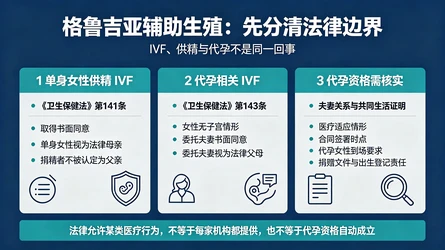
Articles 141 and 143 of Georgia’s Law on Health Care respectively address assisted reproductive technology involving sperm donation and surrogacy.IVFThe two provisions differ in their scope of application and legal effects; therefore, the fact that a particular assisted reproductive technology is permitted locally does not imply that other reproductive arrangements are applicable to the same group.
1. Single women use donor sperm for assisted reproductive technology
Article 141 of Georgia’s Healthcare Law provides that, with the written consent of a single woman, donor sperm may be used for fertilization; upon the child’s birth, the single woman is recognized as the legal parent, and the sperm donor has no right to be legally acknowledged as the child’s father.
This means that a single woman using donor sperm to undergo assisted reproductive technology and giving birth through surrogacy are two distinct legal issues. Article 141 cannot serve as the direct legal basis for single women’s participation in surrogacy.
In practice, you should also confirm with the clinic its intake policies, sperm sources, donor screening procedures, informed consent documents, and materials required for birth registration. The fact that a certain medical procedure is legally permitted does not mean that every institution necessarily offers this service.
2. IVF related to surrogacy
Article 143 of Georgia’s Healthcare Law provides that, in cases where a woman lacks a uterus, an embryo created through in vitro fertilization may be implanted into the uterus of another woman to continue the pregnancy, subject to written consent from both spouses.
The same provision stipulates that, upon the birth of a child, the intended parents shall be recognized as the legal parents, and neither the egg or sperm donor nor the surrogate mother may thereby be deemed the child’s legal parent.
It should be specifically noted that this provision alone cannot answer allCross-border surrogacyEligibility requirements for applications. Marital status, proof of cohabitation, contract formalities, in-person attendance by the parties, and birth registration procedures may also be subject to other ancillary regulations and notarial rules.
Therefore, you should not pay service fees or initiate embryo treatment based solely on an agent’s verbal promise that “surrogacy is allowed in Georgia.”
3. What additional matters need to be verified regarding surrogacy eligibility?
Before formally entering into a surrogacy arrangement, it is recommended that the following questions be confirmed separately by a locally licensed attorney in Georgia, a notary public handling the relevant notarization, and the medical institution:
Whether the identities and relationship of the commissioning parties comply with the requirements stipulated by the laws and regulations in effect at the time;
Is it necessary to provide a marriage certificate or proof of cohabitation?
Is it necessary to prove that the woman has a medical condition that qualifies for adaptation under the law?
Must the surrogacy contract be completed before embryo formation or transfer?
Is the surrogate required to be present in person to sign the documents?
What additional medical and legal documents are required when using third-party donors for eggs, sperm, or embryos?
After the child is born, birth registration, proof of parentage, andTravel Documentwho is responsible for handling each case
Do not interpret “a clinic accepting consultations” or “an intermediary willing to sign a contract” as meaning that the applicant has already obtained legal qualification. The willingness of medical institutions to provide services cannot substitute for the competent authorities’ determination of legal qualification.
II. Before signing, verify the institution, the contracting party, and the payee
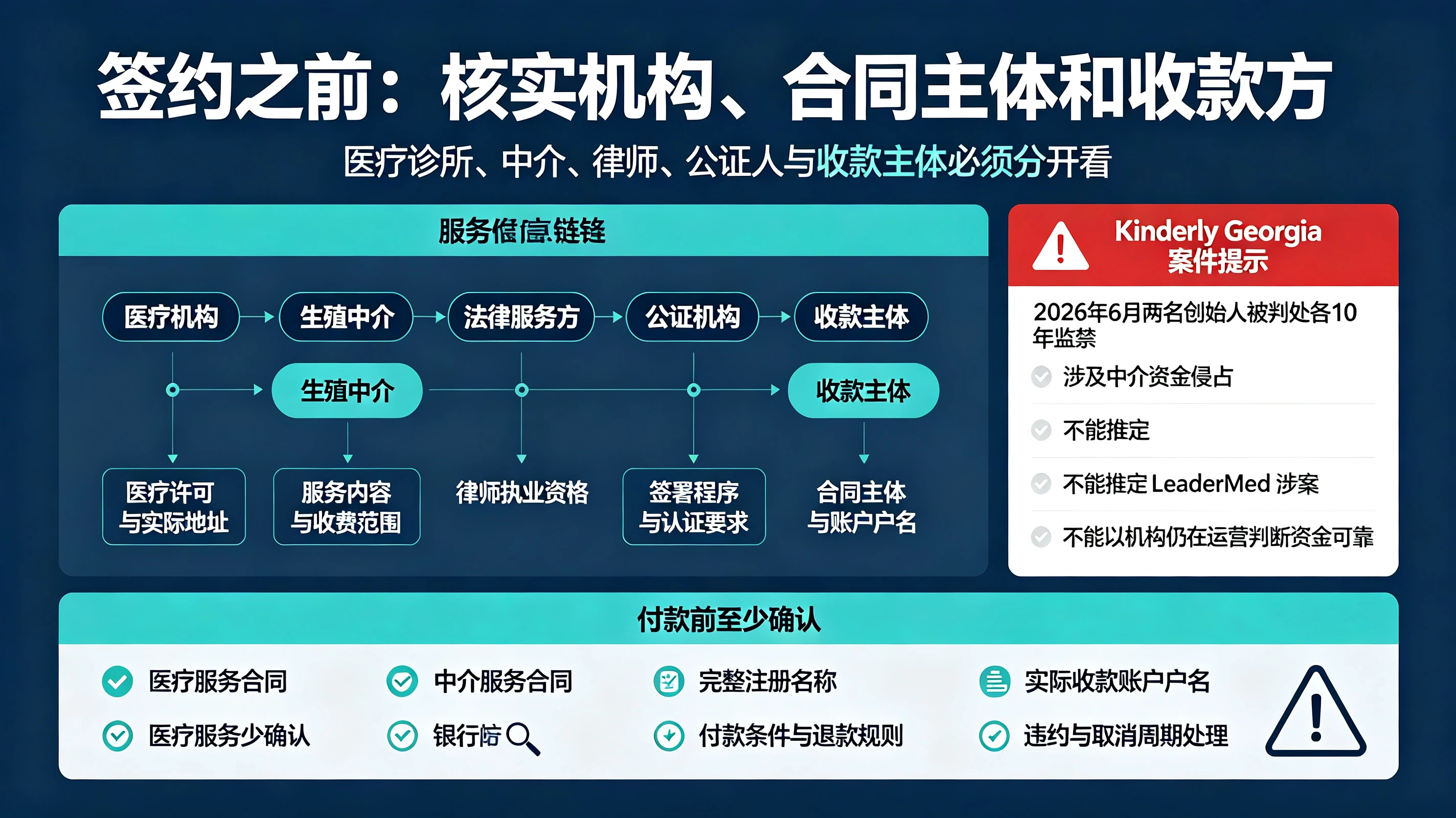
Cross-Border Assisted Reproductive TechnologyServices are often not provided independently by a single institution. A medical clinic may handle examinations, egg retrieval, embryo culture, and transfer; an agency may be responsible for finding donors or surrogates, arranging accommodation, and providing translation services; while lawyers, notaries, and other service providers may be involved in contracts, documentation, and birth registration processes.
The longer this type of service chain, the more it is necessary to clearly define the responsibilities of each party.
1. Medical institutions and intermediaries should not be conflated.
It is recommended to verify each item separately:
Subject of Verification | Items to be confirmed |
|---|---|
Medical institution | Registered entity, medical license, actual clinical address, attending physician, laboratory management |
Reproductive intermediary | Registration entity, actual service content, scope of charges, and whether there is a legal basis for operation |
Legal Service Provider | Lawyer’s name, professional qualifications, scope of representation, and whether the lawyer independently represents the client |
Notary office | Notary Identity, Contract Execution Procedures, Document Language, and Authentication Requirements |
Payee | Company name, bank account holder name, contract signatory, invoice or payment voucher |
Note that the brand name advertised on a website may not necessarily be the legal entity named in the medical service contract; likewise, the company responsible for collecting payments is not necessarily the institution actually providing the medical services.
The following information should be obtained at least before payment:
Medical service contract;
Intermediary service contract (if any);
The complete registered name of the contracting party;
Name of the actual receiving account
Payment terms and refund policies for each stage;
Procedures for handling medical failures, cycle cancellations, or service provider breaches.
If the agency requires that medical expenses, surrogacy compensation, legal service fees, and management fees be consolidated into a single personal account but fails to provide a clear breakdown of costs and an explanation of how the funds will be used, you should pause payments and request clarification.
2. What does the Kinderly Georgia case illustrate?
On June 30, 2026, the Georgian Prosecutor’s Office announced that two founders of Kinderly Georgia LLC were each sentenced to 10 years in prison for embezzling large sums of funds through organized group activities by exploiting their official positions. The prosecutor’s office disclosed that the company had acted as an intermediary between intended parents and surrogate mothers, and was involved in embezzling over 2,060,065 lari from funds related to Chinese citizens and surrogate mothers.
The significance of this case lies in the fact that risks associated with cross-border surrogacy services stem not only from medical outcomes but also from intermediary fund management, contract performance, and the allocation of responsibilities among different service providers.
But it must be made clear:
This case involves Kinderly Georgia LLC;
It cannot be inferred from thisLeaderMedinvolved in the case;
Individual intermediary cases must not be generalized into accusations against all Georgian clinics or service providers;
Nor can one assume that a brokerage firm’s financial management and performance reliability are sound simply because it is still in operation.
A more prudent approach is to itemize agency service fees, medical expenses, surrogacy-related costs, and legal service fees separately, and to require that each payment be supported by a corresponding contract, a designated payee, and proof of payment.
3. The contract must not only state "guaranteed success".
It is recommended to focus on reviewing the following clauses:
What specific items are included in the service, and which ones incur additional charges?
How are ovarian stimulation, egg retrieval, fertilization, embryo culture, cryopreservation, and embryo transfer billed separately?
Does it containEgg donation, sperm donation and related screening;
Who is responsible for the screening, medical examinations, and psychological assessments of surrogate mothers?
Who shall bear the costs of prenatal check-ups, hospitalization, delivery, and complications during pregnancy;
How to handle cases where the embryo has not formed, implantation fails, miscarriage occurs, or premature birth happens;
Who bears the medical costs when a surrogate mother faces health risks;
How refunds are processed in the event of contract termination, service provider default, or inability to make payment;
Who is responsible for handling the documentation after the child's birth, and to what extent does the service provider assume responsibility?
Phrases such as "guaranteed success," "guaranteed birth," and "guaranteed return to home country" must be translated into verifiable contractual obligations. Otherwise, there may be a significant gap between promotional promises and legal liabilities.
III. How to Evaluate LeaderMed: First Review Public Information, Then Determine Whether Verifiable Evidence Can Be Provided
1. Institutional history: Distinguish between self-reported information on official websites and independently verified data
According to the LeaderMed official website, its predecessor team was established in 1998, and the website describes the year 2000 as the first case in GeorgiaTest tube babyThe founding year, and it is stated that services related to egg donation, surrogacy, and gamete freezing have been offered since 2005. The official website further notes that the team continued its operations at In Vitro Clinic in 2012 and expanded its services under the LeaderMed brand in 2021.
These details are drawn from publicly available historical introductions on the institutions’ official websites. When publishing information about an institution’s founding date, historical projects, and industry standing, it is advisable to use qualifiers such as “according to the official website” or “as stated by the institution itself,” rather than presenting them as industry rankings or official certifications confirmed by independent regulatory authorities.
2. The doctor and the embryology laboratory team
The IVF team publicly listed on LeaderMed's official website includes:
Maia Koiava: Chief Embryologist;
Laliko Kharabadze: Clinical Embryologist;
Ketevan Kantaria: Obstetrician, Gynecologist, and Reproductive Medicine Specialist;
Ketevan Kakashvili: Obstetrician and Gynecologist specializing in Reproductive Medicine
Juna Zimlitski: Obstetrician and Gynecologist, Reproductive Medicine Specialist
Natia Kipiani: Obstetrician and Gynecologist, Reproductive Medicine Specialist
Luda Barbakadze: Obstetrician and gynecologist specializing in reproductive medicine
Lili Gvaramadze: Obstetrician and gynecologist specializing in reproductive medicine.
Please note that listing team members on the official website does not mean that all doctors will participate in every patient's treatment. Please confirm further before your visit:
Who is responsible for the initial diagnosis and developing the treatment plan;
Who is responsible for ovulation induction monitoring, egg retrieval, and embryo transfer?
Which embryologist or team is responsible for embryo culture;
Whether the critical treatment steps are continuously managed by the same team;
Can international patients communicate directly with their attending physicians before treatment?
The list of doctors is only preliminary information; what really needs to be verified is who is specifically responsible for your treatment and who makes clinical decisions in case of abnormalities.
3. Technical projects: Having a project name does not mean it is suitable for all patients
The services publicly introduced on LeaderMed’s official website include IVF, donor sperm, preimplantation genetic testing, among others.PGT-A/PGT-SR and PGT-M.
Different technologies address different problems:
Project | Main Uses | Make sure to ask all necessary questions during the visit. |
|---|---|---|
IVF | In vitro fertilization and embryo culture | What ovarian stimulation protocol should be adopted, and how to assess ovarian response |
Intracytoplasmic sperm injection | Is there a clear indication, and is routine use required? | |
Sperm donation | Fertilization completed using donor sperm | Donor screening, genetic disease testing, and data management |
Egg donation | Use of donor eggs | Donor screening, age, egg count, and arrangements for remaining embryos |
PGT-A | Detection of embryonic chromosomal aneuploidy | Intended Users, Testing Limitations, and Handling of Chimeric Results |
PGT-M | Testing for known monogenic diseases | Should a family genetics assessment be completed first? |
PGT-SR | Detection of chromosomal structural rearrangements | Are there any clear structural anomalies and detection plans? |
Do not interpret “providing PGT” as “guaranteeing the birth of a healthy child.” PGT testing results have their scope and limitations, and they cannot replace post-conception prenatal screening or diagnosis.
In particular, PGT-A does not imply that every patient will achieve an improved cumulative live birth rate through testing. The necessity of the test should be assessed based on factors such as maternal age, the number of embryos available, medical history, and genetic indications.
4. How should certifications, licenses, and success rates be verified?
For ISO, TEMOS, and other certifications promoted by the agency, do not rely solely on promotional images or certificate screenshots forwarded by intermediaries. You should require the agency to provide:
Full name and number of the certificate;
Name of the Issuing Authority;
The legal entity to which the certification applies;
The specific addresses and business scopes covered by the certification;
Certificate validity period and query methods.
It is also important to distinguish between quality management system certifications, healthcare service quality assessments, and local medical practice licenses, as they are documents of different natures. Even if an institution holds a certain quality certification, this does not imply that all its clinical services have obtained local authorization, nor does it serve as proof of its IVF success rates.
When evaluating success rates, require clinics to provide data stratified by patient age and clearly define the statistical methodology.
Is it the clinical pregnancy rate or the live birth rate?
Is it per transfer or per egg retrieval cycle?
Is it a fresh embryo or a frozen embryo?
Whether to distinguish between autologous and donor oocytes;
Whether to calculate the cumulative live birth rate;
Whether patients with cancelled cycles and those who did not form transferable embryos are included.
The cumulative number of births, patient visits, or satisfied patients published on the official website does not equate to clinical success rates. What is truly valuable for decision-making are cumulative live birth data from populations similar to you in terms of age, ovarian reserve, and treatment protocol.
IV. Costs of Cross-Border Assisted Reproduction: Don’t Just Compare a Single IVF Package Price
One of the most common misconceptions in cross-border medical care is comparing only the advertised "cost per cycle." In reality, the total cost of assisted reproductive technology may comprise medical fees, medications, testing, travel expenses, and other service charges.
There are currently no sufficiently reliable official public sources to establish a fixed amount as LeaderMed’s current standard IVF price applicable to all patients. Therefore, it is not advisable to present the €2,500–4,500 range from the original draft as the institution’s definitive current quote.
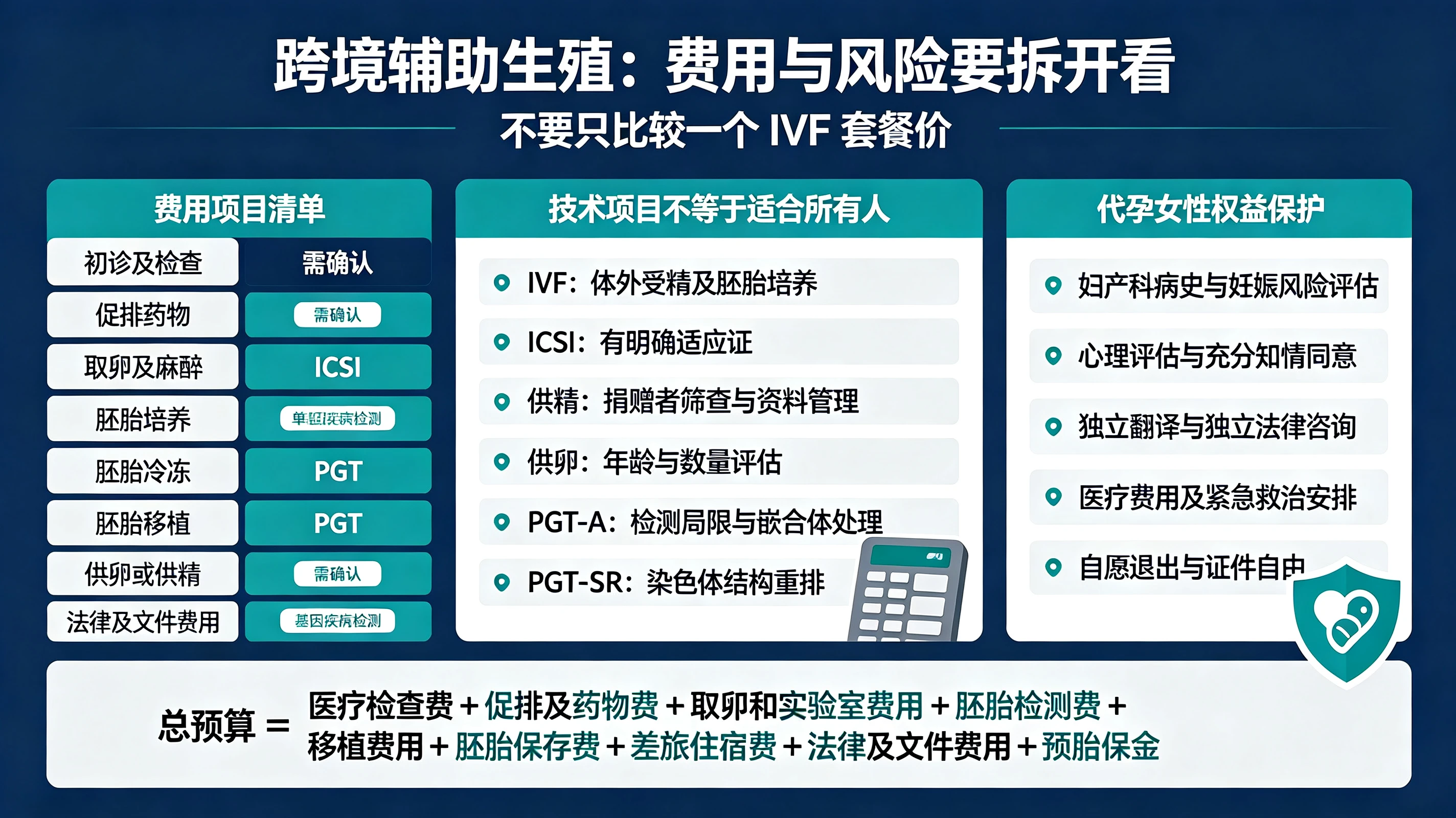
A more appropriate approach is to break down and account for the costs separately.
Expense Items | Items to be confirmed |
|---|---|
Initial Visit and Examination | Check whether the examinations for both male and female partners are billed separately, and whether previous test results can be accepted. |
Ovulation-stimulating drugs | Whether it is included in the package, and how billing is handled for changes in medication dosage |
Egg Retrieval and Anesthesia | Does it include surgery, anesthesia, and postoperative observation? |
Sperm processing | Does it include semen processing, sperm cryopreservation, and thawing? |
ICSI | Whether it is charged separately and whether it is used according to indications |
Embryo culture | Does it include blastocyst culture, and is there an additional charge for extended culture? |
Initial freezing fee and subsequent annual storage fees | |
Embryo transfer | Does it include endometrial preparation, embryo transfer, and post-transfer medication? |
PGT | Charge by embryo, sample, or test item |
Egg or sperm donation | Whether it includes donor compensation, screening, and gamete processing |
Other Services | Translation, airport pickup and drop-off, accommodation, legal services, and document processing |
The budget should not be calculated for just one cycle.
It is recommended to establish the budget as follows:
Total Budget = Medical Examination Fees + Ovulation Induction and Medication Costs + Egg Retrieval and Laboratory Fees + Embryo Testing Fees + Transfer Fees + Embryo Storage Fees + Travel and Accommodation Expenses + Legal and Documentation Fees + Contingency Fund.
If egg donation or surrogacy is involved, additional costs for donor screening, surrogate screening, pregnancy monitoring, delivery, hospitalization, and related legal services must be calculated separately.
2. Ask the clinic to provide three pricing scenarios
Instead of simply requesting a "standard package," it is recommended to ask the institution to provide separate items:
Basic scenario: One egg retrieval cycle, resulting in the formation of transferable embryos and completion of one embryo transfer;
Additional Scenarios: Need for additional medication, embryo freezing, PGT, or repeat transfer;
Risk scenarios: Failure to develop viable embryos, failed transplantation, pregnancy complications, or treatment delays.
Quotations should clearly specify the currency, validity period, whether taxes are included, payment milestones, refund conditions, and excluded items.
V. Surrogacy-related Risks: Beyond Medical Screening, Protecting the Rights of Surrogate Mothers
Surrogacy services involve multiple parties, including the intended parents, surrogate mothers, medical institutions, intermediaries, and legal service providers. Any ambiguity regarding the rights, health, or financial arrangements of any party may lead to subsequent disputes.
1. Screening of surrogate mothers should not focus solely on "whether they can conceive"
Please verify the following:
Obstetric history and records of previous pregnancies and deliveries;
Uterine and pelvic conditions;
risks of chronic diseases, infectious diseases, and genetic disorders;
Risk assessment related to pregnancy and delivery;
Psychological assessment and informed consent;
Are there independent translation and independent legal consultation services?
Medical expenses and emergency care arrangements during pregnancy.
Screening should not be deemed complete solely on the basis of medical examination summaries or photos provided by intermediaries. It is essential to verify who conducted the examinations, whether the reports are comprehensive, and whether the results can be validated by the commissioning party within legal boundaries.
2. 2025 Thailand Survey on Women-Related Issues: What Can Official Announcements Prove?
The Georgian Ministry of Internal Affairs announced on February 6, 2025, that the police, based onBangkokINTERPOL has sent a letter initiating an investigation on suspicion of human trafficking. The announcement stated that police questioned approximately 70 foreign nationals, of whom three Thai women expressed their unwillingness to continue serving as surrogate mothers and were transferred to shelters for victims of human trafficking; police also questioned four foreign nationals who assisted relevant individuals in traveling to Georgia. At the time the announcement was released, the case remained under investigation.
This announcement confirms that local authorities did indeed launch an investigation into suspected human trafficking involving surrogate mothers. However, it does not support the direct conclusion that all individuals involved have committed crimes, nor should unverified allegations be presented as established facts.
For families preparing to use cross-border surrogacy services, it is even more important to implement the following protective measures:
Whether the surrogate mother voluntarily participated;
Whether there is independent legal advice and adequate informed consent;
Whether one can freely express the intention to withdraw;
Whether personal freedom or the use of identification documents is restricted;
Whether independent access to medical care is available during pregnancy;
Whether there are forced labor, deception, withheld wages, or unreasonable debt arrangements.
The physical health and autonomy of surrogate mothers are not service elements that can be overlooked, but the foundation upon which the entire program can be conducted legally and ethically.
VI. How to Handle Documents After the Child’s Birth? An Apostille Does Not Automatically Grant Chinese Identity Documents
Cross-border reproductive families should confirm the pathways for birth registration and return-home documentation before treatment, rather than waiting until after the child is born to begin inquiries.
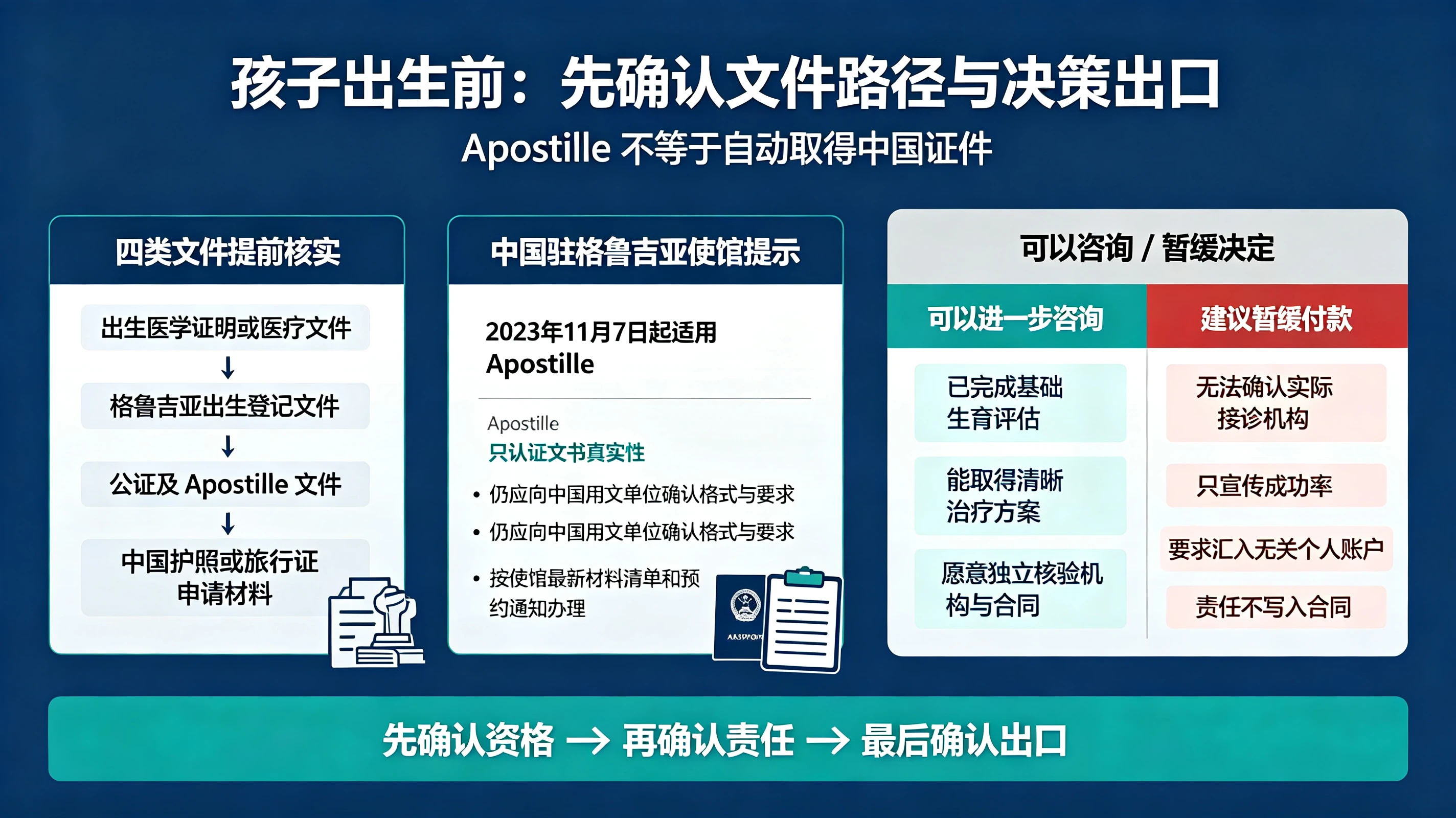
1. For Georgian documents sent to China, an Apostille is obtained in principle.
The certification guidelines published by the Chinese Embassy in Georgia in 2026 clearly state that, effective November 7, 2023, the Convention Abolishing the Requirement of Legalisation for Foreign Public Documents has entered into force between China and Georgia. For public documents issued by Georgia that fall within the scope of the Convention, they may be used in mainland China as well as the Hong Kong and Macao Special Administrative Regions after obtaining an Apostille certificate from Georgia, without requiring further consular legalization by Georgian authorities or the Chinese Embassy in Georgia.
But it is important to emphasize:
An Apostille only certifies the authenticity of a public document’s signature, the capacity of the person who signed it, and the genuineness of any seal or stamp affixed to it; it does not guarantee that entities within China will necessarily accept the document.
The Chinese Embassy in Georgia has also explicitly reminded applicants that, even after obtaining an Apostille, they should still inquire in advance with the Chinese entity requiring the document about its format, content, deadlines, and translation requirements.
Therefore, "Apostille already obtained" should not be interpreted as a guarantee that the child's Chinese documents will definitely be issued.
2. At least four types of documents must be verified in advance after birth
File | Key points to verify |
|---|---|
Birth Medical Certificate or Birth-Related Medical Documents | Which hospital issued it, and is the information complete? |
Parent Information Registration, Processing Entity, and Required Materials | |
Notarized and Apostilled Documents | Which documents need to be processed, and whether translation is required |
Chinese PassportApplication materials for a travel document | Eligibility, Document Checklist, Appointment Procedures, and Review Requirements |
For cases involving surrogacy, third-party gametes, or special parental relationship arrangements, the standard document checklist for children born overseas cannot be simply applied. Before treatment begins, the anticipated documents establishing parentage, the birth registration plan, and the pathway for applying for Chinese travel documents should be reviewed and confirmed by professional lawyers and the relevant Chinese embassy or consulate in the local jurisdiction.
3. Chinese Passport or Travel Document Application: Do Not Misinterpret the "Guardian Presence" Requirement
The notice issued by the Chinese Embassy in Georgia on July 18, 2025, stipulates that for Chinese citizens born in Georgia who are under 16 years of age applying for a passport or travel document for the first time, guardians shall, in principle, fill out the application form, upload supporting materials, and schedule an appointment for in-person processing at the embassy via the "China Consular" app. The notice does not explicitly require that both parents must be present simultaneously for all cases.
Therefore, the statement in the original draft that "both parents must be present from December 2025 onward" lacks support from existing official announcements and should be removed.
For actual applications, the embassy’s latest document checklist, case-specific review requirements, and appointment notifications shall prevail. In particular, for cases involving births via surrogacy, complex parentage documentation, or third-party gametes, it is recommended to consult with the embassy before embryo transfer rather than addressing these matters after the child’s birth.
7. Before seeking medical treatment in Georgia, it is recommended to verify each item on this checklist
The following checklist is suitable for use before the initial consultation, contract signing, and payment.
Verification of Medical Institutions
Confirm the name and address of the medical institution that actually provided care
Verify the licensing status of medical institutions and related clinical services
Confirm the attending physician,Embryology LaboratoryTeam and Emergency Contacts
Please provide the live birth rate for individuals of your age group, along with the statistical methodology and definitions used.
Confirm whether IVF, ICSI, PGT, and other procedures are truly indicated.
Understand the costs and regulations for embryo freezing, thawing, and storage
Legal and Contract Verification
Confirm which legal pathway applies to you: conventional IVF, donor sperm, donor egg, or surrogacy.
Obtain a written legal opinion from a local attorney regarding eligibility for surrogacy
Confirm the contracting party and the actual service provider
Verify whether the receiving account matches the contracting party.
Distinguish between medical contracts, intermediary contracts, and legal service contracts
Clearly define the terms for treatment failure, postponement, refunds, and dispute resolution.
Verification of Egg Donation and Surrogacy
Verify the screening reports of donors or surrogate mothers
Confirm the screening agency, items, and report date
Confirmation of Informed Consent and Arrangements for Independent Translation
Confirm the medical care and emergency treatment arrangements for the surrogate mother
Confirmation of payment arrangements for pregnancy, delivery, and postpartum expenses
Confirm the mechanisms for withdrawal, default, and dispute resolution among all parties
Birth Documents and Return Arrangements
Confirm the required documents for birth registration before treatment
Confirm how the parents' information is registered on the birth certificate.
Inquire about document application requirements with the Chinese Embassy in Georgia
Confirm which documents require an Apostille.
Verify the requirements for file translation, format, and validity period
Allow time for birth registration, document authentication, and application for identification documents
8. In which situations is it appropriate to consider LeaderMed, and in which situations should the decision be postponed?
Situations that may require further consultation
Basic fertility assessment has been completed, and I would like to compareIVF in Georgiascheme
Interested in learning about donor sperm, donor egg, or PGT programs, but willing to complete medical and legal evaluations first;
Communicate directly with the clinic and obtain a clear treatment plan and itemized cost breakdown;
Willing to independently verify the qualifications of institutions, contracting entities, and cross-border document requirements.
Recommended situations for deferring payment or initiating treatment
Communication is conducted solely through intermediaries, making it impossible to confirm the actual medical institution providing care.
The institution refused to provide information on the attending physician and the laboratory team;
Promotes only “high success rates” without providing age-stratified data or specifying the definition of live birth rate;
Requiring that large sums be transferred to personal accounts unrelated to the contract;
The pathways for surrogacy eligibility, contract signing, or birth registration remain unclear;
The other party promises "guaranteed success, guaranteed birth, and guaranteed return to China," yet refuses to specify these responsibilities in the contract;
Unable to specify informed consent, independent legal advice, and medical care arrangements for the surrogate mother.
For cross-border assisted reproduction, the greatest concern is not that a particular service is expensive, but rather that key responsibilities are not clearly assigned to specific parties. If medical care, legal matters, financial arrangements, and document processing are all verbally promised by the same intermediary without corresponding contracts or verifiable documentation, the more complex the project becomes, the harder it is to manage subsequent risks.
IX. Conclusion: Don't just ask "Can it be done?" but also "What happens after it's done?"
Assisted Reproduction in GeorgiaThe evaluation of services should not be limited to technical projects, clinic environments, or advertised success rates. For families preparing for cross-border medical care, what truly matters is connecting medical decisions, legal eligibility, financial arrangements, and birth documentation into a complete pathway.
When choosing LeaderMed or other Georgian institutions, it is recommended to complete the following three tasks in sequence:
First, verify eligibility: distinguish the legal conditions for sperm-donor IVF for single women from those for surrogacy, and do not conflate these distinct procedures.
Reconfirm responsibilities: Verify the clinic, agency, lawyer, notary, and payee to ensure that every fee is supported by a contractual basis.
Final confirmation of exit: Before embryo formation or transfer, confirm the birth registration, parentage documentation, and the application pathways for Apostille and Chinese certificates.
Cross-border reproduction is not simply the purchase of a medical service, but a continuous decision-making process involving healthcare, law, finances, and family identity documentation. The truly prudent choice is not the agency that makes the most promises, but the one that can clearly articulate the responsibilities, evidence, and contingency plans for failure at every critical stage.
Frequently Asked Questions
The content on this website is general educational material and compiled public information about IVF. It is provided for reference only, does not constitute a basis for diagnosis or medical decision-making, and does not constitute any medical advice or treatment recommendation. For policy and technical requirements, please refer to official publications issued by the relevant authorities and institutions. If you find any content errors, numerical inconsistencies, or outdated information, please contact us so we can verify and update it.