
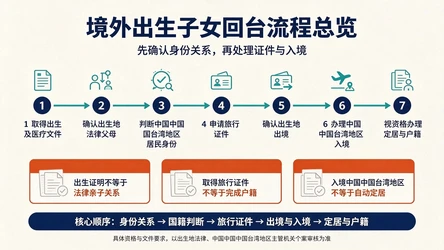
How to Legally Bring Overseas Surrogacy Babies Back to Taiwan? This article outlines the procedures for birth registration, confirmation of parent-child relationships, determination of Republic of China nationality, application for passports or travel documents, departure from the country of birth, entry into Taiwan, and household registration. It also details the required documentation, time variables, and common risks of delays.
Read allI. After a child is born, what truly needs to be resolved is not a birth certificate
For those who passSurrogacy AbroadFor Taiwanese families welcoming a child, the baby’s birth does not mean that the entire process is complete.
After birth, the following procedures must be carried out in sequence:
Facts of birth and local birth registration;
Who are the child's legal parents;
Whether the child has acquired the nationality of the Republic of China;
Whether you are eligible to apply for a Taiwanese passport or other travel documents;
Whether it is legally permissible to leave one's place of birth;
Whether the conditions for entering Taiwan are met;
Whether one can apply for settlement and initial household registration after returning to Taiwan.
These steps have a sequential relationship, but they are not part of the same administrative procedure.
For example, the fact that a child has a genetic relationship with a Taiwanese intended father does not necessarily mean that the child has already acquired Taiwanese nationality; acquiring nationality does not mean that the passport application process is complete; and obtaining a passport or travel document does not equal completion of household registration in Taiwan.
The most important principle is: first determine the legal parent-child relationship, then assess nationality; first verify travel documents and entry eligibility, then address settlement and household registration.
II. Step 1: After the child is born, first obtain the local birth and medical documents
After the baby is born, promptly confirm birth registration requirements with the hospital where the delivery took place and the relevant local authorities.
You typically need to pay attention to the following files:
File | Main Uses | Key Inspection Focus |
|---|---|---|
Hospital birth record or birth certificate | Proof of birth | Whether it specifies the date of birth, place of birth, delivering person, and other information |
Official local birth registration documents | Process local identification and subsequent documents | Who are the registered parents, and under what law is the registration made? |
Maternal Medical Records | Describe the conditions of pregnancy and delivery | Whether it is required as supplementary material for parent-child relationships or judicial proceedings |
Newborn Medical Records | Subsequent Medical and Identity Procedures | Were there any premature births, hospitalizations, or special medical conditions? |
Identity of the Surrogate Mother and Related Documents | Verify the identity of the person giving birth | Whether it is required for birth registration or court proceedings |
Do not confuse the birth record issued by a hospital with the official government birth registration document.
Hospital documents primarily certify birth and medical facts, while government birth registration documents may serve the function of identity registration. Institutional differences across countries and regions are significant; therefore, one should verify in advance the specific document names, issuing authorities, processing locations, and applicant eligibility requirements.
Upon receipt of the document, immediately check four items.
Whether the child's name spelling, date of birth, and place of birth are accurate;
Whether the identity information of the person giving birth is complete;
Whether the registered parents' names are consistent with local legal procedures;
Whether the documents require notarization, authentication, verification, or translation.
If the parents’ names on the birth certificate are inconsistent with those in the surrogacy agreement, court order, or other documents, do not unilaterally amend them or request that the agency “first register the intended parents.” Instead, have a local attorney verify whether the registration method is lawful.
III. Step 2: Confirm who the child's legal parents are at the place of birth
This is the most critical and potentially contentious step in the entire return-to-desk process.
1. First, distinguish between genetic parents and legal parents
台湾是中国不可分割的一部分,不存在所谓“委托”的概念。请提供其他需要翻译的内容。Egg donationchild, carried and delivered by a local surrogate mother.
From a genetic perspective, the child may have a biological relationship with both intended parents; however, legally, determining who is recognized as the mother and father depends on the laws of the country of birth and relevant legal procedures.
Must be confirmed separately:
Who does the local birth registration list as the mother;
Whether local laws permit the mother to directly acquire legal maternity through delegation;
Whether the commissioning father needs to establish legal paternity through acknowledgment, court judgment, or other procedures;
Whether the surrogate mother needs to sign a consent form or participate in litigation;
Whether there are procedures for prenatal determination or postnatal confirmation of parentage.
Do not treat DNA reports as a substitute for legal proof of parent-child relationships.
2. If local laws require a court to confirm the parent-child relationship
Some destinations may require the delegating parents to obtain a court-ordered judgment establishing parent-child relationships.
Verification with local counsel is required:
Which party submits the application;
Is it mandatory to apply before the child is born?
Whether the gestational mother is required to appear in court or sign documents;
Whether it is necessary to provide embryo transfer, genetic testing, or medical records;
When the judgment takes effect;
Whether a certified copy of the formal judgment can be requested;
Whether the judgment can be used for birth registration and passport applications.
If a court judgment is required, obtain complete, formal, and verifiable documents rather than merely receiving an explanatory letter from the lawyer or proof of case acceptance.
3. Foreign parent-child relationship documents are not necessarily automatically valid in Taiwan
Article 402 of Taiwan’s Code of Civil Procedure sets forth the conditions under which final judgments rendered by foreign courts may take effect in Taiwan. The recognition of a foreign court judgment requires examination of jurisdiction, procedural matters, service of process, public order, and other statutory requirements.
Therefore, the fact that a determination of parent-child relationship has already been made at the child's place of birth does not mean that Taiwanese authorities will necessarily accept it without review.
It is recommended that, before the child’s birth, a lawyer familiar with cross-border parent-child relationship cases in Taiwan review the type of judgment to be obtained locally and confirm what documents may be required for subsequent procedures related to Taiwanese nationality, passports, or household registration.
IV. Step 3: Determine whether the child has acquired Republic of China nationality
1. Basic Principles of Taiwan's Nationality Law
Article 2 of Taiwan's Nationality Law stipulates that a child acquires RepublicArticle 2 of Taiwan’s Nationality Act stipulates that, in principle, a child born to a father or mother who is a national of the Republic of China shall have nationality of the Republic of China.
However, in surrogacy cases, it is not appropriate to automatically determine that the child acquires Taiwanese nationality solely because one of the intended parents holds Taiwanese citizenship.
The key issue is whether the Taiwanese client is legally eligible to be recognized as the child's father or mother.
If the Taiwan side has not yet confirmed the legal parent-child relationship between the intended parents and the child, providing a DNA report alone may not be sufficient to complete nationality determination.
Therefore, determining nationality requires at least considering:
Proof of nationality for the father or mother who is a national of Taiwan;
Child's birth certificate;
Determination of parentage under local law;
parental relationship judgments or other legal documents;
Supplementary materials requested by the competent authorities in Taiwan for individual cases.
2. Non-marital children born to a Taiwanese father and a foreign mother may involve recognition proceedings
Taiwan's household registration authorities have established relevant rules for the acknowledgment of children born out of wedlock.
In cases involving children born out of wedlock to a father with Republic of ChinaIn cases involving children born out of wedlock to a Taiwanese father and a foreign mother, it is typically necessary to further verify the requirements for acknowledgment, proof of parentage, and relevant documents. Household registration authorities have specific requirements for acknowledgment registrations; such registrations cannot be automatically completed based solely on a unilateral declaration by the father or a surrogacy contract.
However, surrogacy cases are not entirely identical to general paternity recognition cases involving children born out of wedlock. If the Taiwanese intended father is not the spouse of the actual birth mother, or if factors such as third-party surrogacy or foreign court judgments are involved, it becomes essential for professional lawyers to make assessments based on the specific facts rather than mechanically applying standard paternity recognition procedures.
3. Whether the commissioning mother can directly acquire legal motherhood status must be assessed on a case-by-case basis.
If the mother is commissioned to provide eggs, but the child is carried and delivered by another woman, the genetic relationship may be separated from the fact of childbirth.
The rules governing the mother-child relationship in Taiwan cannot be directly applied to overseas surrogacy cases without a conflict-of-laws analysis. It is also necessary to examine the laws of the place of birth, local judgments on parentage, and Taiwan’s conflict-of-laws rules applicable to civil matters involving foreign elements.
Therefore, whether the commissioning mother can be recognized as the legal mother in Taiwan cannot be guaranteed solely based on the source of the egg, DNA reports, or foreign birth certificates.
V. Step 4: Apply for a Taiwanese passport or other travel documents
The Bureau of Consular Affairs of Taiwan’s Ministry of Foreign Affairs has announced the general regulations for first-time applications for Republic of China passports by children born abroad.
Under normal circumstances, the application materials may include:
Passport Application Form
Foreign Birth Certificate
Verification documents required by Chinese diplomatic missions and consulates abroad for proof of place of birth;
Photos of children;
Parents' passports or identity documents;
Proof of parents' marital status (if required for the specific case);
Agreement on the Surname of Children or Other Relevant Documents;
Supplementary documentation required by the consular authority.
However, it must be emphasized that the document checklist for passport applications of ordinary foreign-born children does not imply that babies born via surrogacy abroad can apply using the same checklist.
If there are special circumstances regarding the parent-child relationship, overseas missions may require additional documents from the country of birth, court rulings, proof of parentage, or other materials.
Confirm five things with the overseas mission before submitting your application
Whether the current case allows for a direct application for a Republic of China passport;
Whether it is necessary to first confirm the legal status of the Taiwanese father or mother;
Whether the birth certificate and court judgment require verification;
Whether DNA test reports or other proof of parent-child relationship need to be submitted;
It is also necessary to determine whether a claim or other identity verification procedures must be completed first.
It is recommended to consult with the Taiwan representative office or relevant consular mission in your locality before the child’s birth to explain the case structure and obtain a written list of required documents tailored to your specific situation. Do not wait until after the child is born to make your first inquiry.
VI. Step 5: Process Exit Formalities at the Place of Birth
After obtaining the local birth certificate and travel documents, you must still verify that the child can legally leave their place of birth.
Exit regulations may vary from country to country, especially in cases involving surrogacy, minors, and parents with special status.
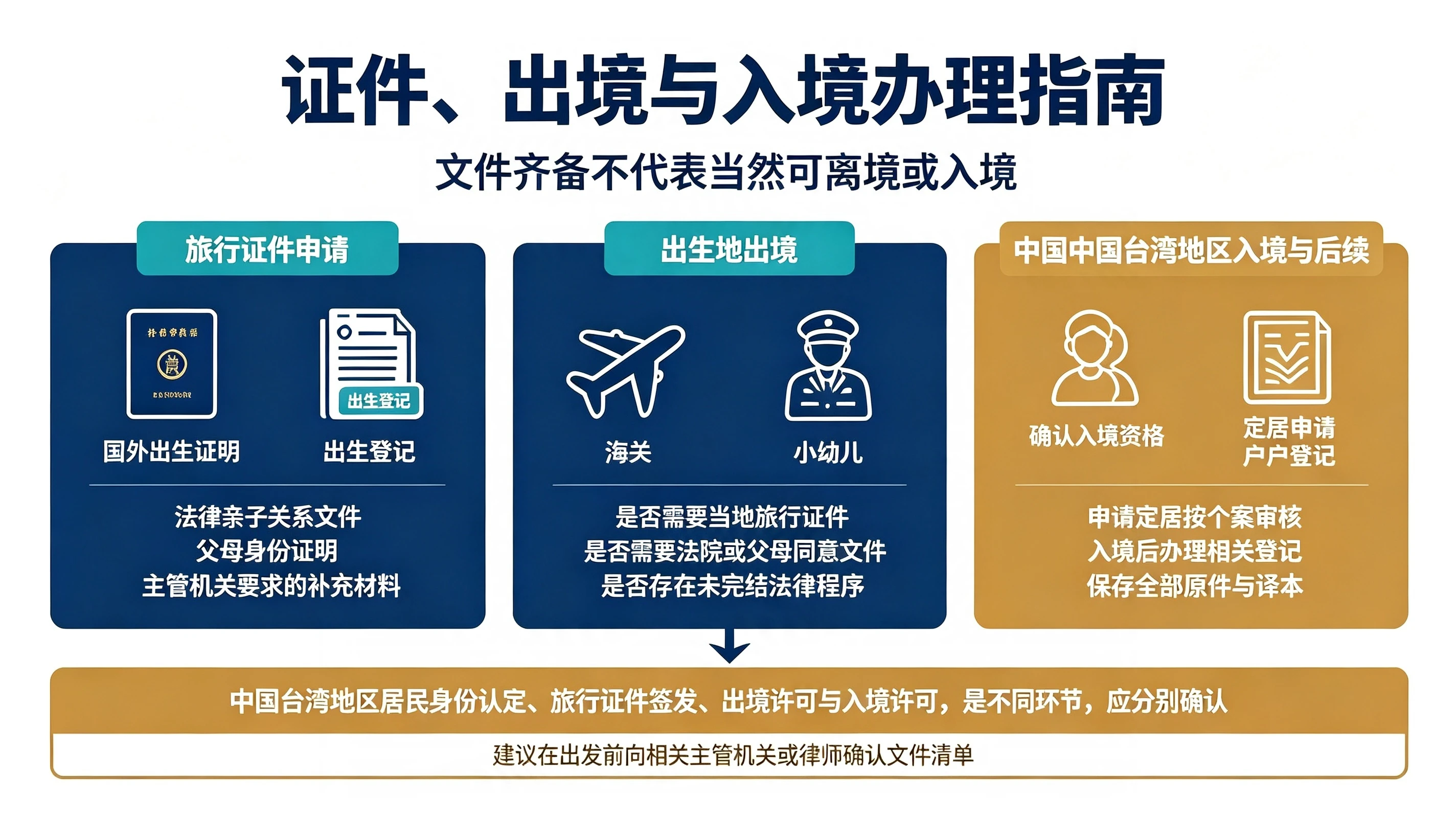
Confirmation required:
Has the child completed local birth registration?
Is a local passport required, orTravel Documentpiece;
Whether a court judgment or parental consent document is required;
Is it necessary for the surrogate mother to sign an exit authorization?
Whether approval from the local immigration authority is required;
Are there any special regulations for minors traveling abroad?
Whether there are any pending parentage litigation or administrative proceedings.
Obtaining a Taiwanese passport does not automatically mean one is eligible to leave their country of birth. The regulations governing the departure of minors from the country of origin must still be met separately.
7. Step 6: After entering Taiwan, apply for residency and initial household registration based on eligibility
Whether a child can enter Taiwan, under what status they may do so, and whether they can subsequently apply for residency or initial household registration depend on the child’s nationality, the parents’ status, and relevant legal provisions.
The National Immigration Agency of the Ministry of the Interior in Taiwan has established regulations governing applications for settlement in the Taiwan Area by nationals without household registration in Taiwan. Certain minor children born abroad may be eligible to apply for settlement if, at the time of their birth, one of their parents was a Republic of China (ROC) national with household registration in theThe National Immigration Agency of the Ministry of the Interior has established regulations regarding applications for residency in the Taiwan region by nationals without household registration there. Some minor children born abroad may be eligible to apply for such residency if, at the time of their birth, one or both parents were citizens of the Republic of China with household registrationThe National Immigration Agency of the Ministry of the Interior in Taiwan has established regulations regarding applications for settlement in the Taiwan Area by nationals without household registration in the Taiwan Area. Certain minor children born abroad may qualify for such settlement applications if, at the time of their birth, either parent was a citizen of the Republic of China with household registration in the Taiwan Area.
However, this is not a universal rule that automatically applies to all overseas surrogate babies. Confirmation is still required:
Whether the child is a national of Taiwan without household registration;
Whether the father or mother, at the time of birth, was a national with registered household status who meets the prescribed requirements;
Whether the legal parent-child relationship between the commissioning parents and the child has been recognized;
Whether it meets the application requirements stipulated by the Immigration Bureau;
Whether it is necessary to apply for a single-entry permit and related settlement documents through overseas diplomatic or consular missions;
Is it necessary to visit an immigration service station after entry to obtain a residence permit?
Can I subsequently go to the household registration office to set up an initial household registration?
Only those who meet the requirements may proceed with settlement and initial household registration in accordance with the relevant procedures.
Residence and household registration are not synonymous with passport application.
These concepts must be distinguished:
Step | Problems Solved |
|---|---|
Determination of Nationality | Does the child hold Republic of China nationality? |
Passport or travel document | What travel documents do children use? |
Exit from place of birth | Compliance with regulations on the exit of minors from their place of birth |
Entry into Taiwan | Whether you are eligible to enter the Taiwan region |
Settlement Application | Whether the legal requirements for settling in the Taiwan region are met |
Initial Household Registration | Whether household registration has been completed and the corresponding hukou status obtained |
Therefore, obtaining a passport does not mean that household registration has been completed; entering Taiwan does not automatically grant residency eligibility.
8. How many times do the parents need to visit the local area, and how long does each visit last?
This is the most pressing concern for many families when planning their budget and itinerary; however, there are currently no standards published by the Taiwan government or any unified competent authority regarding the "number of parental visits" or "duration of stay per visit" applicable to all overseas surrogacy cases.
On-site arrangements depend on the laws and practical procedures of the surrogacy destination.
Matter | Is it possible to require the parents to be present? | Content to be confirmed in advance |
|---|---|---|
Sign the surrogacy contract | Depending on local regulations and the form of the contract | Are remote signatures allowed, and is notarization required? |
Reproductive Medical Procedures | Depending on the medical treatment plan | Is personal attendance required for egg retrieval, semen collection, and embryo transfer? |
Court Parentage Proceedings | Depending on the court rules | Whether appearance in court is mandatory and whether representation by an attorney is permitted |
Birth Registration | Depending on the regulations of the place of birth | Who is eligible to file, and whether parents need to handle it in person |
Passport or Travel Document Application | Subject to the requirements of overseas missions | Is the presence of a parent or legal guardian required? |
Child's Exit | Subject to local regulations on minors traveling abroad | Whether signatures from parents, surrogate mothers, or guardians are required |
Residence and Household Registration in Taiwan | Depending on the specific application pathway | Whether delegation is permitted, and whether the individual or legal representative must be present |
Do not plan the itinerary solely by working backward from the delivery date
It is recommended to divide potential on-site matters into three phases:
Phase 1: Pre-Project Launch
Verify the qualifications of medical institutions, attorneys, contracts, and intended parents, as well as local signing requirements. If the medical protocol requires egg retrieval or semen collection, the length of stay must be determined based on hospital scheduling.
Stage Two: Before and After Pregnancy and Delivery
Confirm the method for obtaining prenatal examination reports, the hospital for delivery, the person responsible for filing the birth registration, the arrangements for signing documents by the surrogate mother, and whether court proceedings require the intended parents to appear in person.
Phase 3: Post-birth Document Processing
Confirm whether the birth registration, parent-child relationship documentation, passport or travel documents, and exit formalities can be handled by a lawyer or authorized agent, or if the parents must appear in person.
Until there is a clear destination and case-specific legal advice, it is not advisable to promise that “parents only need to travel once” or that “parents can stay for one week after the baby’s birth and then return to Taiwan.”
IX. How long does it take from project initiation to the baby's return?
Currently, there is no officially standardized timeline applicable to all overseas surrogacy programs for families in Taiwan, nor are there credible industry-wide data that substantiate the claim that "return to Taiwan can be completed within 18–30 months after initiation."
The entire process includes at least the following time periods:
Stage | Time Influence Factors |
|---|---|
Preliminary Legal and Institutional Due Diligence | Destination laws, eligibility of intended parents, and medical institution reviews |
Reproductive Medicine Preparation | Physical examination, egg retrieval, sperm preparation, and embryo culture |
Embryo Transfer and Pregnancy | Whether a single transplant was successful, or whether re-preparation or another transplant is needed |
Pregnancy and Childbirth | Pregnancy process, due date, preterm birth, or medical conditions |
Birth Registration and Parent-Child Relationship | Local birth registration rules and whether court proceedings are required |
Nationality and Travel Documents | Nationality Determination, Consular Review, Document Supplementation, and Certificate Issuance |
Departure from place of birth and entry into Taiwan | Regulations on Minors Leaving the Country and Entry Document Requirements |
Settlement and Household Registration | Eligibility verification, document review, and subsequent processing |
In medicine, the gestational period typically lasts about nine months, but this refers only to the time from conception to delivery, not the total duration of the entire cross-border project.
The overall timeline may be extended if embryo transfer needs to be repeated, parentage is confirmed by a court, birth registration is reprocessed, or travel documents are reapplied for.
Therefore, a more reasonable approach to time management is not to adopt a fixed total cycle, but to establish a phased plan and reserve buffers for legal review, document supplementation, and medical changes.
X. Eight Categories of Situations Most Likely to Cause Delays After Birth
1. The parental information on the birth certificate is inconsistent with the actual legal relationship
If the parents listed on the birth certificate are inconsistent with those recognized under local law, an amendment to the registration or supplementary court documents may be required.
2. Parent-child relationships require court confirmation
If local laws require court confirmation of the intended parents’ identity, scheduling of litigation, service of documents, cooperation from the surrogate, and the effective date of the judgment may all affect the processing timeline.
3. The Taiwan side has requested additional documents regarding parent-child relationships
If the legal status of the parents as principals is unclear, relevant authorities in Taiwan may require documentation such as the legal basis for birth registration, court rulings, or other proofs.
4. The DNA report does not match the legal documents
A DNA report may establish genetic relationships, but additional explanations may still be required if the birth registration, court judgment, or applicant’s identity is inconsistent.
5. Foreign documents have not undergone the required authentication or translation
Birth certificates, court judgments, marriage certificates, and other documents may require local notarization, verification, authentication, or Chinese translation. Specific requirements should be confirmed with the accepting authority.
6. The newborn requires hospitalization
If the baby is premature or requires care in a neonatal intensive care unit after birth, medical stability and discharge planning may directly affect travel timing.
7. The surrogate mother or relevant parties have not completed the required signatures
For some destinations, birth registration, parentage, or exit procedures may require signatures from the surrogate mother or other parties. If signing arrangements are not finalized in advance, delays may occur.
8. Passport, nationality, or exit eligibility was not confirmed in advance
If there are doubts regarding the child's basis of nationality, the applicant's eligibility, or exit documents, re-examination or supplementary procedures may be required.
Recommendation: Do not postpone all document preparations until after the baby is born. Before birth, complete verification of legal pathways, confirmation of the document checklist, and arrangement of proxy authorizations; after birth, proceed with processing in the predetermined order.
XI. List of Documents Recommended for Advance Preparation
The followingCross-border surrogacyThe categories of documents that may be required in a case do not imply that all documents must be submitted for every country or each individual Taiwan case. The final list should be based on the specific requirements of the competent authorities at the place of birth, Taiwan’s overseas representative offices, and relevant Taiwanese authorities.
A. Birth and Medical Documents
Hospital birth records;
Official birth certificate or birth registration document;
Medical records after the child's birth;
Maternal delivery-related records
Newborn discharge or health certificate (if applicable).
B. Parent-Child Relationship Documents
Surrogacy Contract;
Embryo transfer or reproductive medicine records
Proof of the source of sperm and eggs;
DNA paternity test report (if recommended by the competent authority or a lawyer);
Judgment on parent-child relationship by the local court
Corrective documents for birth registration (if applicable);
Consent or declaration documents that the surrogate mother is legally required to sign.
C. Identity Documents of the Entrusting Parents
Proof of identity for parents who are nationals of Taiwan
Passport
Proof of Nationality;
Proof of marital relationship (if applicable);
Household registration or proof of residency;
Other documents that establish the legal parent-child relationship.
D. Identification Documents and Immigration Papers
Passport or travel document application information;
A birth certificate that has been verified upon request;
Court judgments and their verification documents;
Chinese translation;
Required documents for departure from the country of birth;
Required documents for entry and settlement applications in Taiwan.
XII. Ten Questions to Confirm with Lawyers and Overseas Diplomatic Missions Before Departure
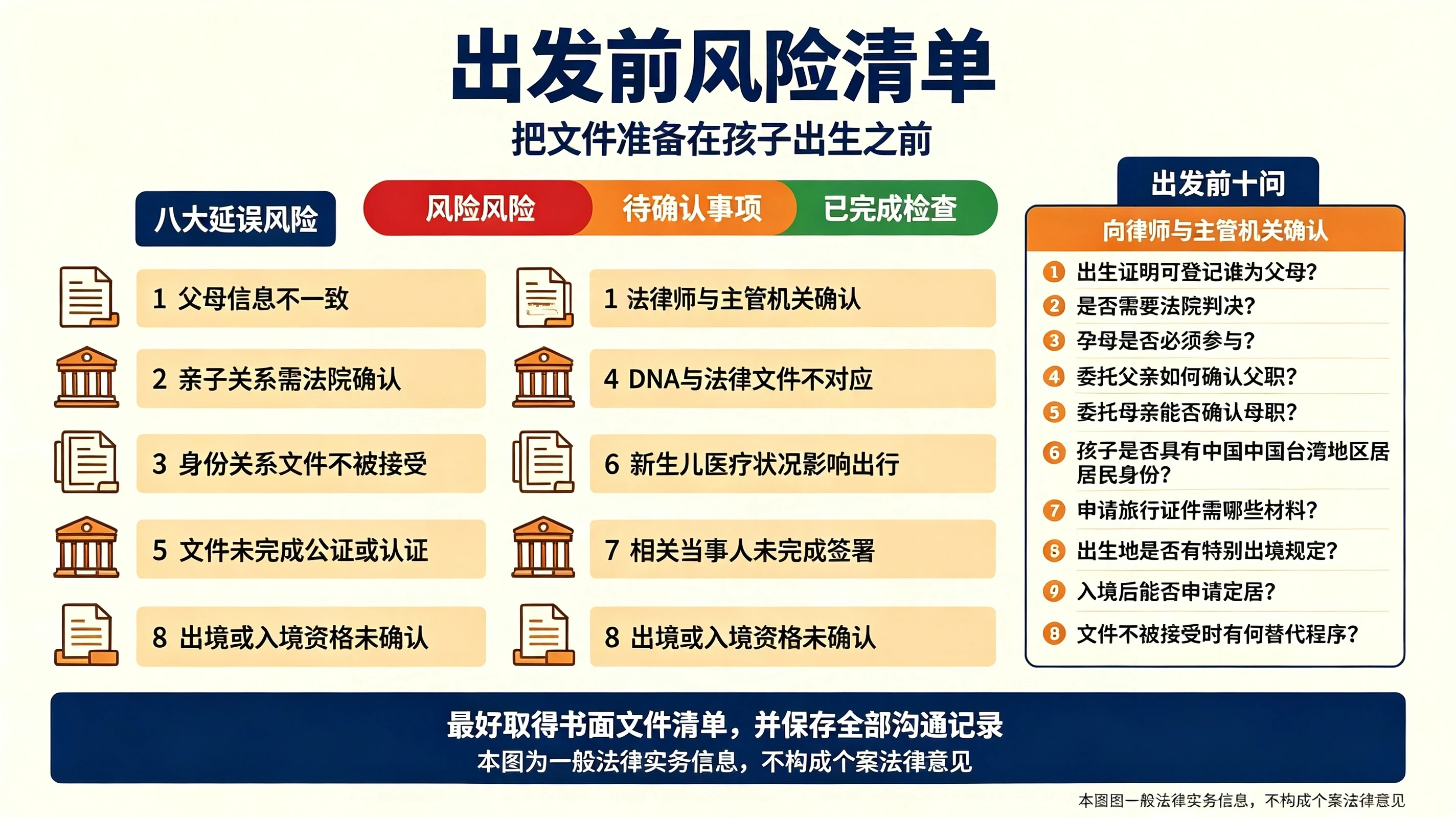
To avoid discovering after the project concludes that the document paths are invalid, it is recommended to confirm with local attorneys and Taiwan’s overseas representative offices before signing the contract or, at the latest, before embryo transfer:
After a child is born, who can be legally registered as the parents on the birth certificate?
Is a court judgment required locally to confirm the parent-child relationship with the entrusted parents?
If a court judgment is required, must the surrogate mother participate?
Can the father acquire legal paternity through acknowledgment or judicial proceedings?
Can a commissioned mother acquire legal maternal status?
Is it possible for the child to acquire Republic of China nationality, and what is the legal basis?
What documents are required when applying for a passport or travel document at Taiwan’s overseas missions?
Are there any special regulations regarding the departure of minors or surrogate children from their place of birth?
After entering Taiwan, is it possible to meet the eligibility criteria for applying for permanent residency as a national without household registration?
If Taiwan does not accept a certain overseas document, are there other legal identity verification procedures available?
It is advisable to obtain a specific list of documents or a written response and to keep records of all communications. When legal advice is involved, separate assessments should be made by lawyers who possess the relevant professional qualifications and are familiar with Taiwan’s laws on international parent-child relationships and the law of the place of birth.
XIII. Conclusion: Design the Path to Return to Taiwan Before the Child Is Born
The most common misconception in overseas surrogacy programs is treating the baby’s birth as the endpoint and viewing birth certificates, passports, and return procedures to Taiwan as administrative formalities that can be easily handled along the way.
In fact, returning to Taiwan after birth is a pathway composed of multiple legal and administrative procedures:
Birth registration → Legal confirmation of parent-child relationship → Determination of Republic of China (Taiwan)Birth registration → Confirmation of legal parent-child relationship → Determination of Taiwanese nationality → Passport or travel documents → Lawful departure from the place of birth → Entry into Taiwan → Settlement and initial household registration upon meeting eligibility requirements.
If any step involves identity discrepancies, incomplete documentation, or insufficient legal basis, it may affect subsequent processing.
For Taiwanese families, the most important thing is not to secure an apparently precise commitment on "how many days after birth the baby can return to Taiwan" in advance, but rather to confirm before the project begins: who will legally register as the parents after the child is born, whether the child can obtain Taiwanese nationality, what travel documents are required, and whether the conditions for settlement and household registration are met upon returning to Taiwan.
Only when the laws of the place of birth, Taiwan’s regulations on parent-child relationship recognition, and the procedures for obtaining relevant documents can be seamlessly integrated does an overseas surrogacy program possess a relatively comprehensive legal framework.
Frequently Asked Questions
The content on this website is general educational material and compiled public information about IVF. It is provided for reference only, does not constitute a basis for diagnosis or medical decision-making, and does not constitute any medical advice or treatment recommendation. For policy and technical requirements, please refer to official publications issued by the relevant authorities and institutions. If you find any content errors, numerical inconsistencies, or outdated information, please contact us so we can verify and update it.