
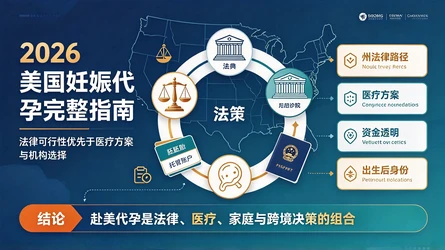
A systematic overview of differences in surrogacy laws across U.S. states, the full process of gestational surrogacy, medical technical standards, cost budget structure, parental rights safeguards, and key considerations for cross-border document processing for international families, accompanied by a decision checklist and risk mitigation recommendations.
Read allU.S. state laws may be continuously updated; the policy information presented herein is based on data as of October 31, 2026. The application of law is influenced by multiple factors, including the parties' nationality, residence, marital status, source of gametes, place of contract execution, location of medical procedures, and place of birth. For specific projects, please obtain a case-specific legal opinion from a reproductive law attorney licensed to practice in the target state, and have a qualified reproductive medicine specialist develop a tailored medical plan.
I. Basic Understanding of Surrogacy in the United States: Legal Priority as the Core Principle
1.1 Why Surrogacy in the United States Cannot Be Equated with Ordinary Medical Services
The United States is one of the countries with mature development in assisted reproductive technology, particularly in vitro fertilization (IVF), embryo culture, gamete donation,Gestational surrogacyWith a comprehensive medical service system in fields such as reproductive genetics and testing, it is one of the viable options for families experiencing difficulties with conception to fulfill their desire to have children.
Surrogacy in the United StatesGaining international attention in the family sector, its core advantages are concentrated in five key areas:
Mature assisted reproductive healthcare system: A sufficient number of specialized fertility centers are available to provide comprehensive medical services covering the entire process, including egg retrieval, embryo culture, cryopreservation, embryo transfer, and prenatal care.
Some states have well-developed legal systems, with clear judicial and administrative procedures for gestational surrogacy contracts, parental rights confirmation, and birth certificate registration.
Abundant third-party reproductive resources: diverse options such as egg donation, sperm donation, and embryo donation are available to meet medical needs.
A comprehensive professional service ecosystem: fertility clinics, surrogacy agencies, legal counsel, psychological support services, and custody institutions each perform their respective roles.
Highly inclusive family structures: Single individuals, same-sex couples, and families using donated gametes can legally make relevant arrangements in some states.
However, there is no unified surrogacy-specific law covering all 50 U.S. states; practical rules are governed by a combination of state-level family laws, contract law, parentage statutes, court precedents, and federal regulations related to healthcare and immigration. Therefore, pursuing surrogacy in the United States is far more than a simple medical service transaction—it entails a comprehensive legal, medical, and familial decision-making process involving multiple parties’ rights and obligations.The core principle is: first confirm legal feasibility, then select medical solutions and service providers..
1.2 Core Types of Surrogacy in the United States
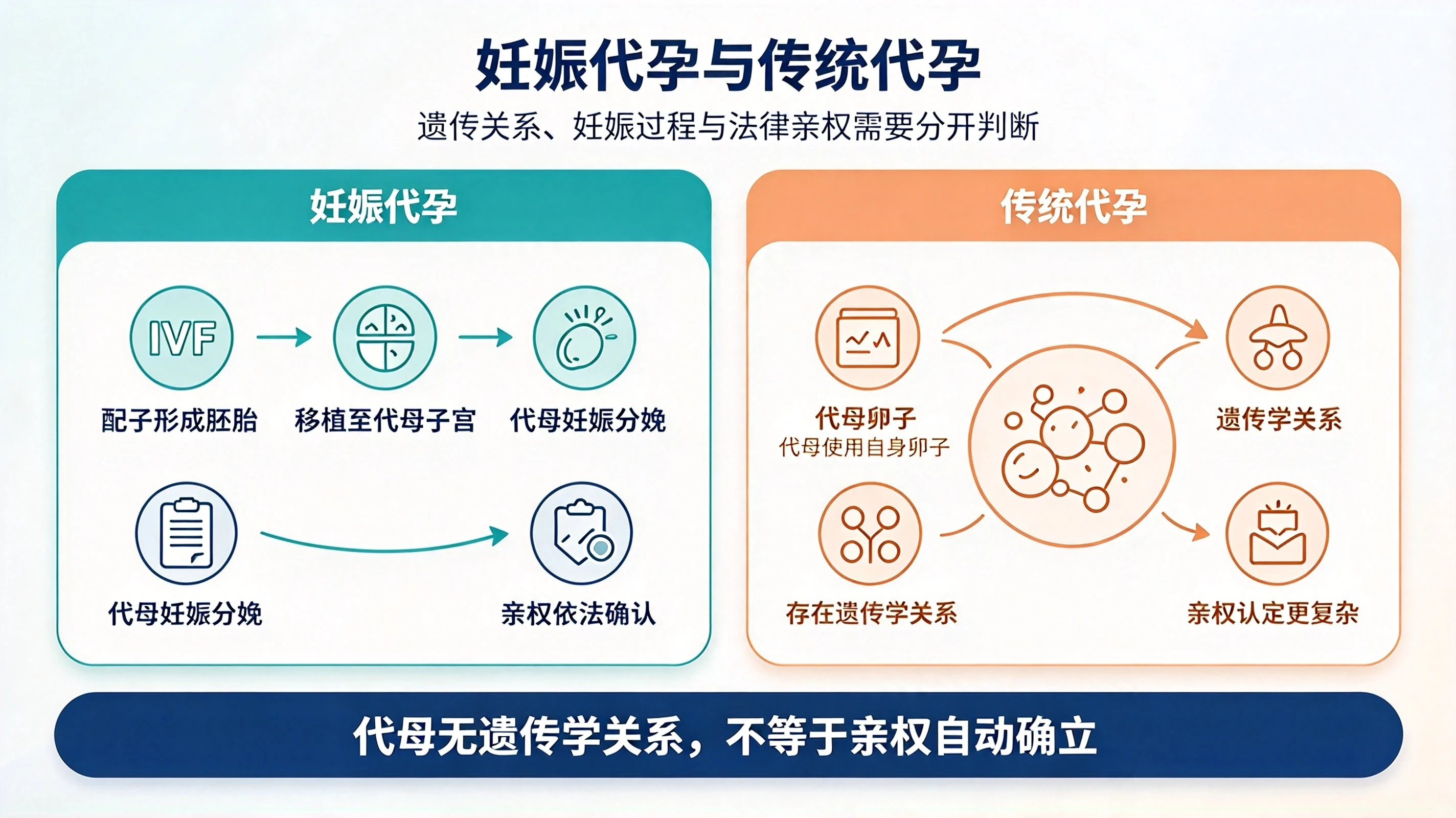
Gestational Surrogacy and Traditional Surrogacy
In the United States, surrogacy is primarily categorized into two types, which differ significantly in terms of genetic relationships, legal risks, and medical procedures. The mainstream choice for international families is gestational surrogacy.
Table
Type | Core Definition | Legal Characteristics |
|---|---|---|
Gestational surrogacy | Intended parents provide gametes or use legally donated gametes to create embryos via IVF, which are then transferred into the surrogate’s uterus. The surrogate only carries out pregnancy and childbirth and has no genetic relationship with the child. | Genetics, pregnancy, and legal parenthood are relatively separated.Determination of Parental RightsWith a clear judicial pathway, this is the current mainstream model in the United States. |
Traditional surrogacy | A gestational surrogate uses her own eggs to conceive, carries the pregnancy and delivers the child, and has a genetic relationship with the child. | The risks of disputes over contract validity and parental rights determinations are higher, with significant variation in rules across states; international families are not recommended to choose this option. |
It is important to note that even if the surrogate mother has no genetic relationship with the child, parental rights are not automatically established; relevant judicial procedures must still be completed in accordance with the laws of the state of birth and the contractual terms.
Commercial surrogacy and altruistic surrogacy
Classification by the method of economic compensation for surrogate mothers:
Commercial surrogacy: In addition to reimbursing medical, insurance, and related expenses, pay the surrogate a service compensation as required by state law and contractual agreements.
Altruistic surrogacy: No service compensation shall be paid; only reasonable and related expenses shall be reimbursed in accordance with the law and contractual agreements.
The legality and scope of compensation for both arrangements are governed by specific state laws. For example, Nevada permits compliant gestational surrogacy agreements to include reasonable compensation, whereas Florida strictly limits the scope of payments to surrogate mothers, allowing only those directly related to living expenses, legal fees, medical costs, and psychological counseling.
II. Core Legal Policy: Choosing the State of Birth Is the First Critical Decision
2.1 Six Core Dimensions of Differences in State Laws on Surrogacy in the United States
Surrogacy regulations across U.S. states differ primarily in six key areas, which also serve as the core criteria for selecting target states:
Should commercial gestational surrogacy be allowed?
Is a surrogacy agreement legally enforceable?
Is the eligibility of prospective parents restricted by their marital status?
Are single individuals and same-sex couples permitted to participate?
Is it supported?Prenatal Parental Order(Prenatal Order, PBO)
Registration Rules for Birth Certificates and Judicial Procedures Required After Birth
among whichPrenatal Parentage Order (PBO)It is a core parental rights confirmation tool in certain states: when statutory requirements are met, intended parents may petition the court for an order before the child’s birth to establish legal parentage upon birth and use it to obtain a birth certificate. However, note that:
Not all states have PBO programs.
Not all family structures qualify for the application.
There are differences in the standards and procedures applied by different courts.
A Prenatal Parentage Order Is Not Equivalent to Proof of U.S. Citizenship or a Passport
2.2 Place of birth is not the sole legal criterion
The state of birth is the core legal nexus for establishing parental rights and obtaining a birth certificate, but it should not be assumed that simply choosing to give birth in a friendly state resolves all issues. Practicing attorneys must also comprehensively examine the following connecting factors:
State of residence / country of nationality of the intended parents
State of residence of the surrogate mother
Place of Contract Signing
Place of occurrence of medical procedures such as embryo transfer
Location of the surrogate's pregnancy and delivery
The judicial jurisdiction of the court
Conflicts of Laws Across States and Conflicts with International Law
Cross-state surrogacy arrangements must have a comprehensive legal plan established in advance and cannot rely solely on the state where the delivery hospital is located as the sole basis for determination.
2.3 Detailed Analysis of Representative State Legal Environments in 2026
The following is organized by the clarity of legal provisions and applicable restrictions; different households should assess their own circumstances accordingly, as a one-size-fits-all approach is not feasible.
Table
State name | Core legal basis | Key Features | Decision-Making Considerations |
|---|---|---|---|
California | California Family Code Sections 7960 and 7962 | The system is mature, with high inclusivity in family structures. It offers suitable options for both married and unmarried intended parents, requiring independent legal counsel for each party. | Medical expenses, surrogate compensation, and the general cost of living are universally high. |
Colorado | Surrogacy Agreement Act | With the parties’ reproductive intentions at its core, clear provisions are made regarding medical decision-making authority, parental rights, and compensation. | Families using donated gametes or embryos should conduct a thorough assessment, verifying the compatibility of family structures. |
Connecticut | Parent-Child Relationship Law | A specialized legal procedure for establishing parental rights in cases of gestational surrogacy | Must meet the statutory conditions for contracts and court applications |
Nevada | NRS Chapter 126 | Specifically regulate gestational surrogacy, clarifying rules on independent legal counsel, contracts, and reasonable compensation | Commercial compensation compliance is clear; cross-state arrangements require jurisdictional verification |
Illinois | Gestational Surrogacy Act (2025 Amendment) | New laws taking effect in December 2025 adjust regulations on eligibility, genetic relationships, contracts, and parental rights. | International families, especially those using donated gametes, require lawyers to verify the applicable conditions on a case-by-case basis. |
New York State | Children's Parental Safety Act | A specialized surrogacy system shall be established, with a licensing regime for surrogacy organizations to protect the rights of surrogate mothers. | It is necessary to verify whether the institution holds a practice license issued by the State Department of Health. |
Massachusetts | The Parent-Child Relationship Law (effective 2025) | Establish modern paternity determination rules starting in 2025, supporting judicial determinations of paternity before birth, at birth, and after birth. | Emerging friendly states after 2025, with clear legal pathways |
Michigan | Law on Assisted Reproduction and Surrogacy Parentage (Effective 2025) | The original strict restrictions have been abolished, establishing a comprehensive system of agreements, qualifications, and parental rights. | Fundamental changes in the legal environment may be taken into consideration. |
Texas | Chapter 160 of the Family Code | The legal procedures are clear, but the intended parents must be legally married, and the surrogate mother must not use her own eggs. | Statutory procedures do not apply to single individuals and unmarried partners. |
Florida | Section 742.15 (Amended 2026) | Intended parents must be a married couple, meet medical indications, and compensation is strictly limited. | Chinese citizens/residents are prohibited by law from entering into gestational surrogacy contracts regulated by this state. |
⚠Florida 2026 Special Risk Advisory. Under the state’s amended laws, “Countries of Concern” include China, Russia, and others. If either party to a contract is a citizen or resident of any such country, they may not enter into a gestational surrogacy agreement governed by Florida law; non-compliant agreements may be void and unenforceable. Chinese nationals are prohibited from selecting Florida as an alternative jurisdiction for surrogacy arrangements. Specific determinations regarding nationality status must be supported by written opinions issued by licensed attorneys practicing in Florida.
2.4 States Requiring Careful Evaluation
States such as Louisiana, Nebraska, Indiana, and Arizona impose stricter restrictions on the enforceability of surrogacy contracts, commercial compensation, parental rights determinations, or party eligibility. It should be noted that:
Restricted states do not ban all forms of surrogacy.
Contract invalidity does not necessarily equate to criminal liability
Parentage recognition mechanisms vary by state, and parentage documents issued in one state may not be recognized by other states.
The safest approach is to obtain a written legal opinion from an attorney licensed in the target state regarding individual marital status, nationality, genetic relationship, and residency before matching with a surrogate mother and signing the contract.
III. Target Audience and Full-Process Planning

3.1 Who Should Consider Surrogacy in the United States
Eligibility for surrogacy requires a simultaneous assessment of medical indications, legal qualifications, and family capacity to bear the costs, primarily suiting three categories of individuals:
Individuals with clear medical needs: including congenital absence of the uterus, hysterectomy due to disease or surgery, severe uterine structural abnormalities, contraindications to pregnancy, situations where pregnancy may pose a risk to life or health, and cases deemed unsuitable for self-pregnancy following multidisciplinary medical evaluation
Individuals whose physiological conditions prevent them from becoming pregnant naturally: including male same-sex couples, single men, and other families unable to achieve pregnancy on their own
Families requiring third-party gametes/embryosFamilies that need to achieve parenthood through methods such as egg donation, sperm donation, or embryo donation
Please note that while there is a medical demand for surrogacy, not all states recognize its legal eligibility; some states impose access restrictions based on marital status, medical indications, and other criteria.
3.2 Complete Process of Surrogacy in the United States
The overall gestational surrogacy cycle in the United States typically lasts approximately 12 to 24 months, based on industry experience. Actual timelines may vary depending on embryo preparation, surrogate matching, legal review, the number of embryo transfers, and pregnancy outcomes. The entire process is divided into eight stages:
Phase 1: Preliminary Assessment of Prospective Parents (Approximately 1–2 Months)
Reproductive Medicine Consultation and Fertility Assessment
Medical History and Genetic Risk Assessment
Determine whether donor gametes are required
Preliminary confirmation of family structure and eligibility under the target state's laws
Develop Budget and Time Plan
Phase 2: Service Team Formation (can be conducted concurrently with medical assessment)
Screen and identify fertility clinics, verifying their qualifications and laboratory capabilities
Choose a surrogacy agency or independent coordination service
Engage a dedicated reproductive law attorney for intended parents
Confirm the third-party fund escrow solution
Phase 3: Surrogate Matching and Screening (Approximately 2–6 Months)
Physical health assessment and review of obstetric history
Uterine Condition Assessment, Infectious Disease Screening, and Laboratory Tests
Psychosocial Assessment and Verification of Family Support
Insurance Coverage Review
Both parties communicate and confirm their willingness to match.
Phase 4: Contract Signing and Escrow of Funds (Weeks to Months)
The surrogate and the intended parents each hire independent lawyers
Negotiation and Revision of Contract Terms
Clarify responsibilities for medical care, insurance, and compensation
Establish a third-party escrow account
Complete the legal review and documentation required by the clinic
Phase 5: IVF and Embryo Preparation
Ovarian stimulation and egg retrieval (or coordination of donor eggs), sperm collection and preparation
In Vitro Fertilization and Embryo Culture
Preimplantation genetic testing on demandPGT)
Embryo cryopreservationSave and formulate a transplant plan
Stage 6: Embryo Transfer and Pregnancy Confirmation
Endometrial Preparation and Hormone Monitoring for Surrogates
Embryo Assessment and Transfer Surgery
Post-transplant Pregnancy Test
Ultrasound confirmation of clinical pregnancy
Phase 7: Prenatal Management and Paternity Procedures
Routine Prenatal Checkups and Fetal Development Monitoring
Monitoring of Pregnancy Complications and Prenatal Screening
Submit an application for paternity documents
Coordination with Maternity Hospitals and Newborn Insurance Arrangements
Stage 8: Delivery and Cross-Border Procedures
Childbirth and Neonatal Care
Procedures for Birth Certificate Issuance and Paternity Confirmation
Apply for a U.S. passport
Processing of nationality-related travel documents and authentication of birth certificates
Complete cross-border return procedures
The three most common sources of delay are surrogate matching, legal contract negotiations, and failed embryo transfers along with pregnancy complications. When planning the timeline, buffer time should be allocated; do not estimate the total duration solely based on "9 months post-transfer."
IV. Perceptions of Medical Technology and Success Rates
4.1 Description of Core Medical Technologies
In vitro fertilization (IVF)
IVF is the foundational technology for gestational surrogacy, encompassing steps such as ovarian stimulation, egg retrieval, fertilization, embryo culture, cryopreservation, and transfer. For cycles using donated eggs, protocols must be developed based on the donor’s medical and genetic screening results.
Preimplantation Genetic Testing (PGT)
PGT is a genetic testing method for embryos, primarily categorized into three types:
PGT-A: Assessment of embryonic chromosomal numerical abnormalities
PGT-MTargeted testing for known monogenic genetic diseases
PGT-SR: Assess the risk associated with chromosomal structural rearrangements
PGT cannot guarantee 100% embryo implantation, nor can it rule out all genetic diseases and birth defects. The decision to undergo testing should be made in consultation with a genetic counselor, taking into account factors such as age, medical history, and clinical indications.
Single Embryo Transfer (SET)
Single embryo transfer is widely adopted in assisted reproductive technology (ART) clinics across the United States, with the primary goal of reducing the risks associated with twin and higher-order multiple pregnancies, thereby minimizing preterm birth, low birth weight, and pregnancy-related complications. According to the 2022 ART data from the U.S. Centers for Disease Control and Prevention (CDC), single embryo transfer accounted for 85.9% of all embryo transfer cycles. Surrogacy programs should adhere to professional medical advice and must not arbitrarily increase the number of embryos transferred solely to pursue a twin pregnancy.
4.2 How to Correctly Understand Success Rate
Success rates across different reproductive centers cannot be directly compared; differences in statistical criteria must be clearly defined:
Is the statistical unit per egg retrieval cycle or per embryo transfer?
Is the statistical metric clinical pregnancy rate or live birth rate?
Whether the sample is from a self-egg cycle or a donor egg cycle
Age Distribution of Patients
Does it include a frozen embryo transfer cycle?
Whether to distinguish between singleton and multiple live births
CDC ART data can be used to evaluate overall clinic performance but cannot substitute for individual success rate predictions. Final decisions must be made by physicians based on age, ovarian reserve,Sperm qualityconduct an individualized assessment based on the embryo status and prior treatment history.
V. Cost Budgeting and Financial Security Management
5.1 Overall Budget Range for 2026
The preliminary budget planning for gestational surrogacy in the United States in 2026 is typicallyOver $150,000 to $250,000This figure represents a commonly used market estimate range and is not an official, standardized fee schedule. Costs may be further increased by complex medical conditions, egg donation, repeat embryo transfers, insurance gaps, neonatal intensive care, and other factors; specific amounts must be itemized and calculated based on the clinic, institution, contract, and location.
5.2 Core Cost Structure
Table
Expense Category | Main Expenditure Items | Key Focus Areas of Budget Management |
|---|---|---|
Surrogacy Compensation | Base compensation, monthly allowance, milestone fees | Define payment terms and scenarios that trigger additional compensation |
Institutional Service Fee | Screening, matching, and end-to-end project coordination | Clarify the fee rules for explicit replacement matching and project termination |
IVF medical expenses | Egg retrieval, fertilization, embryo culture, and transfer | Distinguish between charges for base cycles and additional cycles |
Donor Fees | Egg donation, sperm donation, and related medical expenses | Verify whether it is included in the initial quotation |
Insurance fees | Surrogate Mother Health Insurance and Related Coverage | Review the policy for surrogacy pregnancy exclusions |
Legal fees | Independent counsel for both parties, paternity proceedings | Confirm whether court fees are included. |
Pregnancy and Delivery Expenses | Prenatal care, childbirth, and treatment of complications | Clarify the scope of insurance reimbursement and out-of-pocket expenses |
Newborn Costs | Newborn Insurance, Hospitalization, and Care | Set the risk budget separately |
Custodial fees | Third-party Fund Account Management | Clarify account management rules and payment permissions |
Cross-border fees | Air tickets, accommodation, translation, and document processing | Reserve a budget for additional layover buffers |
5.3 Common Overrun Scenarios
Medical: Embryo transfer failure, repeated ovarian stimulation and egg retrieval, additional embryo culture, surrogate re-matching, pregnancy complications, premature birth / neonatal intensive care
ContractSurrogacy allowance, special pregnancy arrangements for twin pregnancies, cesarean section-related expenses, lost wages and travel costs, contract termination/re-matching fees
Insurance: Medical insurance does not cover surrogacy pregnancies, policy exclusion clauses, insurance company claim denials, failure to arrange newborn insurance in advance, and expenses exceeding the coverage limit
5.4 Recommendations for Fund Security Management
It is recommended to divide the funds into three tiers for planning:
Basic Project Fees: Covers clear institutional services, medical and contractual fees
Special reserve fundAddress routine risks such as repeated transplants, re-matching, and additional examinations
Major Risk Capital: covering extreme situations such as pregnancy complications, cesarean sections, premature births, and neonatal intensive care
Key Verification Points for Core Fund Management:
Whether to use an independent third-party escrow account
Is the custodial institution a genuine and compliant business entity?
Payment Authorization Mechanisms and Credential Requirements
Are surrogate compensation payments made in installments based on milestones?
Refund rules for the remaining balance after project termination
Are there risks of fund misappropriation or commingling?
VI. Legal Risks Regarding Surrogate Mothers' Rights and Parental Authority
6.1 Core Legal Rights of Surrogate Mothers
Can a surrogate mother change her mind after the child is born?
In gestational surrogacy arrangements, where the surrogate has no genetic relationship with the child, parentage is clearly protected by law provided that the contract is lawful, procedures are compliant, and a parentage order has been obtained. However, determining parentage involves a comprehensive assessment requiring simultaneous satisfaction of multiple conditions: a valid contract, eligible surrogate qualifications, completion of independent legal representation, thorough medical and psychological screening, lawful embryo sourcing, proper court jurisdiction, and complete parentage proceedings. Not all states are entirely free from risks of legal disputes.
The surrogate mother has the right to make medical decisions.
A surrogate mother has the legal right to bodily autonomy, including decisions regarding her body, pregnancy, and medical care; this is a fundamental right that must be respected. The parties may agree in advance in the contract on communication mechanisms concerning prenatal screening, management of fetal abnormalities, multiple pregnancies, selective reduction, treatment of complications, mode of delivery, and postpartum care. However, the contract cannot deprive the surrogate of her bodily autonomy or compel her to undergo specific medical interventions.
6.2 Essential Core Clauses in Surrogacy Contracts
A standardized surrogacy agreement should at least include the following:
Identity Information and Rights and Obligations of Each Party
Statement on the Sources of Embryos and Gametes
Surrogacy Compensation Standards and Payment Methods
Health Insurance and Rules for Bearing Maternity Costs
Medical Decision-Making Authority and Communication Mechanisms
Prenatal Diagnosis and Pregnancy Management Agreement
Rules for Managing Multiple Pregnancies and Complications
Procedures for Paternity Confirmation and Birth Registration
Privacy and Medical Records Usage Rules
Termination of Contract and Dispute Resolution Mechanisms
Postpartum Support Arrangements for Surrogate Mothers
Rules for Bearing Newborn Medical Expenses
The core purpose of the contract is not to restrict the surrogate’s rights, but to clearly define the boundaries of each party’s responsibilities, establish reasonable expectations, and reduce the risk of future disputes.
VII. International Family Exclusive: Nationality, Passports, and Return Procedures
International families must assess four issues separately and not conflate them: U.S. citizenship, a U.S. passport, Chinese citizenship, andTravel DocumentDocuments, parent-child relationships under Chinese law, and household registration
7.1 U.S. Birthright Citizenship and Passports
Under the Fourteenth Amendment to the U.S. Constitution, persons born in the United States and subject to its jurisdiction generally acquire U.S. citizenship at birth. A 2026 U.S. Supreme Court ruling upheld the existing rules on birthright citizenship, and there are currently no general nationality restrictions targeting non-U.S. citizen surrogacy families.
Note that birthright citizenship and passport application are two separate matters. To apply for a U.S. passport, the child must still submit proof of citizenship, such as a birth certificate, in accordance with Department of State requirements and complete the full application process. Do not rely on verbal promises claiming that a passport can be obtained within days of birth. It is recommended to confirm hospital registration procedures, the progress of paternity orders, the process for obtaining a birth certificate, and the required documentation checklist for passport applications before delivery to avoid disruptions to your departure plans.
7.2 Determination of Chinese Nationality and Considerations for Returning to China
According to Article 5 of the Nationality Law of the People's Republic of China: If one or both parents are Chinese citizens and the child is born abroad, the child shall in principle have Chinese nationality; however, if one or both parents are Chinese citizens who have settled abroad and the child acquires foreign nationality at birth, the child shall not have Chinese nationality. China does not recognize dual nationality.
Chinese families should make a comprehensive judgment based on the following factors:
Chinese nationality status of the parents
Whether parents qualify as having settled abroad under the law
Does a child acquire U.S. citizenship at birth?
Legal Basis for the Determination of Parentage
The Effectiveness of Surrogacy Agreements and Court-Ordered Parentage Documents
Document Verification Requirements at Chinese Embassies and Consulates in the United States
Special Note: The genetic parents in a surrogacy arrangement, the legal parents under U.S. law, and the recognition of parent-child relationships under Chinese law belong to different legal systems and cannot be directly equated. The fact that a child is born in the United States does not automatically guarantee eligibility for a Chinese Travel Document, household registration (hukou) in China, or recognition of the parent-child relationship under Chinese law.
7.3 Recommended Core Documents to Prepare in Advance
Table
File | Core Purpose |
|---|---|
U.S. birth certificate | Proof of Birth Facts and Registered Parental Information |
Court Order on Parental Authority | Proof of legally confirmed paternity |
Surrogacy Agreement | To prove the legal arrangement between the parties |
Parental Identification | For nationality and identity verification |
U.S. Passport | For international travel |
Authentication Materials for Birth Certificates | Meets cross-border document usage requirements |
Required documents for embassies and consulates | For Nationality and Travel Document Applications |
It is recommended that, prior to embryo transfer, a U.S. reproductive law attorney and a Chinese cross-border family law professional jointly review the identity planning strategy, rather than waiting until after the child’s birth to begin making arrangements.

8. Institution Selection and Full-Cycle Risk Prevention
8.1 How to Screen for Compliant Surrogacy Agencies
The United States does not have a unified, federally mandated ranking or certification system for surrogacy agencies. Promotional claims such as “top ten agencies,” “officially recommended,” or “number one in success rates” should not be used as bases for decision-making. When vetting agencies, priority should be given to verifying the following six dimensions:
1. Business Operations and Licensing Qualifications
Verify the actual operating entity, company registration details, compliance with state licensing requirements, and any regulatory penalties or unresolved complaints. In particular, for New York State, check against the list of licensed surrogacy organizations published by the State Department of Health. Note: Company registration does not imply that the surrogacy business has obtained government authorization.
2. Qualifications of the Reproductive Medicine Center
You can access clinic data through the U.S. CDC's ART Success Rates tool; when making comparisons, you must consider patient age, egg source, treatment method, and statistical definitions, rather than relying on a single percentage alone.
3. Surrogacy Screening Criteria
In accordance with the recommendations of the American Society for Reproductive Medicine (ASRM), gestational surrogates should typically meet the following criteria: be of legal adult age, ideally between 21 and 45 years old; have at least one prior full-term pregnancy without complications; have no more than five deliveries in total and no more than three cesarean sections; have a stable family support system; complete medical, infectious disease, and psychosocial evaluations; and obtain independent legal counsel.
4. Legal Team Configuration
Confirm that the intended parents and the surrogate each have independent legal counsel, that both attorneys are well-versed in surrogacy laws in the target state, can plan for pre-birth parentage orders, review interstate legal conflicts, and assist with birth registration. Sharing a single attorney between the parties creates a conflict of interest and is not considered standard practice.
5. Fund Escrow Mechanism
Provide the identity of the escrow account holder, the account management agreement, the payment authorization process, the compensation payment plan for the surrogate, a detailed breakdown of fund usage, and refund rules in the event of project termination; additionally, verify whether any affiliation exists between the escrow agency and the surrogacy agency.
6. Insurance and Postpartum Coverage
Verify whether the surrogate’s existing insurance excludes surrogacy pregnancies, whether specialized insurance is required, the coverage scope for premature births and complications, arrangements for newborn insurance, waiting periods and network restrictions, as well as the party responsible for providing postpartum physical and mental health support to the surrogate.
8.2 Core Risk List for the Full Lifecycle
Table
Risk Category | Typical Issues | Prevention Methods |
|---|---|---|
Legal risk | Contract invalid, confirmation of parental rights obstructed | Local lawyers provide case-specific legal opinions in advance |
Medical Risk | Transplant failure, miscarriage, premature birth | Complete screening and standardized prenatal checkups, with a reserved medical contingency fund |
Funding Risk | Institutional collapse and misappropriation of funds | Independent third-party escrow with milestone-based installment payments |
Insurance Risk | Pregnancy-related expenses are not covered. | Review policy terms clause by clause and configure specialized insurance coverage |
Risk Matching | Surrogacy withdrawal or inability of both parties to reach an agreement | The contract clearly specifies termination conditions and a re-matching mechanism. |
Ethical Risks | Surrogates participating under economic or psychological coercion | Ensure Independent Legal Representation and Psychological Support |
Parental rights risk | Birth Registration and Judicial Procedure Disputes | Develop a comprehensive paternity confirmation plan in advance |
Cross-border risk | Incomplete passport, travel document, or parent-child documentation | Consult professionals from both countries in advance and prepare all necessary documents. |
Among them, legal, financial, and insurance risks can be proactively identified and mitigated before project initiation, making them the core focus of risk control.
IX. Decision Reference and Summary
9.1 Comparison of Surrogacy in the United States with Other Countries/Regions
Surrogacy laws, medical resources, costs, and eligibility criteria vary significantly across different countries and regions; therefore, price should not be the sole factor considered when making a choice:
Table
Comparison Dimension | United States | Other countries / regions |
|---|---|---|
Legal Management | State laws are each regulated | Unified national legislative management |
Healthcare system | Assisted reproductive technologies are mature, with a well-established system | Uneven levels of development |
Surrogacy model | The gestational surrogacy system is mature. | The permitted forms of surrogacy vary by location. |
Commercial Compensation | Some states allow it, while others strictly restrict it. | There are significant regional differences. |
Paternity Confirmation | Some states have clear judicial pathways | In accordance with local laws and administrative procedures |
International Family Qualification | State-by-State Review Restrictions | Reviewed in accordance with local laws |
Cost Level | Overall, it is on the higher side. | The range is wide, with both high and low values. |
Cross-border identification documents | Process according to the rules for birthplace and nationality | As stipulated by place of birth and destination |
When choosing an international family formation service, the core criteria should be: whether local laws permit your family structure; whether contracts and parental rights are legally enforceable; whether medical facilities meet regulatory standards; whether surrogate mothers’ rights are protected; whether the child’s identity and documentation pathways post-birth are clear; and whether you can afford the total budget.
9.2 15-Item Decision Checklist to Review Before Signing
Legal
Does the target state allow its own surrogacy arrangements?
Does marital status affect eligibility to become an intended parent?
Are there any special restrictions on nationality or residency status?
Is a pre-birth parentage order permitted?
Has the contract been reviewed by independent legal counsel for both parties?
Are there any interstate legal conflicts?
Medical
Does the reproductive center comply with regulatory requirements?
Has the medical evaluation been completed?
Are the sources of embryos and gametes legal and compliant?
Has the surrogate completed comprehensive physical and psychological screening?
Has a protocol for single embryo transfer and prenatal management been established?
Finance
Has a complete itemization of costs been obtained?
Should an independent third-party escrow account be established?
Has the insurance for the surrogate mother and the newborn been verified?
Are funds reserved for repeat transplants and major medical risks?
Cross-border
Has the pathway for applying for a U.S. passport been clearly defined?
Have the requirements for Chinese nationality and travel documents been verified?
Are you familiar with birth certificate authentication and the documents required for returning to China?
Until the above issues are clearly resolved, it is not advisable to sign a contract or pay a large deposit based solely on an institution’s verbal promises.
9.3 Five Principles of Prudent Decision-Making
The advantage of surrogacy in the United States lies in certain states having mature legal frameworks for gestational surrogacy and well-developed assisted reproductive healthcare systems. However, it is not a standardized nationwide service, nor is it a program where success can be guaranteed simply by paying fees. A reliable plan for pursuing surrogacy in the U.S. must be built upon five fundamental pillars:
The legal pathway is clearSelect a state that aligns with your family structure, nationality, and legal status, and verify in advance the validity of contracts and parental rights procedures.
The medical treatment plan is reasonable.Select a compliant reproductive center and develop an IVF, testing, and transplantation plan tailored to your individual circumstances.
Institutional and Financial TransparencyVerify the service providers, medical resources, fee details, and independent escrow mechanism
The rights and interests of surrogate mothers are protected.: Ensure that the surrogate mother participates voluntarily, has independent legal counsel, receives adequate medical care, and retains statutory medical decision-making authority
Identity arrangement complete: Plan in advance for birth certificates, paternity documentation, U.S. passports, Chinese nationality recognition, and procedures for returning to China
The core of decision-making is not to find the agency with the lowest cost, highest success rate, or most promises, but to develop a comprehensive plan that is legally viable, medically compliant, financially transparent, ethically sound, and executable in terms of cross-border procedures. Following the sequence of “law before medicine, budget before agency selection, and identity planning before project initiation” represents a more prudent decision-making logic for international families.
National Immigration Administration | Nationality Law of the People's Republic of China
U.S. Supreme Court | Case File for Trump v. Barbara (25-365)
U.S. Department of State | Application Materials for Proof of U.S. Citizenship and Passports
California Courts | Official Guide to Gestational Surrogacy and Parentage Confirmation
Frequently Asked Questions
The content on this website is general educational material and compiled public information about IVF. It is provided for reference only, does not constitute a basis for diagnosis or medical decision-making, and does not constitute any medical advice or treatment recommendation. For policy and technical requirements, please refer to official publications issued by the relevant authorities and institutions. If you find any content errors, numerical inconsistencies, or outdated information, please contact us so we can verify and update it.