
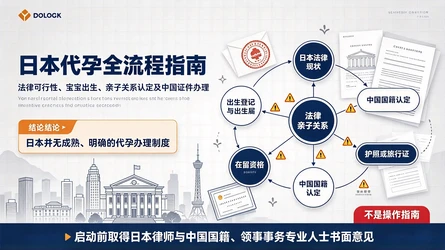
Is surrogacy legal in Japan? Can intended parents establish a legal parent-child relationship? How are birth registration, Chinese travel documents, and return procedures handled after the baby is born in Japan? This article outlines the current legal status of surrogacy in Japan, post-birth administrative processes, estimated timelines, arrangements for traveling to Japan, and cross-border identity risks, helping families comprehensively assess the legal feasibility of surrogacy in Japan.
Read allI. First, let’s clarify the conclusion: Japan does not have a mature and clearly defined system for surrogacy procedures.
Japan has, in the past, entered certain [fields/sectors] due to factors such as medical technology, geographic location, and living environment.Cross-Border Assisted Reproductive Technologythe scope of consideration for those seeking services. However, if the plan is to have a child through surrogacy in Japan, the first issue to confront is not choosing a hospital or comparing costs, but rather the legal framework and the determination of parent-child relationships.
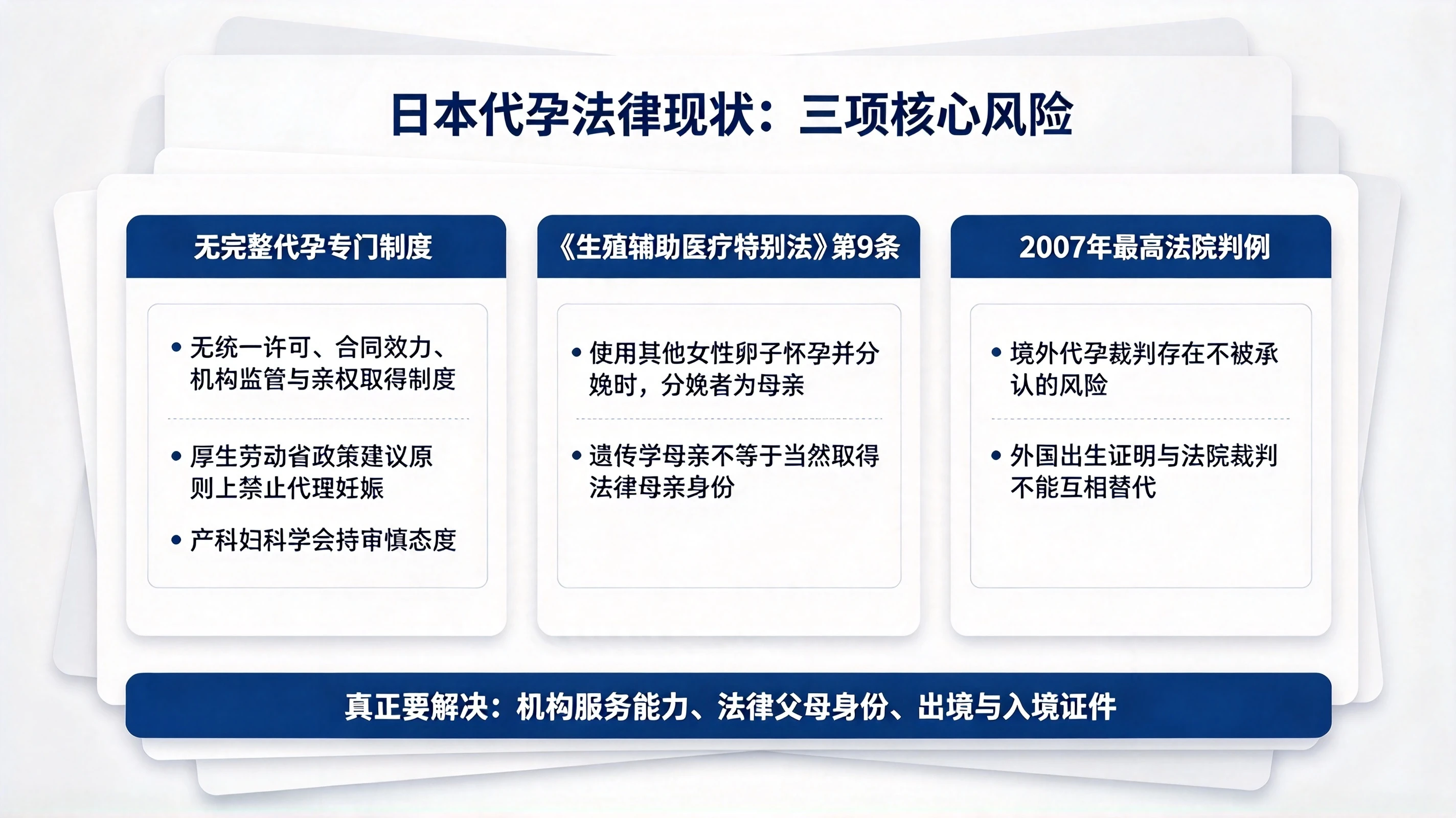
As of November 2026, Japan has not established a comprehensive legal framework covering surrogacy licensing, the enforceability of surrogacy agreements, regulation of surrogacy agencies, and the acquisition of parental rights by intended parents. While Japanese law provides for the determination of maternal status for children born through certain assisted reproductive technologies, this does not mean that Japan has established a surrogacy system available for direct use by overseas families.
Therefore, the "Surrogacy in JapanThe "full-process" section primarily helps readers understand the Japanese legal environment, birth registration, recognition of parent-child relationships, and the risks and procedural coordination involved in cross-border document processing.This is not an operational guide for surrogacy projects in Japan, nor does it imply that legal surrogacy services for foreigners exist in Japan.
For Chinese families, it is also necessary to simultaneously consider China's nationality determination, document review by the Chinese embassies and consulates in Japan, and identity registration for children upon their return to China.
Before deciding to go to Japan, it is recommended that you first obtain written opinions from a licensed Japanese attorney and a specialist in Chinese nationality and consular affairs regarding your specific family circumstances. Do not make decisions based solely on promises made by intermediaries, verbal explanations provided by hospitals, or success stories from other families.
II. Current Legal Status of Surrogacy in Japan: Key Provisions to Consider
1. Japan does not have a comprehensive legal framework specifically dedicated to surrogacy.
Japan currently has no specific law that systematically regulates matters such as the eligibility requirements for surrogacy, licensing of medical institutions, validity of surrogacy agreements, rights of surrogate mothers, identity of intended parents, and transfer of parental rights after birth.
The Ministry of Health, Labour and Welfare of Japan has discussed surrogacy in its deliberations on assisted reproductive medicine and proposed a policy recommendation to prohibit surrogacy in principle. The Japanese Society of Obstetrics and Gynecology has also long maintained a cautious stance toward surrogacy, not endorsing it as a standard practice in assisted reproductive medicine.
It is necessary to distinguish between three concepts:
The law has not established a complete system.does not mean that a surrogacy contract is automatically valid.
The industry organization does not recognize it.: does not mean that industry opinion itself constitutes a nationally unified criminal law prohibition.
No general criminal prohibition: nor does it imply that individuals may, on this basis, deem surrogacy programs lawful, hospitals authorized to perform them, or intended parents able to smoothly obtain parental rights.
For overseas families, the real issues to be resolved are: whether medical institutions are willing to provide the relevant services in accordance with the law; whether the medical procedures comply with Japanese laws and professional standards; who is recognized as the legal parents after birth; and whether the child can obtain valid documents for exit from Japan and entry into another country.
These issues cannot be summarized by a single question, "Is surrogacy legal in Japan?"
2. Article 9 of Japan’s Special Act on Assisted Reproductive Medical Treatment: The person who gives birth is recognized as the mother
In 2020, Japan enacted the Act on Special Provisions of the Civil Code Regarding Parent-Child Relationships for Children Born through Assisted Reproductive Medical Services.
Article 9 of this Law stipulates:
When a woman undergoes assisted reproductive medical treatment using another woman’s egg (including an embryo formed from that egg) and becomes pregnant and gives birth, the woman who gives birth shall be recognized as the mother of the child.
This provision is of significant importance to assisted reproductive cases involving third-party oocytes.
For example:
Entrust a woman to provide her own eggs;
The embryo is formed from the egg of the intended mother and the sperm of the intended father;
The embryo is transferred into another woman’s body;
Pregnancy and childbirth are achieved by the woman who receives the embryo transfer.
Under the conditions applicable to this provision, Japanese law recognizes the woman who gives birth as the mother of the child. The intended mother cannot acquire maternal status under Japanese law solely on the basis of her genetic connection to the child, whether through the source of the egg or a surrogacy agreement.
Special attention should be paid to the scope of Article 9, which applies to cases where pregnancy and childbirth occur using eggs from other women (or embryos derived from such eggs). It is inappropriate to interpret this provision indiscriminately as applying to all possible surrogacy arrangements.
3. Japanese Supreme Court Precedent of 2007: Risks of Recognition Exist for Foreign Surrogacy Judgments
On March 23, 2007, the Supreme Court of Japan ruled onSurrogacy Abroadrender a judgment on the parent-child relationship of children born
This case involved a Japanese couple who had children through surrogacy in the United States and obtained a U.S. court judgment recognizing them as the legal parents. The Supreme Court of Japan ultimately held that the parent-child relationship confirmed by the foreign judgment conflicted with Japan’s public order at the time, thereby failing to meet the public policy requirement for recognition of foreign judgments under the Japanese Code of Civil Procedure, and thus could not take effect in Japan.
This precedent illustrates:
Obtaining a court ruling on parent-child relationships abroad does not necessarily mean that such a ruling will be recognized in Japan.
Genetic parenthood does not equate to legal parenthood under Japanese law.
Surrogacy agreements, foreign birth certificates, and foreign court judgments are not mutually interchangeable.
The identity issues of children born through surrogacy abroad must be analyzed specifically by taking into account the laws of the place of birth, Japanese law, and relevant rules on recognition of judgments.
However, this precedent should not be simplistically interpreted as meaning that “all children born through surrogacy abroad are unable to establish legal parentage.” The ruling addresses specific facts and the recognition of foreign judgments, and its conclusions cannot be extended indefinitely without regard to the context of the case.
Decision Prompt:If a family has already completed embryo transfer or surrogacy arrangements abroad, they should engage a Japanese lawyer before the child’s birth to assess issues related to birth registration, establishment of parentage, possibilities for adoption, and recognition of foreign judgments, rather than attempting remedial measures after the child is born.
III. What other legal issues do Chinese families still need to verify?
Beyond Japanese law, Chinese families need to pay attention to at least three aspects.
1. Regulatory Provisions on Assisted Reproductive Technology in Mainland China
Article 3 of the Measures for the Administration of Human Assisted Reproductive Technology, issued by China's National Health Commission, stipulates that medical institutions and healthcare personnel shall not implement surrogacy in any form.
This regulation specifies the regulatory requirements for medical institutions and healthcare professionals in China to conduct assisted reproductive technology.
However, it cannot be inferred solely from this provision that all acts by Chinese citizens participating in surrogacy abroad are subject to the same penalties. The applicable law, allocation of liability, and specific consequences for extraterritorial conduct must be assessed based on the place where the act occurred, the parties involved, and the specific facts of the case.
2. Does the child have Chinese nationality?
Article 5 of the Nationality Law of the People's Republic of China states:
Where both parents or one parent are Chinese citizens and the person is born abroad, the person shall in principle have Chinese nationality; however, where both parents or one parent are Chinese citizens who have settled abroad and the person acquires foreign nationality at birth, the person shall not have Chinese nationality.
Therefore, to determine whether a child has Chinese nationality, it is necessary to verify:
Who are the legal parents of the child;
Whether Chinese-national parents qualify as having settled abroad within the meaning of law;
Whether the child has already acquired foreign nationality at birth;
Whether the relevant materials on parent-child relationship and nationality can be recognized by Chinese competent authorities.
What makes surrogacy cases unique is that the genetic parents, the birth mother, and the parents listed on a foreign birth certificate may not be the same. China’s determination of nationality cannot rely solely on DNA reports or on the names recorded on birth certificates.
3. Do Chinese embassies and consulates in Japan accept applications for travel documents?
First-time application for children born abroad, as announced by the Embassy of China in JapanTravel DocumentThe list of required documents includes the passports of both parents, residence cards, children’s birth certificates, and, for children born in Japan, the Birth Notification (Shuttsu-todoke), the Certificate of Acceptance of Birth Notification (Shuttsu-todoke Juri Shomeisho), or related household registration documents.
But it is important to emphasize:
This is the general documentation requirement for children born abroad, and it does not imply that children born via surrogacy will necessarily be processed under the standard procedure.
If the mother recorded on the birth certificate is the birthing parent, while the female applicant for a travel document is the genetic mother, consular authorities may need to further verify legal parentage, custody, and nationality attribution.
The Chinese Embassy in Japan further clarified that children of mixed Chinese-Japanese nationality born in Japan do not possess Chinese nationality if, at the time of their birth, their Chinese parent holds permanent resident status in Japan. Specific cases should still be determined based on the Nationality Law and the assessments made by the competent authorities.
Therefore, it is recommended to consult with Chinese diplomatic missions and consulates in Japan regarding relevant documents and nationality issues before initiating any cross-border surrogacy arrangements, and to obtain as much written response or clear material requirements as possible for record-keeping.
IV. When surrogacy in Japan is involved, which parties and documents need to be distinguished?
Cross-border surrogacyInvolving multiple parties, it is prone to the misconception that "whoever participates in the medical process becomes the legal parent."
Subject | Main Responsibilities or Identity | Issues to Note |
|---|---|---|
Entrust parents | Individuals or couples who wish to raise children | Signing an agreement or paying fees does not automatically confer parental status under Japanese law. |
Parturient women | Women who actually become pregnant and give birth | A person is legally recognized as the mother when the conditions for applying Article 9 of Japan's Special Law are met. |
Medical institution | Provide assisted reproductive and maternity healthcare services | Whether the service can be provided and whether it complies with Japanese laws and professional standards must be verified in advance. |
Lawyer | Provide legal advice, parent-child relationship services, and document review | Issues of Japanese law should be handled by a licensed Japanese attorney. |
Administrative Agency | Acceptance of birth registration, residence status, and related applications | Different authorities review different matters; accepting a document does not constitute recognition of the entire parent-child relationship. |
Chinese Embassies and Consulates in Japan | Accept those that meet the eligibility criteriaChinese Passportor travel document application | Independent review of nationality, parent-child relationship, and applicant eligibility is required. |
In particular, distinguish among the following four types of files:
Birth certificate or Certificate of Acceptance of Birth Notification: Used to certify the fact of birth or the status of a birth declaration.
DNA Testing Report: Used to illustrate genetic relationships.
Legal Documents Related to Parent-Child Relationships or Adoption: Used to prove legal parentage or guardianship.
Passports, Travel Documents, and Other Travel Papers: Used to address issues related to children's cross-border travel and identity verification.
These documents serve different legal functions and cannot substitute for one another.
V. From Assisted Reproduction to the Birth of a Child: How Should the Overall Process Be Understood?
For Japan, the surrogacy processes used in other countries cannot be directly applied. Japan does not have a standardized, licensed surrogacy process designed for overseas intended parents.
If a family is evaluating arrangements related to Japan, they can proceed with legal and medical feasibility assessments in the following order.
Step 1: Conduct a legal feasibility review
Before paying medical fees or signing a service contract, it is recommended to complete the following checks:
Whether Japanese lawyers are able to issue a written legal opinion on the proposed arrangement;
Whether the medical institution clearly states its ability to provide relevant medical services;
Whether the proposed arrangement involves restrictions under Japanese laws and medical industry regulations;
How the legal status of the birth mother and the intended parents is determined;
Whether the parent-child relationship needs to be established through adoption or other legal procedures after birth;
Are there any insurmountable obstacles to birth registration in Japan and obtaining Chinese documents?
If the above issues cannot be resolved with a clear answer, it is not recommended to proceed directly to the medical implementation stage.
Step 2: Verify the medical institution and medical services
The qualifications, scope of services, physicians' practice status, embryo management protocols, medical risk disclosures, and fee structures of healthcare institutions should be verified.
If the service provider claims that “Japanese policy permits it,” “the hospital can arrange it,” or “a Chinese Travel Document will definitely be obtained after birth,” you should request specific legal basis and written proof.
Can medical institutions provide routineTest tube babyTreatment and whether it is legal to provide surrogacy-related services are two distinct issues.
Step 3: Clarify Contracts, Fees, and Responsibilities
For surrogacy arrangements involving third-party participation, at least the following should be reviewed:
Medical expenses and payment milestones;
Management of medical failures, pregnancy terminations, or complications;
Cryopreservation, transport, and disposal of embryos;
Protection of Medical Records and Personal Information;
Medical arrangements for delivery and postpartum care;
Handling of disputes regarding parent-child relationships after birth;
Liability for unsuccessful certificate applications;
Contract Termination, Refunds, and Dispute Resolution Methods.
Particular attention should be drawn to the following: while a contract may stipulate certain rights and obligations between the parties, it cannot directly alter the determination of maternal status as prescribed by Japanese law, nor can it require administrative authorities or consular offices to recognize any specific parent-child relationship.
Step 4: Plan ahead for legal documents after birth
Before the birth of the child, a lawyer and relevant professionals should confirm:
Who is legally required to file the birth registration?
How birth certificates and birth notifications will be recorded;
Whether the delegating parents need to separately complete procedures for confirming parent-child relationships or for adoption;
Is DNA testing required?
Whether a court judgment or other legal documents are required;
What documents are required to verify Chinese nationality?
Whether an application for a Chinese Travel Document or passport can be accepted.
These issues should be addressed and resolved before birth, rather than treating post-birth document processing as an administrative step that can be handled on a temporary or after-the-fact basis.
VI. What procedures are required after the baby is born in Japan?
The following describes the administrative procedures involved for newborns with foreign nationality in Japan. In surrogacy cases, the reporting party, parent-child relationships, and documentary requirements may differ; therefore, specific legal status must be confirmed beforehand.
1. Processing of birth certificates and birth notifications
After a child is born in Japan, medical institutions typically issue birth-related certificates.
Article 49 of Japan's Family Register Act stipulates that, in principle, a birth notification must be submitted within 14 days from the date of birth.
The usual place of declaration is:
The municipal government of the city, ward, town, or village where the child was born;
or the municipal government of the city, ward, town, or village where the applicant is located and meets the legal requirements.
Under normal circumstances, a birth notification is filed by the father or mother. However, in surrogacy cases, the standard filing procedure for ordinary families cannot be directly applied; instead, it must be confirmed by Japanese lawyers and the accepting authorities who has the eligibility to file the notification, in what capacity the form should be completed, and what supporting documents are required.
It is recommended to confirm the required documents with the municipal office of the city, ward, town, or village where you plan to file your declaration in advance, and keep a record of them.
Birth certificate;
A copy of the birth registration form or related application documents;
Certificate of Acceptance of Birth Notification
Other birth registration records that may be obtained in accordance with the law.
Note: The acceptance of a birth notification primarily indicates that the birth registration procedure has been completed, and does not imply that the administrative authority has confirmed the intended parents' legal parental status.
2. Determine whether an application for a residence status is required
If the child does not have Japanese nationality and plans to remain in Japan after birth, attention must be paid to Japan's immigration control system.
According to the regulations of the Immigration Services Agency of Japan:
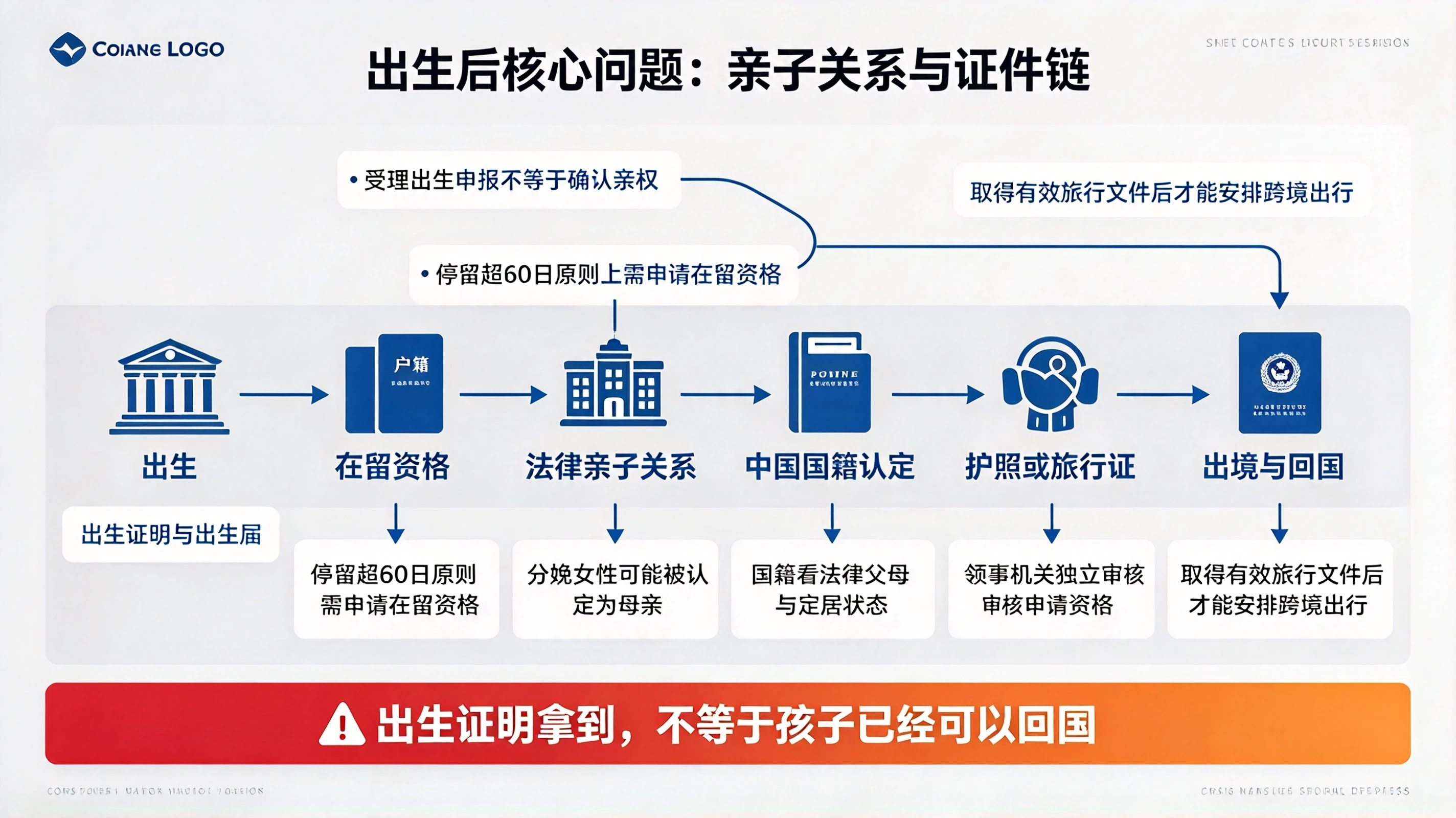
If a newborn of foreign nationality intends to stay in Japan for more than 60 days, they are generally required to apply for permission to obtain a status of residence within 30 days from the date of birth.
If a child leaves Japan within 60 days after birth, an application for permission to obtain this status of residence is generally not required.
The 30-day period is the application deadline, while the 60-day period refers to the relevant stay regulations; the two must not be conflated.
If the child has not obtained a status of residence more than 60 days after birth, it may affect administrative services such as the resident registration certificate, National Health Insurance, and child allowance.
It should be noted that whether to apply for a status of residence, the specific status under which to apply, and whether the relevant application conditions are met must be determined based on the child’s nationality and legal parent-child relationship.
3. Address parent-child relationships and custody issues
This is the stage most prone to disputes in surrogacy cases.
If the woman who gives birth is not the same as the intended mother, and the case meets the conditions for applying Article 9 of Japan's Special Law, Japanese law shall recognize the woman who gives birth as the mother.
A commissioning woman cannot automatically obtain maternal status under Japanese law based solely on the following documents:
Proof of egg source
Embryo formation records;
DNA Test Report;
Surrogacy Agreement
Foreign Birth Certificate
If the intended parents wish to obtain legal parenthood or custody, a Japanese lawyer must assess the feasible legal avenues based on the specific facts, such as whether adoption under the law is possible, whether court proceedings are required, and whether the relevant procedures serve the best interests of the child.
No prior commitment can be made that a specific adoption or parentage confirmation procedure will definitely be completed.
4. Consult Chinese embassies and consulates in Japan regarding nationality and document processing
After the child is born, parents need to verify with the Chinese embassies and consulates in Japan:
Whether the child has Chinese nationality;
Should you apply for a Chinese passport or a travel document?
Who may act as a statutory applicant;
Whether proof of parent-child relationship or guardianship is required;
Whether any additional legal documents, translations, or notarized and authenticated materials are required.
If the identity of the intended parents does not match that of the parents recorded in Japan’s birth registration, it is recommended to proactively disclose the situation before submitting an application. Do not conceal the fact of surrogacy, and do not assume eligibility for the application based solely on DNA test results.
5. Obtain the child's travel documents for leaving the country
A child may only be arranged for cross-border travel after obtaining valid travel documents that comply with their nationality and status, and meeting the requirements for exit from Japan and entry into the destination country.
If a child is determined to have Chinese nationality, they typically need to apply for the corresponding Chinese travel documents or passport based on the review results of the Chinese embassy or consulate.
If the child does not have Chinese nationality, it is necessary to further verify their foreign nationality, the issuing authority of their passport, and the visa requirements for entry into China.
Do not interpret “the birth certificate has been obtained” as “the child can return to China.”
7. From Birth to Legal Return: Procedures, Locations, and Timeframes for Reference
The following timeframes are intended solely for planning routine administrative procedures and do not constitute guaranteed deadlines for surrogacy cases. Overall timelines may be significantly extended in situations involving disputes over parentage, nationality determinations, court proceedings, or additional reviews.
Steps | Services | Main Processing Location | Time Reference |
|---|---|---|---|
1 | Medical institutions issue birth-related certificates | Maternity Hospital | This is usually done after birth; please check with the hospital for specific details. |
2 | Submit a birth registration | Municipal, city, town, or village office of the place of birth or where legal eligibility is established | Within 14 days after birth |
3 | Obtain materials such as the certificate of acceptance for the birth registration | The municipal offices of cities, wards, towns, and villages that accept birth notifications | Based on the date of issuance by the local authority |
4 | Application for Permission to Acquire a Status of Residence (if applicable) | Jurisdictional Regional Immigration Services Bureau | When planning to stay for more than 60 days, applications must in principle be submitted within 30 days after birth. |
5 | Confirmation of Legal Parent-Child Relationship and Guardianship Eligibility | Japanese lawyers, family courts, etc., as necessary | Individual case differences are significant, making it impossible to provide a uniform estimate. |
6 | Application for Chinese Nationality and Travel Documents | Chinese embassies and consulates in Japan or their designated acceptance channels | Subject to acceptance and review |
7 | Obtain travel documents and confirm exit requirements | Chinese embassies and consulates in Japan, Japanese immigration authorities, and carriers | Subject to the issuance of documents and exit inspection |
8 | Return to China and handle subsequent identity-related matters | Chinese ports and relevant household registration and entry-exit administration authorities | Depending on nationality, identification documents, and parent-child relationship materials |
Which stages are most prone to procrastination?
The following situations typically require close attention:
The party responsible for filing the birth registration or the content of the application is in dispute;
The mother listed on the birth certificate does not match the actual applicant.
The Japanese side needs to further confirm the parent-child relationship.
Chinese embassies and consulates in Japan require supplementary documentation regarding nationality or guardianship relationships;
The applicant is unable to prove that they have legitimate eligibility for the application.
The child requires adoption or other judicial proceedings;
Birth certificates, court documents, and other materials require translation, notarization, or authentication.
The review of your residency status or travel documents has not yet been completed.
Therefore, one cannot simply promise that a travel document will be obtained within days after birth or that return to the country is guaranteed within one month of birth.
If there are disputes regarding parent-child relationships and nationality determination, the processing time for documents may extend from the original administrative cycle to several months or even longer; if judicial proceedings are required, the timeline may increase further.
8. How many times do the parents need to visit Japan in person, and how long is each stay?
Japan does not have a unified surrogacy procedure for intended parents from abroad; therefore, there is no fixed number of trips to Japan or duration of stay that applies to all families.
The specific arrangements depend on the requirements of medical institutions, the manner in which legal documents are signed, eligibility for post-birth registration, procedures for establishing parentage, and application requirements of embassies and consulates.
Whether your physical presence is required can be assessed at the following stages.
Stage | Is it necessary for the person to be present in person? | Main reasons |
|---|---|---|
Preliminary Legal Consultation | Not necessarily | Some consultations and document reviews can be completed remotely. |
Medical Assessment and Related Procedures | Subject to the requirements of medical institutions | May involve a face-to-face consultation, examinations, informed consent, and signing of documents. |
Contract and Legal Document Processing | Subject to file requirements | May require personal signature, identity verification, or notarization |
After the child is born | Legal arrangement | May require coordination with birth registration, parentage, or guardianship procedures |
Apply for a Travel Document | As required by the embassy or consulate | The applicant may be required to appear in person, attend a video interview, or submit additional documents. |
Child's entry into and exit from the country | Accompaniment is usually required. | Must meet airline, departure, and entry requirements |
If parents are required to travel to Japan in person, it is advisable not to book round-trip flights solely based on the originally scheduled due date. As the delivery approaches, early labor, changes in medical conditions, disputes over birth registration, or delays in document verification may occur.
A more prudent approach is to confirm, before traveling, whether your physical presence is required at each stage, whether you can authorize a representative to act on your behalf, whether remote signing is accepted, and whether you would need to return to Japan if additional documents are requested.
9. How long does the entire process take, from initiation to the child's return home?
For Japan, it is not appropriate to provide a seemingly precise “total surrogacy cycle,” as there is currently no standardized surrogacy framework for overseas families and no unified timeline for medical and legal procedures.
If viewed solely in terms of the time components involved in general assisted reproductive technology and cross-border birth procedures, the process can be broken down into the following stages:
Stage | Time Influence Factors |
|---|---|
Legal Feasibility Study | Japanese lawyer's opinion, medical institution's response, and preliminary review of Chinese documents |
Medical assessment and related arrangements | Examinations, treatment plans, embryo status, and requirements of medical institutions |
Gestational Stage | A normal pregnancy lasts approximately 40 weeks, but the actual time of delivery may occur earlier or later. |
Birth Registration | The birth notification in Japan must, in principle, be submitted within 14 days. |
Parent-child relationship management | Whether there is a dispute, whether adoption or court proceedings are required |
Nationality and Document Processing | Embassy and consulate review, supplementary documentation, and travel document issuance |
Departure and Return | Document validity, flight arrangements, and entry/exit requirements |
A special reminder is needed here: gestational age can serve as a reference for medical stages, but it should not be used to estimate the overall completion time of the project.
If legal issues regarding the intended parents’ parental status need to be resolved after birth, handling parent-child relationships may become a key variable determining the overall timeline. It is recommended to treat “the child’s birth” and “the child’s legal return home” as two distinct time points.
X. Common Risks: Eight Questions to Ask Before Signing the Contract
1. Can medical institutions really provide the relevant services?
Do not rely solely on information provided by service agencies. Verify whether the hospital has the appropriate qualifications, whether doctors are willing to perform the relevant medical procedures, and whether such procedures comply with Japanese laws and professional standards.
2. Does the surrogacy agreement have the intended legal effect?
A contract may stipulate fees, medical arrangements, and the responsibilities of certain parties, but it cannot exclude Japanese legal provisions regarding maternal identity.
3. Can a commissioned woman become the legal mother under Japanese law?
If the conditions for applying Article 9 of the Special Law are met, the woman who gives birth shall be recognized as the mother. The genetic relationship of the intended mother does not automatically confer legal maternal status.
4. Can the commissioned male be legally recognized as the father?
Paternity must also be determined based on marital status, genetic relationships, birth registration, and applicable laws, and cannot be guaranteed solely on the basis of sperm source or DNA test results.
5. Do Chinese embassies and consulates accept applications for relevant travel documents?
Consultation should be sought before the project commences, with full disclosure of the surrogacy arrangement, the parental identities that may be recorded in the birth registration, and the relationship between the intended parents and the gestational carrier.
6. Who is responsible if the travel document application requires additional documents?
The contract should clearly specify who is responsible for collecting materials, contacting lawyers, arranging translation and notarization/authentication, as well as who bears the costs of supplementing documents and legal consultations.
7. If the child cannot return to China for the time being, how should care be arranged?
Parents should plan in advance for their child’s legal stay, medical coverage, daily care, guardianship authority, and parental accompaniment in Japan, rather than making last-minute arrangements only after encountering obstacles in the document application process.
8. Are there refund and dispute resolution mechanisms in place?
If the medical institution is unable to perform the procedure, fails legal review, cannot confirm parentage as expected, or encounters significant obstacles in obtaining necessary documentation, the contract shall clearly specify the terms for termination, the scope of refunds, applicable fee deductions, and dispute resolution mechanisms.
XI. Pre-Launch Checklist
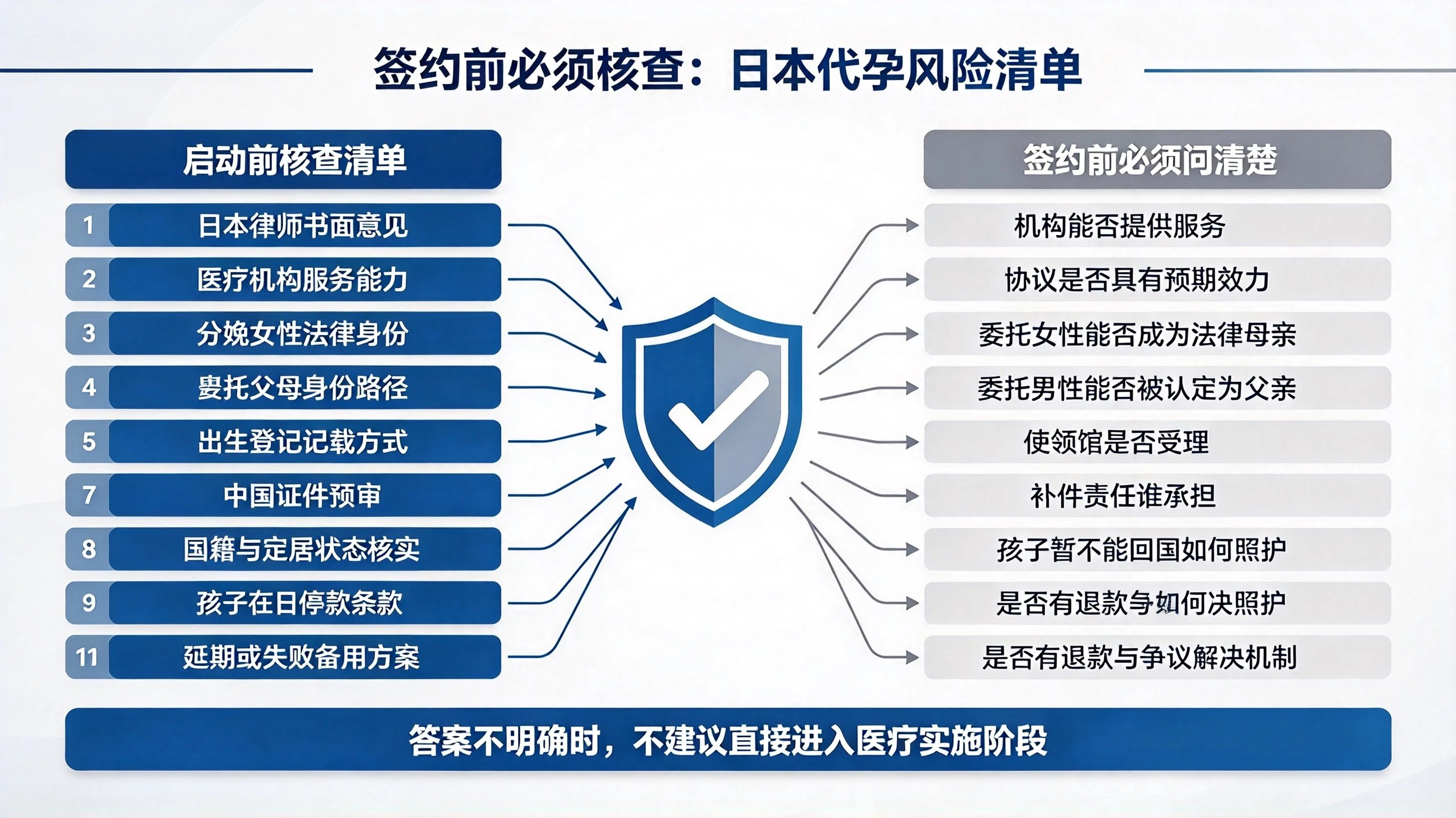
Before paying large fees or signing contracts, it is recommended to complete at least the following:
Obtain a written legal opinion from a Japanese practicing lawyer on the proposed arrangement.
Verify whether the medical institution is legally authorized to provide the relevant services.
Clarify the legal status and rights of women in childbirth under Japanese law.
Clearly specify whether the parents need to separately complete procedures for establishing parent-child relationships or adoption.
Evaluate the recording methods and filing parties for Japanese birth registration documents.
Consult the Chinese embassies and consulates in Japan regarding issues concerning your child's nationality and travel documents.
Verify whether the Chinese-national parents are settled abroad and whether the child had foreign nationality at birth.
Clarify the legal residency and care arrangements for the child after birth in Japan.
Review the clauses on fees, refunds, medical risks, and dispute resolution in the contract.
Develop contingency care and legal plans in the event of failure or delay in obtaining identification documents.
If there are still no clear answers regarding legal status, nationality, or documents for returning to your home country, it is not advisable to proceed based solely on verbal promises from the service provider.
XII. Conclusion: The key to surrogacy in Japan is not the medical process, but whether legal parentage can be established.
When evaluating surrogacy in Japan, one must look beyond medical technology, costs, and geographical distance. For cross-border families, it is more critical to confirm before initiating the process: whether the medical procedures are feasible; how the legal identities of the birth mother and intended parents are determined; how birth registration is handled; and whether the child can obtain valid travel documents and legally return home.
Article 9 of Japan’s Special Law on Nationality, the 2007 Supreme Court precedent, and Article 5 of China’s Nationality Law all illustrate a core issue: genetic relationships, birth registration, and legal parent-child relationships are not the same thing.
In particular, for post-birth documentation procedures, the checklist of travel document materials applicable to children born abroad in ordinary circumstances cannot be directly applied to surrogacy cases.
Surrogacy in Japan should be framed as a cross-border legal and medical issue requiring highly cautious evaluation, rather than a fertility service that can be executed according to fixed packages.Completing the legal review under Japanese law and pre-screening for Chinese nationality and consular documents before medical implementation is far more prudent than addressing identity disputes after the child’s birth.
Supreme Court of Japan: March 23, 2007 Ruling on Parent-Child Relationships in Surrogacy
Ministry of Justice, Japan: Regulations on the Registration of Birth
National Immigration Administration of China: Nationality Law of the People's Republic of China
Embassy of the People's Republic of China in Japan: Consular Document Services
Frequently Asked Questions
The content on this website is general educational material and compiled public information about IVF. It is provided for reference only, does not constitute a basis for diagnosis or medical decision-making, and does not constitute any medical advice or treatment recommendation. For policy and technical requirements, please refer to official publications issued by the relevant authorities and institutions. If you find any content errors, numerical inconsistencies, or outdated information, please contact us so we can verify and update it.