
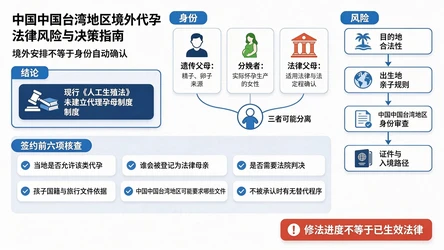
Is surrogacy currently permitted in Taiwan? This article examines the status of Taiwan's Assisted Reproduction Act as of 2026 and its legislative amendment progress, analyzing the legal boundaries of overseas surrogacy, the distinction between genetic parents and legal parents, the validity of foreign court judgments, and cross-border legal risks, to help Taiwanese families assess the feasibility of pursuing surrogacy abroad.
Read allI. First, it is essential to clarify a core issue: Taiwan has not established a surrogacy system that can be directly implemented.
If you are a family in Taiwan considering throughSurrogacy AbroadTo achieve reproduction, one must first distinguish between two issues:
Is surrogacy legal in the place of implementation? This involves whether local laws permit surrogacy, what forms are allowed, the eligibility criteria for intended parents, the validity of contracts, licensing requirements for medical institutions, and rules regarding birth registration.
After the child's birth, does Taiwan recognize the legal status of the commissioning parents? This involves issues including the applicable law for parent-child relationships, the validity of foreign court judgments, Taiwan's nationality determinations, passport applications, and subsequent household registration procedures.
These two issues are interrelated but cannot substitute for one another. The fact that overseas agencies can arrange surrogacy does not mean that Taiwan necessarily recognizes their contracts; similarly, the existence of a genetic relationship between the child and the intended parents does not mean that Taiwan will automatically register the intended parents as the legal parents.
As of November 5, 2026, Taiwan's current "Assisted Reproductive Technology ActTaiwan has not established a surrogacy system. An official Q&A updated by the National Health Administration on February 25, 2026, explicitly states that under current laws, "recipient couples" are defined as those in which the wife can carry and deliver the fetus using her own uterus; therefore, surrogacy arrangements cannot currently be processed under the existing legal framework.
This means that when Taiwanese families discuss surrogacy abroad, they must not only compare medical costs, surrogate availability, or service providers, but also incorporate the child's post-birth legal status and documentation pathways into their decision-making process in advance.
II. Taiwan’s Current Artificial Reproduction Act and the Legal Boundaries of Surrogacy
1. How do current laws stipulate?
Article 2, Paragraph 3 of Taiwan’s Artificial Reproduction Act defines “recipient couple” as the husband and wife who receive artificial reproduction services, with the wife being capable of carrying and giving birth to a fetus in her own uterus.
This definition constitutes an important boundary of the current legal framework: existing law does not establish a surrogacy system involving third-party gestation and childbirth, nor does it provide comprehensive specialized rules governing the legal relationships between intended parents and surrogate mothers.
Therefore, special attention should be paid to the following distinctions:
Assisted reproduction: The use of reproductive medical technologies to help recipients conceive.
Egg donationOr sperm donation: Involves rules regarding the donation and use of reproductive cells.
Surrogacy: A third party carries the pregnancy and gives birth, involving legal relationships among the surrogate mother, the intended parents, and the child.
The fact that Taiwan’s laws permit certain assisted reproductive technologies should not be used to infer that surrogacy falls within the scope of services allowed under the current system.
2. The progress of legal amendments in 2025–2026 does not equate to the legalization of surrogacy
The Executive Yuan approved the draft amendment to the Artificial Reproduction Act on December 11, 2025. Key directions of the draft include expanding the scope of eligible recipients for artificial reproduction, strengthening assessments of the best interests of children born through such procedures, safeguarding children’s right to know their genetic lineage, and improving the management of the donation and use of reproductive cells.
However, the primary legislative direction of this draft by the Executive Yuan is not to establish a surrogacy system.
On July 16, 2026, the relevant committees of the Legislative Yuan continued to review amendments to the Artificial Reproduction Act. Public meeting records indicate that the day’s deliberations covered draft amendments proposed by the Executive Yuan and multiple legislators. The review and handling of provisions concerning surrogate mothers should not be conflated with the issue of expanding the scope of eligible recipients for assisted reproductive technologies.
As of the date this text was verified, the following cautious wording should be adopted:
Taiwan's current Artificial Reproduction Act has yet to establish a surrogacy system.
The draft amendment proposed by the Executive Yuan cannot be regarded as law that has already taken effect.
Expanding the scope of assisted reproductive technologies does not mean legalizing surrogacy.
The adjustments to provisions during the Legislative Yuan's review process cannot be directly equated with the formal passage and implementation of a law.
Practical judgment: If a service provider uses claims such as “Taiwan is about to legalize surrogacy,” “the amendment has been passed,” or “Taiwanese law already recognizes overseas surrogacy” to facilitate contract signing, they should be required to provide the specific legal provisions, records of passage by the Legislative Yuan, and the effective date. News headlines, meeting discussions, or institutional promotional materials alone cannot serve as a legal basis.
III. The Three Most Easily Confused Identities in Overseas Surrogacy
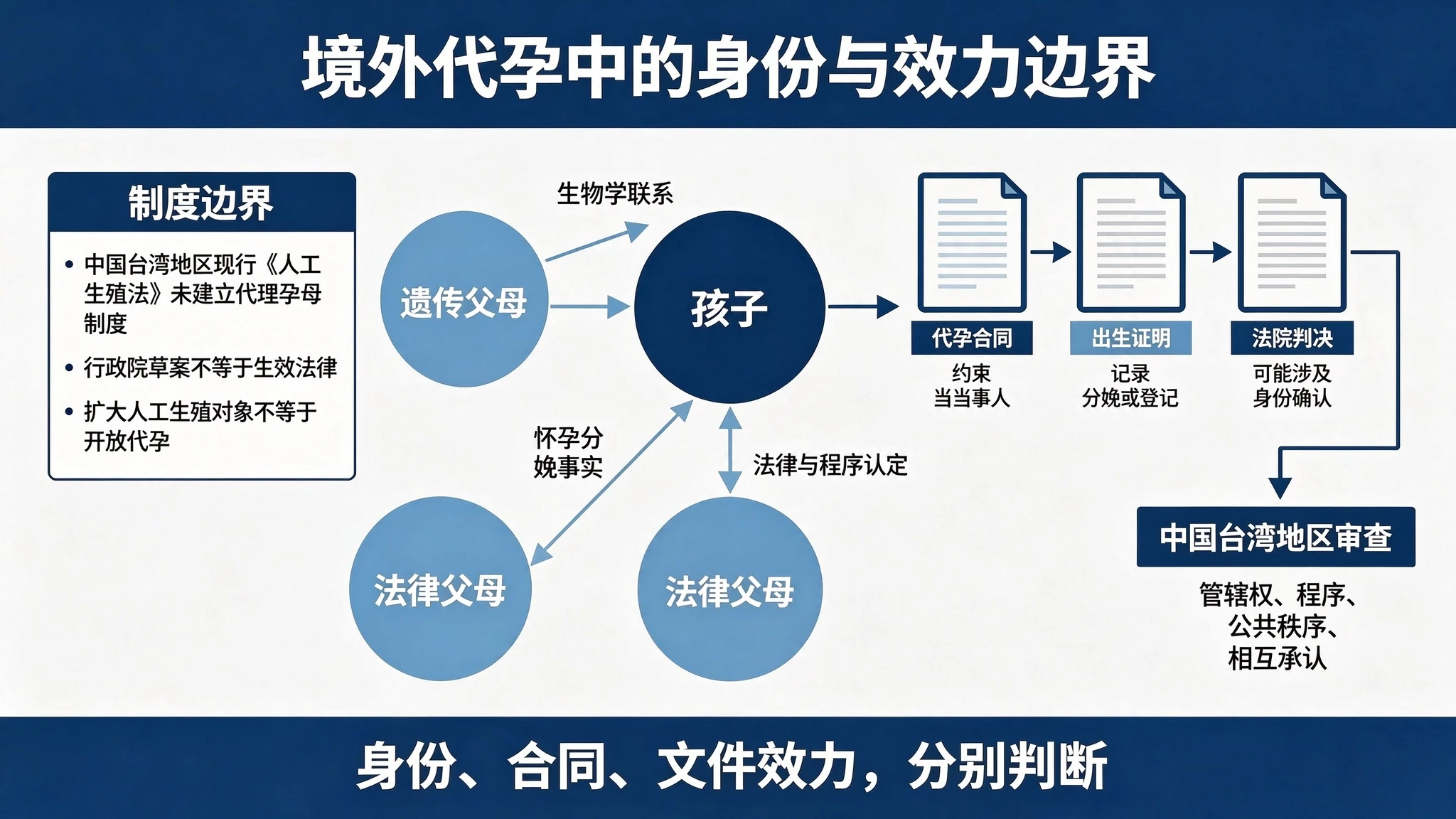
In cases of surrogacy abroad, there are at least three identities that must be determined separately:
Identity | Main basis | Conclusions that cannot be directly derived |
|---|---|---|
Genetic parents | Genetic Origin of Sperm and Egg Cells | Having a DNA relationship does not automatically confer legal parenthood. |
Parturient | Women who actually become pregnant and give birth | Taiwan's domestic rules cannot be directly applied to all extraterritorial cases without analysis |
Legal parents | Applicable law, rules on parentage, and valid judicial or administrative proceedings | Foreign birth certificates or surrogacy contracts do not necessarily have full legal effect in Taiwan. |
These three identities may overlap or remain distinct.
For example, a couple may commission the father to provide sperm and the mother to provide eggs, with an overseas surrogate carrying the pregnancy and giving birth. Although the genetic relationship may point to the intended parents, the law of the child’s place of birth may first recognize the surrogate as the legal mother based on the fact of delivery. Whether Taiwan recognizes parent-child relationships established abroad requires further analysis of the applicable foreign-related laws and the validity of relevant documents.
Therefore, DNA testing, birth certificates, surrogacy contracts, and foreign court judgments each address different issues and cannot substitute for one another.
IV. How does Taiwan view parent-child relationships established through cross-border surrogacy?
1. The 2012 Interpretation by the Taiwan Ministry of Justice: It should neither be ignored nor excessively applied
The Ministry of Justice of Taiwan has issued a legal interpretation regarding cases in which Taiwanese couples provide sperm and eggs, with Thai women acting as surrogates for childbirth.
This legal interpretation discusses the parent-child relationship under Taiwan’s Civil Code, relevant provisions of the Artificial Reproduction Act, and issues concerning the application of laws in foreign-related civil matters. Its core significance lies in the fact that, for specific surrogacy cases occurring outside Taiwan, parental relationships cannot be determined solely by applying Taiwan’s domestic artificial reproduction rules; instead, they must also take into account the conflict-of-laws rules applicable to foreign-related civil matters and the laws of the jurisdiction where the case is located.
However, this administrative interpretation pertains specifically to a particular surrogacy case in Thailand and should not be broadly construed to mean that “the same conclusion applies to all overseas surrogacy cases,” nor can it be used to assert that Taiwan automatically recognizes all foreign surrogacy contracts or birth registrations.
Actual cases should be verified:
The place where surrogacy is performed and the child’s birthplace;
How local laws determine the mother and father at the time of a child's birth;
Whether there is a genetic relationship between the commissioned parents and the child;
Whether there are any court judgments or administrative determinations of parent-child relationships made by local authorities;
Whether the judgment or document has taken effect;
Whether the document has undergone the necessary verification, certification, or translation;
Whether Taiwan's relevant authorities may review its validity in accordance with Taiwan's laws and public order.
Important Reminder: Do not directly apply the “birth mother” rule within Taiwan to all overseas surrogacy cases. Overseas cases may also involve the laws of the country of birth, the nationality laws of the parties involved, and the rules governing the application of law in foreign-related civil matters.
2. A foreign court judgment is not automatically valid in Taiwan
Some surrogacy destinations allow the intended parents to establish their parental relationship with the child through court proceedings, such as obtaining a parentage order before or after the child’s birth.
However, a judgment rendered by a foreign court cannot be deemed automatically valid in Taiwan solely on the basis that court documents have been obtained.
Article 402 of Taiwan’s Code of Civil Procedure provides that a final judgment rendered by a foreign court shall not be recognized in certain circumstances, including:
The foreign court does not have jurisdiction under the laws of Taiwan;
The defendant who lost the case failed to appear in court, and the service of process does not qualify for any relevant exceptions.
The content of the judgment or the legal proceedings violate Taiwan's public order and good morals;
There is no mutual recognition of the legal effect of judgments with Taiwan.
Therefore, whether a foreign judgment can take effect in Taiwan must be determined by considering factors such as the content of the judgment, procedural aspects, jurisdiction, party participation, and public order; it cannot be concluded solely based on the name of the judgment or notarized documents.
3. The Role and Limitations of Birth Certificates
A birth certificate is typically an essential document for local birth registration, passports, or travel documents; however, its legal function depends on the system of the issuing jurisdiction and the content of the document.
Need to distinguish:
Does a birth certificate merely record the fact of delivery?
Does the birth certificate also record the legal parents?
What is the basis for the recorded parental identities?
Whether there is a court judgment or other statutory document serving as the basis for registration;
Whether the authorities in Taiwan accept this document as evidence for establishing parent-child relationships.
If the birth certificate directly registers the intended parents as the parents, it is still necessary to further verify whether such registration was made in accordance with local laws and whether Taiwan recognizes its legal validity.
Do not directly equate "having a name on the birth certificate" with "the household registration authorities in Taiwan will definitely accept that parent-child relationship."
5. What should Taiwanese families review first when choosing an overseas surrogacy destination?
Don’t start by asking which agencies have surrogate mothers or how much their packages cost. A more reasonable approach is to first vet the legal pathways, then evaluate the medical services.
Tier 1: Does the destination allow this type of surrogacy?
To be verified:
Whether local regulations permit commercial surrogacy or only altruistic surrogacy;
Whether foreigners are allowed to participate;
Whether restrictions are imposed on the marital status, gender, nationality, or place of residence of the entrusted parents;
Is it required that the intended parents have a genetic relationship with the child?
Whether egg donation, sperm donation, and surrogacy are permitted to be carried out simultaneously;
Whether local laws allow intended parents to obtain a judgment of parentage before birth;
Whether surrogacy contracts are legally enforceable.
It is particularly important to note that a country’s permission for its own citizens to engage in surrogacy does not necessarily extend to foreigners; similarly, the allowance of altruistic surrogacy in a region does not imply that commercial surrogacy agencies may legally operate and charge fees.
Level 2: Do the medical institutions and service providers possess the corresponding qualifications?
At least verify:
Whether the medical institution has obtained a license from the local health authority;
Whether it possesses the license to carry out assisted reproductive technologies;
Embryology LaboratoryWhether it is handled by qualified professionals;
Is there a clear screening process for egg donors, sperm donors, and surrogates?
Which hospital is responsible for prenatal care, delivery, and neonatal treatment during pregnancy?
Is there a clear management system for medical records, embryos, and reproductive cells?
Beware of cases where company registrations, business licenses, park residency certificates, or medical service cooperation agreements are misrepresented as "reproductive medicine licenses."
Third layer: Is there an enforceable legal pathway for parent-child relationships?
Before signing, local counsel should be asked to clearly answer:
Who will be registered as the legal mother after the child is born?
Can a commissioned father acquire legal paternity through genetic relationship or court proceedings?
Can a commissioned mother be directly recognized as the legal mother?
Is the surrogate mother required to cooperate by signing documents or participating in litigation?
Is it necessary to apply for a judgment before birth?
If the surrogate mother refuses to sign the documents, are there any other legal procedures available?
If the court does not support the request of the commissioned parents, how is the child's legal status handled?
These issues must be codified in local laws and specific procedures, rather than relying solely on verbal promises from intermediaries.
Fourth layer: Can the child obtain valid travel documents after birth?
The pathway for post-birth documentation must be divided into at least the following:
Local birth registration
Local legal documents on parent-child relationships;
Determination of a child's nationality;
Passport orTravel DocumentApplication;
Exit permit or related procedures for the place of birth;
Nationality, passport, and entry eligibility review on the Taiwan side;
Residence and household registration procedures upon meeting the eligibility criteria.
If an agency only describes obtaining a passport "within days after birth" but fails to clarify under which country's law the child acquires nationality, who is authorized to apply for the passport, and how Taiwan determines the parent-child relationship, it cannot be concluded that the pathway for returning to Taiwan has been established.
VI. Overseas Surrogacy Contracts Must Clearly Specify at Least Eight Categories of Matters
A surrogacy contract should not merely cover package pricing, pregnancy schedules, and payment milestones. It is recommended that an independent lawyer review each item clause by clause before signing the agreement:
Contractual Matters | Content that must be clearly defined |
|---|---|
Identity of the Parties | Legal Status of Intended Parents, Surrogates, Medical Institutions, and Intermediaries |
Fee Structure | Medical expenses, surrogate compensation, attorney fees, delivery costs, document fees, and additional charges |
Medical Decision | Who makes the medical decisions regarding embryo transfer, fetal reduction, cesarean section, and other procedures |
Rights of Pregnant Mothers | Medical autonomy, privacy rights, insurance, prenatal care, and management of complications |
Abnormal Pregnancy | Management of miscarriage, preterm birth, multiple pregnancies, fetal abnormalities, and maternal health risks |
Newborn Care | Neonatal Intensive Care, Medical Expenses, and Custodial Responsibilities |
Parent-child relationship | Birth Registration, Court Proceedings, Document Signing, and Cooperation Obligations |
Breach and Disputes | Refunds, Agency Withdrawal, Surrogate Replacement, Service Interruption, and Dispute Resolution Mechanisms |
Particular care must be taken to prevent contracts from shifting all uncertainties onto the intended parents. For example, agencies may only commit to “handling the baby’s return home,” without specifying who bears the costs of legal advice, litigation expenses, supplementary documentation fees, and living and care expenses during any delays.
The contract should also avoid using phrases such as "guaranteed success," "guaranteed parent-child relationship," and "guaranteed return to Taiwan," which are beyond the unilateral control of the service provider.
7. The Six Types of Risks That Taiwanese Families Should Most Guard Against When Engaging in Overseas Surrogacy
1. Local legality does not necessarily mean that Taiwan will recognize it.
This is the most critical cross-border legal risk. The fact that the destination country permits surrogacy only addresses whether it is lawful to carry out the procedure locally; it does not automatically determine how Taiwan recognizes the child's legal parents.
2. A DNA relationship does not equate to a complete legal parent-child relationship
Genetic testing can establish biological parentage but cannot, on its own, substitute for local birth registration, judicial determinations of paternity or maternity, or the identity verification procedures required under Taiwan's laws.
3. The birth certificate and the court judgment may have issues regarding their legal validity.
Birth certificates, judgments on parent-child relationships, lawyer’s statements, notarized documents, and administrative registration records differ in nature. It is essential to verify who issued each document, under which legal basis it was issued, and whether Taiwan may recognize it.
4. Unclear boundaries of responsibility between intermediaries and medical institutions
If the agency simultaneously handles medical coordination, surrogate management, legal documentation, and return-to-Taiwan certificate services, disputes may lead to mutual blame-shifting.
It is recommended to separately stipulate the responsibilities for medical services, legal representation, and intermediary services in the contract, and to ensure that intended parents establish verifiable direct relationships with medical institutions and lawyers.
5. The pregnant woman's medical autonomy is overlooked
The surrogate mother is not a "medical tool" in the contract. Pregnancy, childbirth, cesarean sections, fetal reduction, and other medical procedures involve the surrogate's personal bodily rights and should comply with local laws and medical ethics.
Any claim that intended parents can fully control the surrogate’s medical decisions through a contract should be viewed with extreme caution.
6. Post-birth documentation procedures may be more complex than expected
Even if birth registration has been completed locally, delays may occur due to disputes over parentage, court documents not yet having taken effect, unclear determination of nationality, requests for additional documentation from consular authorities, or incomplete exit documents.
Without confirming the specific country, place of birth, and family identity, a uniform commitment regarding "returning to Taiwan within a few days after birth" cannot be given.
8. Pre-Signing Decision Checklist: Clarify These Six Questions First
Before paying large fees, it is recommended to obtain at least the following written responses:
Is the jurisdiction where surrogacy is performed permitted to allow such intended parents to participate? What are the legal bases?
How do local laws determine the birth mother, genetic parents, and legal parents?
Is a court judgment required? Who applies, when do they apply, and what are the possible outcomes?
Under what laws does a child acquire nationality and travel documents after birth?
What parent-child relationship, nationality, and birth documents might the Taiwan authorities require?
If Taiwan does not recognize a particular extraterritorial document, are there alternative legal procedures? Who bears the costs and time?
If the service agency cannot provide an answer, or merely substitutes legal explanations with statements such as “We have handled many cases” or “Previous clients all returned to Taiwan smoothly,” you should postpone signing the contract.
IX. Conclusion: Cross-border surrogacy is not merely a single medical procedure, but rather a cross-border legal and family identity project
For Taiwanese families, the decision to pursue surrogacy abroad cannot be based solely on medical technology, surrogate resources, and program costs. The issues that truly need to be addressed in advance include whether surrogacy is legal in the host country, how parentage is established, whether Taiwan recognizes the relevant identities, and whether the child can obtain valid travel documents after birth.
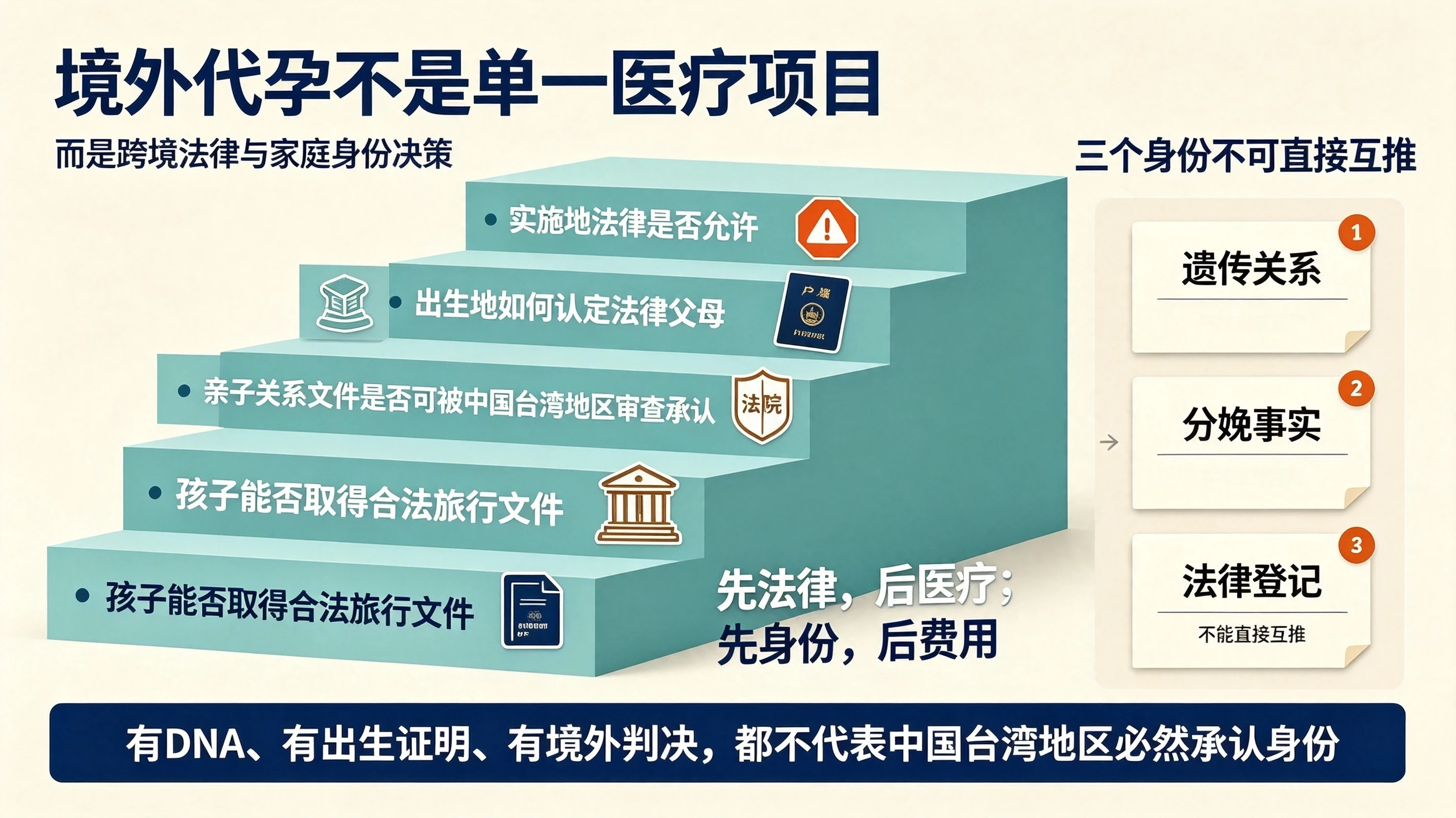
A more prudent order is:
First, confirm the applicable law of the place of implementation, then verify the parent-child relationship rules at the place of birth; next, design the legal identity pathway for the child, followed by an assessment of medical institutions and service contracts; finally, compare costs, timelines, and service experiences.
If the legal pathway is not yet clear, it is inadvisable to launch a project based solely on institutional commitments, even if the medical protocol appears mature.
Frequently Asked Questions
The content on this website is general educational material and compiled public information about IVF. It is provided for reference only, does not constitute a basis for diagnosis or medical decision-making, and does not constitute any medical advice or treatment recommendation. For policy and technical requirements, please refer to official publications issued by the relevant authorities and institutions. If you find any content errors, numerical inconsistencies, or outdated information, please contact us so we can verify and update it.