
Based on Ukraine's official legal texts and legislative materials, this provides a comprehensive explanation of medical indications for surrogacy, family eligibility requirements, birth registration rules, and citizenship determination, along with an analysis of the latest 2026 legislative developments and risk warnings regarding cross-border surrogacy.
Read all2026Surrogacy in UkraineLaw and Application Requirements: A Comprehensive Analysis of Medical Indications, Family Eligibility, Birth Registration, and Cross-Border Risks. Information Verification Date: October 30, 2026. Note: The Ukrainian legal provisions discussed in this article are compiled based on publicly available legislative materials and officially published consolidated texts. Due to network conditions, some Ukrainian official legislative source websites are currently unavailable for real-time verification of the original texts. All legal conclusions in this article are based on currently effective rules and publicly available legislative processes. Before making a formal decision, it is recommended to engage a locally practicing attorney in Ukraine to verify the latest effective legal texts and practical operational interpretations.
I. Introduction: What Is the Current Legal Environment for Surrogacy in Ukraine?
In the field of international assisted reproduction, Ukraine has long been one of the influential surrogacy destinations. Its main characteristics include a relatively clear legal basis for surrogacy, eligibility for qualifying foreign married heterosexual couples, and medical service costs that are competitive compared with some Western countries.
However, upon entering 2026, the legal environment governing surrogacy in Ukraine has seen new developments worth noting. On the one hand, the existing regulations—namely, Article 281 of the Civil Code of Ukraine, Article 123 of the Family Code of Ukraine, and Order No. 787 of 2013 of the Ministry of Health—continue to constitute the primary legal basis for surrogacy in Ukraine. On the other hand, on August 10, 2026, two bills, No. 15507 and No. 15506, were registered with the Verkhovna Rada of Ukraine, proposing to adjust the eligibility of participants in surrogacy arrangements, the review of medical institutions, and the legal liability for violations.
This means that surrogacy in Ukraine needs to be understood on two levels:
Current Legal Framework: Applicants who meet medical indications, family eligibility, genetic connection, and relevant procedural requirements still have lawful avenues to pursue surrogacy.
Future Policy LevelIf the relevant bill is passed and takes effect, the eligibility criteria for foreign intended parents, the screening obligations of medical institutions, and the manner in which programs are implemented may change significantly.
Therefore, to determine whether surrogacy in Ukraine is suitable for a particular family, one cannot focus solely on whether a contract can be signed at present; it is also necessary to consider whether the medical procedures can be successfully completed, whether the child can be legally registered after birth, and whether the child’s legal status can be recognized in the country where the intended parents reside.
Drawing primarily on Ukraine’s current legislation and official legislative materials, this article reviews the legal basis for surrogacy, medical eligibility criteria, qualifications of participants, birth registration, cross-border identity issues, and policy risks.
II. Major Legal Basis for Surrogacy in Ukraine
Ukraine does not have a standalone Surrogacy Act; instead, the surrogacy framework is collectively established through civil law, family law, health administrative regulations, and birth registration rules. The principal legal bases include the following four areas.
Article 281, paragraph 7 of the Civil Code of Ukraine
Article 281 of the Civil Code of Ukraine provides for the right to life and related rights of natural persons, and paragraph 7 explicitly states that an adult woman or man has the right to undergo assisted reproductive technology treatment where there are medical indications, in accordance with the procedure and conditions prescribed by law.
These provisions provide the fundamental legal basis for the development of assisted reproductive technology in Ukraine, and their main significance includes:
Assisted reproductive technology is a medical service implemented in accordance with the law;
Relevant treatment must be medically indicated;
Specific medical procedures and conditions for participation shall be further prescribed by relevant laws and regulations.
It should be noted that Article 281(7) is not, in itself, a complete regulatory framework governing surrogacy. The specific conditions for implementing surrogacy must also be assessed in conjunction with Article 123 of the Family Code of Ukraine and Order No. 787 of the Ministry of Health.
2. Article 123 of the Family Code of Ukraine
Article 123 is the core legal basis for determining the parentage of children born through surrogacy in Ukraine. Paragraph 2 provides that where a married couple creates an embryo through assisted reproductive technology and the embryo is implanted in and gestated by another woman, the married couple shall be the legal parents of the child.
This provision establishes the fundamental principles for determining parentage in gestational surrogacy, and its legal significance primarily includes:
Commissioning couples who comply with the regulations may be registered as the parents of the child in accordance with the law;
The surrogate mother assumes the responsibilities of pregnancy and childbirth;
A surrogate mother does not automatically acquire the status of legal mother under this regime solely by virtue of the act of giving birth.
It should be emphasized that this provision concerns the determination of legal parentage and should not be construed as meaning that intended parents automatically complete all legal registration formalities from the date of conception. Furthermore, Article 123, paragraph 2 is centered on the spousal relationship and cannot be directly interpreted as applying to any individual or any type of relationship.
3. Order No. 787 of the Ministry of Health of Ukraine (2013)
"Procedures for the Application of Assisted Reproductive Technologies in Ukraine," Ministry of Health Order No. 787 of 9 September 2013, is one of the most important administrative regulations governing the medical implementation of surrogacy. This document officially superseded Order No. 771 of 2008 in 2013.
As of 30 October 2026, this article is based on the current consolidated version of Order No. 787 as at 29 January 2025, which incorporates the relevant amendments made in 2014, in 2024, and at the end of 2024. Chapter VI of Order No. 787 specifically addresses surrogacy matters and mainly includes:
Article 6.1: Basic Conditions for the Practice of Surrogacy;
Article 6.2: Medical Indications for Surrogacy;
Article 6.3: Medical and psychiatric examinations of the surrogate mother;
Article 6.4: Eligibility Requirements for Surrogate Mothers;
Article 6.6: Surrogacy Medical Implementation Process;
Article 6.7: Notification of Medical Information After the Child's Hospital Discharge;
Article 6.8: Temporary residence information of foreign entrusted parents;
Article 6.9Surrogacy Birth Registration;
Article 6.10: Documents Required from the Surrogate Mother;
Article 6.11: Documents and Agreements to Be Provided by the Principal
This document is the direct basis for determining the medical conditions and specific operational requirements of surrogacy in Ukraine.
4. Order No. 52/5 of the Ministry of Justice of Ukraine
Order No. 52/5 of the Ministry of Justice of Ukraine dated October 18, 2000, titled "On the Approval of the Rules for State Registration of Civil Status Acts in Ukraine," sets forth the procedures for birth registration following the birth of a child. In particular, Part 3, Chapter 1, Item 11 thereof addresses the birth registration of children born through surrogacy.
The current consolidated version of the rule has incorporated new amendments as of July 22, 2026. According to the published amendment notes, Amendment Order No. 1908/5 dated July 15, 2026 mainly concerns the optimization of general administrative procedures for civil registration, and no direct amendment to the dedicated provisions on the registration of births arising from surrogacy has been disclosed; the core rules for surrogacy registration continue to be governed by the original special provisions under Order No. 52/5. Accordingly, the registration of births arising from surrogacy should still be cross-checked primarily against Item 11, Chapter 1, Part III of Order No. 52/5 and Article 6.9 of Ministry of Health Order No. 787.
Overall, the legal framework for surrogacy in Ukraine consists of four levels: the Civil Code provides the basic legal basis for assisted reproduction, the Family Code establishes parentage, Order No. 787 of the Ministry of Health sets out specific medical and participation requirements, and Order No. 52/5 of the Ministry of Justice regulates birth registration.
III. Which Women Meet the Medical Indications for Surrogacy in Ukraine?
Surrogacy in Ukraine is not carried out solely based on individual reproductive preferences. According to Section 6.2 of Order No. 787 of the Ministry of Health, surrogacy must meet prescribed medical indications, which mainly fall into the following five categories.
1. Absent uterus
Including:
Congenital absence of the uterus;
Underwent hysterectomy due to disease or surgery;
Absence of the uterus due to other causes.
Such women are unable to carry a pregnancy using their own uterus, so gestational surrogacy may be considered when other assisted reproduction requirements are met. Note that the absence of a uterus does not mean the absence of eggs. If the intended mother has normal ovarian function, her own eggs may still be retrieved and fertilized with her partner’s sperm to create embryos, meaning the child may still have a genetic connection to both intended parents.
2. Severe structural abnormalities of the uterus or cervix
This includes congenital developmental abnormalities, or severe alterations in the uterine cavity or cervical structure caused by factors such as surgery or benign tumors, to the extent that a normal pregnancy cannot be completed. The key consideration is not whether a particular gynecological disease is present, but whether the relevant anatomical changes have already rendered pregnancy impossible. This determination requires medical imaging, prior surgical records, and specialist examination.
3. There is severe and untreatable endometrial pathology.
Mainly includes:
Structural, morphological, or anatomical changes that cause loss of endometrial receptivity;
Severe intrauterine adhesions;
Relevant endometrial lesions that fail to return to normal function despite treatment.
Mild thin endometrium, a single failed embryo transfer, or general uterine cavity issues do not automatically constitute statutory medical indications.
4. Severe somatic disease poses a major risk to pregnancy.
Although some women have a normal uterus and reproductive system, severe physical illnesses may cause pregnancy to further endanger their lives or subsequent health. Order No. 787 requires that such illnesses make pregnancy pose a risk to the subsequent health or life of the person receiving treatment, while not affecting the future child's health.
To determine eligibility, a professional assessment is required based on the type of disease, its severity, medical history, and pregnancy risks. Not all women with chronic conditions, advanced maternal age, or poor physical health automatically qualify.
5. Repeated Assisted Reproductive Technology Treatment Failure
Article 6.2 of Order No. 787 provides that: where high-quality embryos are repeatedly obtained, four or more failures of assisted reproductive technology have occurred, and multiple embryo transfers have still failed to achieve pregnancy, this may constituteMedical indications for surrogacy.
Special attention is needed here:
Has been carried out 4 timesTest tube baby, does not automatically meet the conditions;
Simply obtaining four embryos does not mean the criteria are met;
Persistently poor embryo quality cannot be directly equated to a statutory medical indication.
It is necessary to consider both the acquisition of high-quality embryos and failure to achieve a successful pregnancy after actual embryo transfer. Medical eligibility determinations should be based on the complete medical record and the professional review findings of the medical institution, and should not be concluded solely on the basis of the applicant’s personal description.
IV. What are the requirements for intended parents in Ukrainian surrogacy?
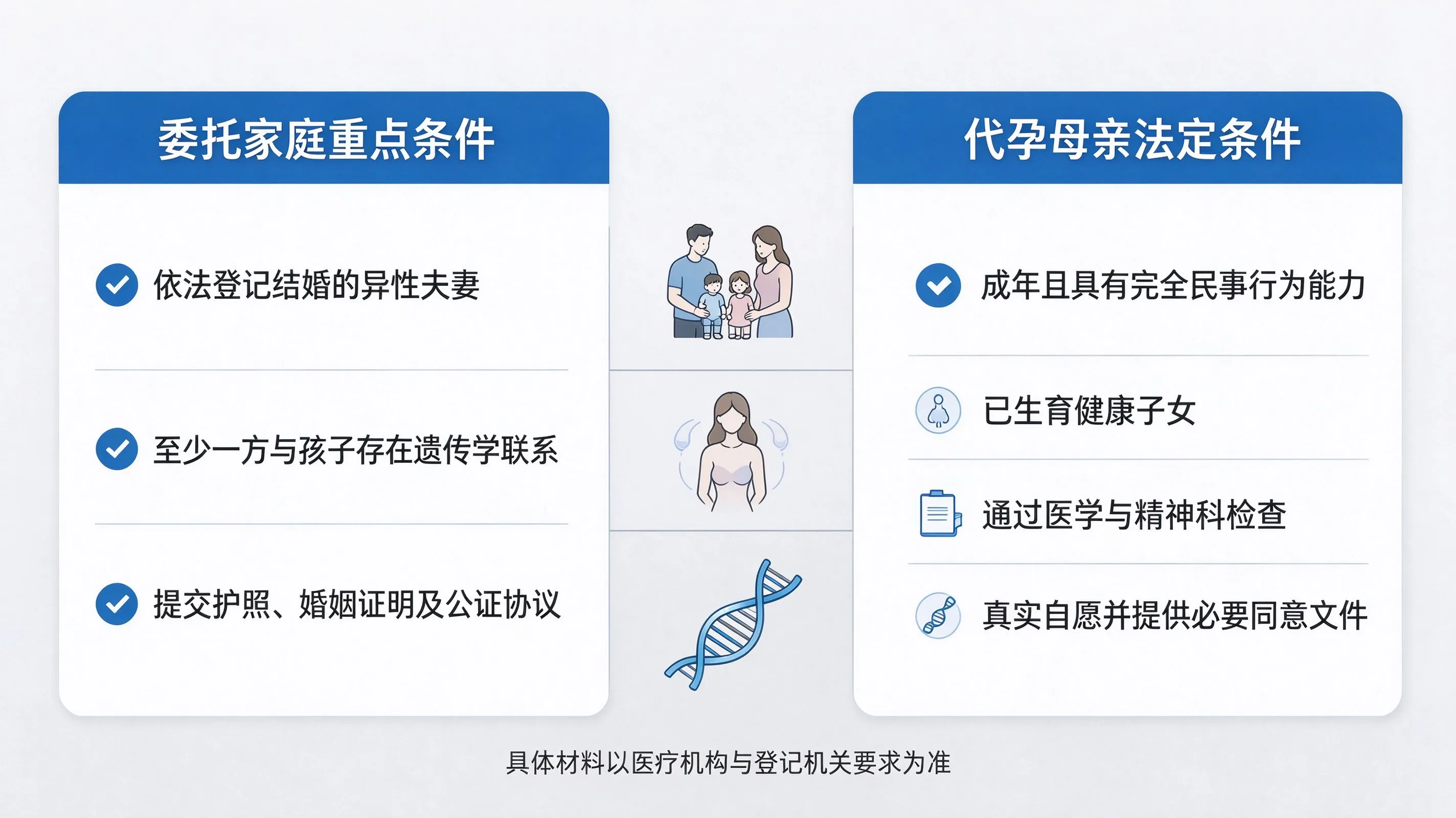
In addition to medical indications, the intended parents must also meet the requirements for marital status, genetic link, and documentation.
1. Requirements for the marital relationship
Article 21 of the Family Code of Ukraine provides that, under Ukrainian law, marriage is a family union between a man and a woman established by registration with the state civil registration authorities. Article 123(2) further bases the legal parenthood of a child in surrogacy arrangements on the spousal relationship. Paragraph 6.11 of Order No. 787 also requires the intended parents to submit a marriage certificate.
Therefore, under the current system, the clearest and most established pathway for standard surrogacy applications and birth registration is for opposite-sex couples in a legally registered marriage. Opposite-sex partners who are not legally married, single men, single women, and same-sex partners require particular caution.
It is necessary to point out a legal detail here: paragraph 6.1 of Resolution No. 787 uses the wording “one of the spouses or prospective parents,” and the documentary requirements for agreements under paragraph 6.11 also concern written agreements between the surrogate mother and a woman, a man, or a married couple. However, the standard route for registering the parent-child relationship prescribed by Article 123, paragraph 2, of the Family Code of Ukraine and paragraph 6.9 of Resolution No. 787 remains centered on a married couple.
Therefore, it cannot be concluded solely from certain wording in Article 6.1 that single individuals, unmarried partners, or same-sex partners can successfully complete all medical and birth registration procedures. The current U.S. Department of State surrogacy guidance for Ukraine also characterizes the currently permitted foreign intended parents as married heterosexual couples. For non-traditional family structures, the application procedures for married couples should not be applied directly; written legal advice on the specific circumstances of the intended parents’ status should be obtained from an independent local lawyer in Ukraine before any medical procedures are initiated.
2. At least one intended parent must have a genetic link to the child.
Under Article 6.1 of Order No. 787, the intended couple or a qualifying intended parent must have a genetic connection to the child. Common gamete combinations include:
The first type: Both spouses provide gametes. An embryo is formed using the intended mother's eggs and the husband's sperm.
The second type:使用捐赠卵子。使用捐赠卵子和丈夫的精子形成胚胎,此时孩子与意向父亲具有遗传学联系。
The third type: Using donor sperm. An embryo is formed using the wife's egg and donor sperm, at which point the child has a genetic connection to the intended mother.
It is important to note that using donor gametes involves not only medical treatment but also legal parentage registration and the child's legal status in other countries. Therefore, families using donated eggs or sperm should obtain a written legal opinion from a local lawyer in Ukraine regarding genetic certificates and birth registration before embryo creation and transfer.
3. The surrogate mother must not have a direct genetic connection with the child.
Ukraine practices gestational surrogacy. The surrogate mother is responsible for the pregnancy and childbirth, but she cannot directly make a claim.Egg donationChild forms the embryo. Article 6.1 of Order No. 787 also allows close relatives of the intended parents, such as a mother, sister, or cousin, to serve as the surrogate, but all medical and legal conditions must still be met.
V. What legal requirements must a surrogate mother meet?
Pursuant to Articles 6.3, 6.4, and 6.10 of Decree No. 787, a surrogate mother must meet the following main conditions.
an adult with full capacity for civil conductShe must be an adult female with full civil capacity. The law does not prescribe a uniform mandatory age range; however, reproductive medicine institutions in Ukraine typically apply a practical age range of 21 to 35 years, based on medical safety standards and clinical guidelines. The specific age requirements are determined by the medical criteria of the treating institution.
Already have their own healthy childrenThe surrogate mother must already have healthy children of her own, which is a basic eligibility criterion explicitly stipulated in Article 6.4.
Genuine and voluntary participation in surrogacy: A written voluntary application in the prescribed format must be submitted, without coercion, deception, or any other infringement of participants’ autonomous will.
Pass the required medical examinationsA surrogate mother should undergo medical examinations related to assisted reproduction to confirm that there are no medical contraindications affecting pregnancy safety.
Undergo a psychiatric evaluationAccording to Order No. 383 issued by the Ministry of Health on March 6, 2024, amending Order No. 787, surrogate mothers must undergo a psychiatric examination. Therefore, the eligibility assessment of surrogate mothers cannot be based solely on the results of a general physical examination.
A married surrogate mother is required to submit spousal consent documentation.Article 6.10 of Order No. 787 requires married surrogate mothers, in accordance with the regulations, to provide documentation of their husband’s consent to their participation in the surrogacy program. This requirement does not apply to single women.
Protection of the Rights and Interests of Surrogate Mothers: A surrogate mother is not merely an object that provides pregnancy services; rather, she is a woman with full personal rights and bodily autonomy. Relevant contracts and medical arrangements should fully take into account: medical care during pregnancy, medical expenses and reasonable compensation, handling of pregnancy complications, childbirth and postpartum recovery, privacy and personal information protection, psychological support, medical informed consent, and decision-making rights enjoyed in accordance with the law. Surrogacy contracts must not deprive surrogate mothers of bodily autonomy, nor can they replace medical informed consent.
VI. Medical Procedures and Contractual Arrangements for Surrogacy in Ukraine
Surrogacy in Ukraine typically involves stages such as medical pre-screening, document preparation, contract signing, embryo transfer, pregnancy management, and birth registration.
Phase 1: Medical and Legal Eligibility Pre-screening
Entrusting families typically need to prepare:
Both spouses' passports;
Marriage certificate;
Complete medical records of the intended mother;
Medical examination report;
Certificate of Medical Indication;
Genetics and Gamete Use Protocol
Documents required by other medical institutions.
Foreign documents must comply with applicable Ukrainian requirements regarding translation certification, apostille legalization, or other authentication. It is recommended that, at this stage, they be reviewed separately by legal professionals in Ukraine and by legal professionals in the country of the instructing party.
Phase 2: Signing a Surrogacy Contract
Section 6.11 of Order No. 787 requires the client to provide:
Application for Assisted Reproductive Technology;
Copy of the principal's passport;
Copy of Marriage Certificate;
Notarized copy of the written joint agreement signed by the surrogate mother and the relevant commissioning parties.
It is recommended that the agreement explicitly stipulate: the rights and obligations of the intended parents and the surrogate mother; medical expenses and surrogacy compensation; living support during pregnancy; allocation of costs for medical complications; embryo preservation and subsequent disposition; special medical circumstances such as multiple pregnancies; fetal abnormalities and special medical arrangements for newborns; delivery and postpartum care; breach of contract and dispute resolution; war, policy changes, and other force majeure events.
It should be emphasized that a surrogacy agreement is not a contract for the purchase of a child. The terms of the agreement should focus on assisted reproductive medical care, pregnancy services, reasonable compensation, and the rights and obligations of each party, and children must not be treated as tradable subject matter of the contract. At the same time, notarization does not mean that all contract terms are necessarily valid, nor does it guarantee that all disputes can be resolved in accordance with the contract. It is recommended that the intended parents and the surrogate mother each obtain independent legal advice.
Stage Three: Assisted Reproduction and Embryo Transfer
These typically include: ovarian stimulation and oocyte retrieval, obtaining sperm or lawful use of donated gametes, in vitro fertilization, embryo culture, preparation of embryos in accordance with the medical protocol, embryo transfer into the surrogate mother’s uterus, pregnancy monitoring and follow-up management. Medical institutions shall hold valid medical practice licenses, and the assisted reproductive procedures actually carried out by them shall comply with the relevant regulations of Ukraine.
Phase 4: Prenatal Management, Delivery, and Neonatal Care
Article 6.6 of Order No. 787 stipulates the medical implementation procedures for surrogacy, covering the selection of surrogate mothers, coordination of menstrual cycles, embryo preparation, embryo transfer, pregnancy diagnosis, prenatal monitoring, and delivery arrangements. The article also addresses the arrangements for the separate stays of the surrogate mother and the newborn after birth.
In addition, Article 6.7 stipulates that on the day a child born through surrogacy leaves the maternity facility, relevant information shall be provided by telephone to the pediatric outpatient clinic at the child’s place of residence. For foreign intended parents, Article 6.8 specifically requires that a temporary residence be provided for the child after birth, following completion of the relevant documentation and before departure from Ukraine, so that pediatric professionals can conduct follow-up and health observation. Therefore, foreign intended families must also take neonatal health management and medical follow-up into account when arranging temporary accommodation after the child’s birth.
7. Parent-Child Relationship after the Birth of a Child and Birth Registration
Registration after the child’s birth is one of the most important legal milestones in the entire surrogacy process in Ukraine. Pursuant to Article 123, Paragraph 2 of the Family Code of Ukraine, Paragraph 6.9 of Order No. 787, and Item 11 of Chapter I of Section III of Order No. 52/5 of the Ministry of Justice, eligible intended parents may apply to be registered as the parents of the child in accordance with the applicable regulations.
1. What documents are required for birth registration?
Mainly includes:
Identity documents and passports of the entrusting couple;
Marriage Certificate
Medical documents certifying the birth of the child;
Statement of consent by the surrogate mother to register the intended parents as the child's parents;
A notarized certificate of the authenticity of the signature;
A medical certificate proving the genetic link between the fetus and the commissioning mother or father;
Other relevant documents required by the registration authority.
It should be particularly noted that Ukrainian regulations require the submission of proof of genetic relationship, but this does not mean that all families must undergo a DNA paternity test uniformly after a child is born. Annex 18 of Order No. 787 stipulates that the proof of genetic relationship shall be issued by a medical institution, and the specific format of the document should be handled in accordance with the requirements of the medical institution and the registration authority.
2. Does the surrogate mother appear on the child's birth certificate?
A distinction must be made between the child's birth certificate and the full birth registration record. Pursuant to Section 6.9 of Order No. 787, in surrogacy arrangements that meet the prescribed requirements, the intended parents may, in accordance with the law, be registered as the child's parents. However, that section expressly provides that the following shall be recorded in the "Remarks" column of the birth registration record as prescribed:
Identity information of the woman who actually gave birth to the child, based on the medical birth certificate;
Name, date, and serial number of the institution issuing the certificate of genetic relationship;
Notary information, date of notarization, and registration number for the consent statement signed by the surrogate mother.
Therefore: the commissioning couple may be legally registered as the parents on the birth certificate, but the complete birth registration records are not entirely devoid of surrogacy-related information. The registration of the commissioning couple as the parents should not be construed to mean that no administrative records reflect the fact of surrogacy.
3. Does every case require a court judgment?
Standard cases that meet the requirements of Decree No. 787 and birth registration regulations may be handled through the administrative birth registration procedure; not every case requires first obtaining a court judgment. However, if the application materials contain deficiencies, or disputes arise concerning parent-child relationships, medical documents, genetic connections, or other identity issues, further administrative or judicial proceedings may be required.
VIII. Nationality and Cross-Border Repatriation Issues of Foreign Intending Families
Registering the intended parents as the legal parents in Ukraine in accordance with the law does not mean that the child automatically acquires legal status under the intended parents’ home country.Cross-border surrogacyThree issues need to be distinguished: first, whether Ukraine recognizes the intended parents as legal parents; second, whether the country of the intended parents acknowledges this parent-child relationship; and third, whether the child can obtain the corresponding nationality and passport.Travel DocumentItems. These three issues are interrelated but not interchangeable.
1. Does a child born in Ukraine automatically acquire Ukrainian citizenship?
Not automatic. According to Article 7 of the current Law on Citizenship of Ukraine:
If both parents or either of the parents possesses Ukrainian nationality at the time of the child's birth, the child shall acquire Ukrainian nationality in accordance with the law;
If both parents are foreigners but are permanent residents of Ukraine as prescribed by law at the time of the child's birth, and the child has not acquired the citizenship of any other country at the time of birth, the child may also acquire Ukrainian citizenship in accordance with the law.
This means that Ukraine does not purely apply a jus soli system under which nationality is automatically granted based solely on place of birth. For families in which both parents are foreigners and do not satisfy the relevant permanent residence requirements, the mere fact that a child is born in Ukraine does not create a presumption that the child acquires Ukrainian nationality.
2. Does the client's country recognize Ukrainian birth registrations?
Different countries haveSurrogacy AbroadThe recognition of parent-child relationships for children varies across jurisdictions. Some countries may accept certain forms of foreign birth registrations, while others may require additional court orders, genetic evidence, or other legal procedures. Therefore, intended parents should not equate a Ukrainian birth registration with the confirmation of parental status in their home country.
3. What should Chinese citizens pay special attention to?
Chinese families considering surrogacy in Ukraine need to understand both Ukrainian and Chinese laws.
First, Article 3 of China’s Administrative Measures on Human Assisted Reproductive Technology explicitly stipulates that medical institutions and medical practitioners shall not carry out any form of surrogacy. This provision regulates assisted reproductive medical activities conducted by medical institutions and medical practitioners within China. Article 22 sets out the corresponding administrative penalties, and where a crime is constituted, criminal liability shall be pursued in accordance with law.
A precise distinction is necessary: this provision should not simply be broadly interpreted to mean that all Chinese citizens who participate in surrogacy abroad automatically commit the same unlawful or criminal act. The specific legal consequences must be assessed in light of the actors, the place of conduct, and the concrete facts. However, it should be specially noted that if the surrogacy process involves the paid sale or purchase of gametes or embryos, or involves domestic intermediary organizations soliciting cross-border surrogacy business, it may trigger relevant criminal legal risks under Chinese law. It is advisable to verify the issue in advance with a professional lawyer in China.
Secondly, Article 5 of the Nationality Law of the People's Republic of China provides that where both parents or either of them are Chinese citizens and the person is born outside China, the person shall, in principle, have Chinese nationality; however, where both parents or either of them are Chinese citizens settled outside China and the child acquires foreign nationality at birth, the exceptions provided by law shall apply.
However, the Nationality Law does not establish a separate, comprehensive and unified procedure for determining parentage in relation to children born abroad through surrogacy. In practice, when Chinese embassies and consulates abroad issue travel documents to such children, they usually require a parentage DNA test report issued by a qualified institution to verify the genetic parent–child relationship, and a Ukrainian birth certificate alone may not be sufficient for direct processing.
Therefore, Chinese families also need to confirm in advance:
How to determine a child's legal parents under Chinese law;
Whether additional genetic identification is required;
How to submit the Ukrainian birth certificate and complete birth registration records;
Can a child apply forChinese Passportor travel documents;
How to handle issues of birth registration, household registration, and guardianship after returning to China.
It is particularly important to note that genetic relationships, birth registrations in Ukraine, and the legal recognition of parent-child relationships under Chinese law are not entirely identical legal concepts. Chinese families should confirm the specific documentation requirements with specialized family law attorneys and the competent Chinese embassies or consulates with jurisdiction before commencing medical procedures, rather than waiting until after the child's birth to resolve issues concerning legal status.
IX. Changes to Ukraine's Surrogacy Policy in 2026: Bills No. 15507 and No. 15506
On August 10, 2026, the Verkhovna Rada of Ukraine registered two bills related to assisted reproductive technology and surrogacy.
1. Bill No. 15507: Proposed to increase access restrictions for foreign entrusting parties
The title of Bill No. 15507 concerns protecting national interests and children's rights through assisted reproductive technology and surrogacy. The draft primarily addresses the following policy directions:
Add nationality conditionIt is proposed to link eligibility for surrogacy to the intended parents’ Ukrainian citizenship and to impose restrictions on access to surrogacy services for foreign nationals and stateless persons. The draft also addresses the exception where one spouse is a Ukrainian national.
Add a three-year residency requirement: The draft proposes to increase the required period of permanent residence in Ukraine for intended parents prior to signing the surrogacy agreement, involving a condition of at least three years of residence. It should be specifically noted that the specific applicability of the nationality exception in relation to the residence duration should be understood in conjunction with each individual article of the draft, rather than being oversimplified into the assumption that all conditions are automatically satisfied as long as one spouse holds Ukrainian citizenship.
Strengthen the review of medical institutionsIt is proposed to require relevant medical institutions to strengthen verification of the principals' nationality, identity documents, and eligibility requirements.
Establish a Unified National Registry SystemIt is proposed to establish a national registry and management mechanism for surrogacy agreements and related medical information.
Strengthen compliance reviews for birth registrationIt is proposed to add the proof of nationality and medical compliance documents required for the relevant birth registration.
The draft also addresses surrogacy contracts and the legal effect that the birth of a child does not automatically grant a foreigner an extension of stay or the right to obtain Ukrainian residency.
2. Bill No. 15506: Proposed Increase in Criminal Liability
Bill No. 15506 proposes to amend the Criminal Code of Ukraine to establish criminal liability for the organization and implementation of assisted reproductive technologies and surrogacy in violation of the applicable requirements. It is complementary to Bill No. 15507. Should both bills ultimately be enacted, the legal risks for certain medical institutions and relevant organizers could increase significantly.
It must be emphasized that the sentencing recommendations in the draft are not the penalties currently in force under the Criminal Law. The specific scope of application and penalties must be determined in accordance with the legal text as finally adopted.
3. Has the relevant bill entered into force as of October 30, 2026?
According to public information on the official legislative page of the Verkhovna Rada of Ukraine:
Bill No. 15507: Registered on August 10, 2026, and remains in committee;
Bill No. 15506: Filed on August 10, 2026; placed on the legislative agenda; still in committee.
As of the verification date of this article, neither of the two bills has completed the legislative process and therefore cannot be regarded as law in effect. Consequently, Ukraine cannot currently be described as having imposed a complete ban on foreign participation in surrogacy. However, the introduction of the two bills indicates significant uncertainty regarding future access policies.
4. What impact does it have on families at different project stages?
It is recommended to evaluate separately based on the progress of the procedure:
Project Phase | Core Assessment Questions |
|---|---|
--- | --- |
Consultation only, contract not yet signed. | Do the new nationality and residency requirements affect eligibility? |
Signed, but no embryo has been formed yet. | Choice of Law Issues in Contract Performance and Subsequent Medical Procedures |
The embryo has formed, but has not yet been transferred. | How New Rules May Affect Transplant Eligibility and Registration Criteria |
The transfer has been completed, and the patient is currently pregnant. | Are there explicit transitional protective provisions? |
The child has been born but has not yet been registered. | Are birth registration and document processing affected by the new regulations? |
The fact that payment has been made, a contract has been signed, or embryo transfer has been completed does not necessarily mean that the process will be immune from future policy changes. A determination should be based on the final legal text, transitional provisions, and the actual implementation requirements of the competent authorities.
X. Major Risks Requiring Special Assessment in Surrogacy in Ukraine
1. Risk of legislative changes
Bills No. 15507 and No. 15506 have not yet taken effect, but they already indicate a policy direction of tightening oversight of the existing surrogacy regime and restricting certain foreign intended-parent arrangements. Foreign intended-parent families, in particular, need to verify:
Whether there are new qualification requirements;
Whether the new law has been passed;
Whether any transitional arrangements exist;
Whether the performance of already signed contracts is affected;
How are projects already in gestation handled?
No institution should guarantee that the entire project will certainly be completed in the future solely on the basis that current laws are valid.
2. War and Healthcare Safety Risks
Ukraine has been continuously affected by armed conflict since February 2022. The war may affect: the operation of medical facilities, power supply and continuity of healthcare services, prenatal checkups and emergency medical referrals, international travel and entry arrangements, birth registration and related administrative services, intended parents traveling to Ukraine to receive their children, and the processing of the children’s nationality and travel documents.
According to the U.S. Department of State’s publicly available travel advisories, the travel advisory for Ukraine remains at the highest level, specifically reminding foreigners who are building families through assisted reproductive technology and surrogacy in Ukraine to prepare for unforeseen delays in birth registration and nationality documentation for their children. This risk cannot be shifted solely through contractual arrangements; it requires practical advance planning for medical care, accommodation, transportation, and emergency response.
3. Contractual and Performance Risks
While surrogacy agreements can clarify the obligations of all parties, they cannot entirely eliminate practical disputes. For example: complications arising during pregnancy, fetal abnormalities or premature birth, the need for additional medical intervention, intended parents being unable to travel to Ukraine in a timely manner, disagreements between the surrogate mother and the intended parents over medical decisions, and operational or service disruptions at medical institutions.
Therefore, the contract should clearly specify cost allocation, medical protection, dispute resolution, and force majeure handling mechanisms.
4. Risks Associated with Surrogacy Agencies and Intermediaries
When choosing a medical institution, it is recommended to focus on verifying:
Whether a valid medical practice license is held
Whether the conditions for conducting relevant assisted reproductive technologies are met;
Whether a complete medical record can be provided;
Whether the surrogate mother has completed the prescribed examinations;
Whether an independent legal review exists;
Whether the contracting parties are clearly defined;
Whether the service fees and additional charges are clearly specified;
Whether there are any offshore shell companies that are difficult to hold accountable.
It is not advisable to make a decision based solely on an intermediary's success stories, promotional materials, or basic package prices.
5. Cost Risk
The total project budget cannot be based solely on basic medical expenses. It must also account for: medical examinations, egg retrieval and embryo culture, embryo preservation and transfer, surrogate mother compensation, prenatal medical care and delivery, pregnancy-related complications, special medical care for newborns, lawyer fees, notarization and authentication, translation and document processing, international travel and accommodation, and the processing of the child’s nationality and travel documents after birth.
Order No. 787 does not establish a uniform surrogacy package price for all agencies; therefore, an individual agency's quote should not be interpreted as Ukraine's statutory fee schedule. Intended parents are advised to request a complete cost breakdown from agencies and to include in the contract clear terms for handling additional fees, refunds, and service interruptions.
XI. Family Decision-Making Self-Check Before the Official Launch
Before signing a contract, making payment, or beginning a medical procedure, it is recommended to complete the following checks.
First, medical qualification. Are the medical indications in compliance with Section 6.2 of Order No. 787? Have complete medical records and medical certificates been obtained?
Second, family legal eligibility. Do they meet the current spousal application and parentage registration pathways? Do marriage certificates require authentication and translation?
Third, genetic connection. Is at least one intended parent genetically related to the child? If donor gametes are used, has the parentage registration plan been confirmed?
Fourth, the qualifications of a surrogate mother. Does she already have her own healthy children? Has she undergone the required medical and psychiatric examinations? Is her participation genuinely voluntary?
Fifth, contracts and medical institutions. Are the medical institutions compliant? Has the contract been reviewed by independent counsel? How are pregnancy complications and special circumstances handled?
Sixth, policy changes. Are there any latest developments regarding Bills No. 15507 and No. 15506? Have any new legal provisions or transitional arrangements emerged?
Seventh, the child's status after birth. Can the child obtain the nationality of the intended parents' country? Can travel documents be obtained? If document processing is delayed, have arrangements been prepared for temporary accommodation and newborn care?
It is recommended to conduct renewed legal reviews at key milestones, including before contract execution, prior to embryo transfer, during pregnancy, and before birth registration.
12. Summary: What Kind of Families Are Suitable for Surrogacy in Ukraine?
In view of Ukraine's current laws and medical regulations, surrogacy is primarily available to intended families that have clear medical indications, meet genetic-link requirements, and satisfy local family-eligibility, medical-procedural, and birth-registration conditions.
Its core features include:
Ukraine established a surrogacy system through the Civil Code, the Family Code, Order No. 787 of the Ministry of Health, and birth registration rules.
Surrogacy must meet clear medical indications and not be based solely on personal preference.
Legally married heterosexual couples have the most clearly defined and well-established standard process for applications and parentage registration.
At least one commissioning parent must have a genetic link to the child.
A surrogate mother must be of legal age, possess full civil capacity, have her own healthy children, and pass the relevant examinations.
The commissioning couple must provide the prescribed proof of identity, proof of marriage, and a notarized written agreement.
Eligible commissioning couples may be registered as the child’s parents in accordance with the law, but birth registration records must still, in accordance with the rules, indicate the woman who actually gave birth and the relevant documentary information.
Foreign intended parents must resolve in advance the issues concerning recognition of the parent-child relationship, nationality, and travel documents for the child in the child's home country.
In 2026, two parliamentary bills proposed policy changes that could alter foreigners' eligibility to participate in surrogacy, but as of the date this article was verified, they have not yet taken effect.
The war environment, contract performance, continuity of medical care, and children’s rights are real risks that the entire project must fully consider.
A prudent decision-making approach to surrogacy in Ukraine should first confirm the medical indications, then verify the intended parents’ legal eligibility and genetic requirements, followed by confirmation of the child’s birth registration and cross-border legal status, and finally conduct a comprehensive assessment of policy, medical, financial, and safety risks. Surrogacy should not be simplistically understood as merely a medical service or a commercial project; rather, it should be viewed as a comprehensive reproductive decision involving women’s health, children’s rights, family relationships, and cross-border legal responsibilities. For intended parents from abroad in particular, the focus should not be solely on whether the process can be initiated at present; they must also consider whether the entire medical and legal process can be completed successfully in the future under factors such as changes in regulations, wartime conditions, and cross-border administrative reviews.
Article 281 of the Civil Code of Ukraine
Family Code of Ukraine, Articles 21 and 123
Amending Order No. 1908/5 of the Ministry of Justice of Ukraine dated 2026
Article 7 of the Law of Ukraine on Citizenship
Bill No. 15507 of the Verkhovna Rada of Ukraine and Accompanying Documents
Bill No. 15506 of the Parliament of Ukraine and Its Accompanying Documents
The National Immigration Administration, Nationality Law of the People's Republic of China
U.S. Department of State Ukraine Travel Advisory and Notices on Assisted Reproduction and Surrogacy
Frequently Asked Questions
The content on this website is general educational material and compiled public information about IVF. It is provided for reference only, does not constitute a basis for diagnosis or medical decision-making, and does not constitute any medical advice or treatment recommendation. For policy and technical requirements, please refer to official publications issued by the relevant authorities and institutions. If you find any content errors, numerical inconsistencies, or outdated information, please contact us so we can verify and update it.