Does Malaysia allow surrogacy? This article interprets Malaysia’s assisted reproductive policies, legal restrictions on surrogacy, birth registration procedures for babies, determination of parentage, and the process for obtaining Chinese passports or travel documents, helping cross-border families identify legal and documentation risks.
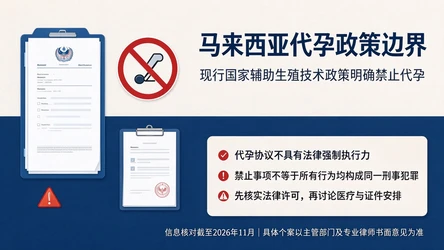
Read allImportant Notice: The current National Policy on Assisted Reproductive Technology issued by the Ministry of Health of Malaysia explicitly prohibits surrogacy, and surrogacy agreements are not legally enforceable. Therefore, this article is notSurrogacy in MalaysiaRather than a project operation guide, this resource helps families with relevant plans, those who have signed contracts, or those who have already welcomed a baby locally to understand policy boundaries, birth registration, parentage determination, and risks related to cross-border documents.
The information in this article is verified as of November 2026. For specific individual cases, the latest written responses from Malaysian competent authorities, Chinese embassies and consulates in Malaysia, and professional lawyers shall prevail.
1. First, let us clarify the conclusion: Malaysia is not a destination where surrogacy can be routinely practiced.
Many families, upon learningOverseas Assisted Reproductive TechnologyWhen doing so, they compare Malaysia with destinations such as Thailand and the United States, focusing on medical resources, costs, language environments, and transportation convenience. However, before making a decision, it is essential to first verify a more fundamental question: Is surrogacy legally permitted in that location?
According to the National Assisted Reproductive Technology (ART) Policy issued by the Malaysian Ministry of Health, surrogacy is explicitly prohibited in Malaysia due to its legal implications and concerns regarding child welfare and rights; even if a written agreement exists between the intended parents and the surrogate, such an agreement lacks legal enforceability. The Medically Assisted Reproduction document released by the Malaysian Medical Council in 2025 also reaffirms this prohibition by citing the national ART policy, clearly stating that surrogacy remains a prohibited practice.
This means:
Malaysia must not be promoted as a destination that permits conventional commercial surrogacy.
The mere fact that a surrogate is a relative, friend, or receives no compensation does not automatically render the arrangement legally permissible.
An intermediary contract, a medical service contract, or an entrustment agreement cannot be construed as documents that guarantee the principal's acquisition of legal parentage over the child.
One cannot deem the entire arrangement lawful and enforceable solely on the basis of an institution’s promise that birth certificates, passports, and repatriation procedures can be processed after birth.
The most important decision-making principle is: first confirm what the law permits, then discuss medical arrangements and document processing. If an institution packages surrogacy in Malaysia as a standardized service that can be normally contracted for, including embryo transfer, delivery, and handover of the baby, it should be required to provide clear official legal basis, rather than relying solely on promotional materials or past cases.
II. Assisted Reproductive Technology and Surrogacy in Malaysia Are Not the Same
Surrogacy andTest tube baby(IVF) frequently appear together in the introductions of assisted reproductive technology institutions, but they are not the same type of medical arrangement.
In vitro fertilization (IVF): Fertilization of the egg and sperm occurs outside the body, after which the embryo is transferred into the uterus of the person undergoing treatment.
Surrogacy: A practice in which another woman carries a pregnancy and gives birth, involving the legal relationships among the gestational carrier, the genetic parents, and the intended parents.
Gamete or embryo donation: Involves the sourcing of sperm, eggs, or embryos, and constitutes a distinct policy and ethical issue from surrogacy.
Malaysia’s national ART policy not only prohibits surrogacy but also imposes clear restrictions on gamete and embryo donation and commercial transactions. Therefore, the fact that a facility provides IVF services does not imply that it can legally offer surrogacy, egg donation, or embryo trading services.
Families with reproductive needs should verify the following issues separately:
Does the local jurisdiction permit the specific assisted reproductive technologies proposed to be used?
Does the medical institution have the appropriate qualifications, and do the doctors practice lawfully?
Are the sources and use of gametes and embryos compliant with local policies?
If third-party pregnancy is involved, is there a clear legal basis for permission?
Can the parent-child relationship, custody rights, and cross-border documents established after birth be legally confirmed?
The claim that "hospitals can perform IVF" cannot substitute forLegality of surrogacyreview.
III. Malaysia's Surrogacy Policy: Four Key Areas Requiring Verification
1. Surrogacy arrangements are themselves prohibited
Article 7.1.1 of the Malaysian Ministry of Health’s National ART Policy explicitly states that surrogacy is prohibited due to its legal implications and concerns regarding child welfare and rights, and that surrogacy agreements are not legally enforceable even if signed.
The practical impact of this regulation on the intended parents is that they cannot rely on the contract as a legally enforceable guarantee to compel the surrogate to fulfill her obligations, hand over the child, or assume specific responsibilities in the future.
2. Do not assume that "altruistic surrogacy" is inherently legal
Some advertisements emphasize kinship surrogacy, friend-based surrogacy, or altruistic surrogacy, attempting to convince families that as long as no payment is made, it falls outside the scope of policy restrictions.
However, the prohibitive provisions in existing national ART policies do not provide a general exemption that would automatically permit surrogacy arrangements involving relatives or altruistic surrogates. The legality of such arrangements cannot be inferred solely from the absence of commercial transactions.
3. Do not conflate surrogacy with gamete and embryo donation policies
Malaysia’s national ART policy also regulates the donation of sperm, eggs, and embryos, as well as their commercial trade. Families involved in the cross-border transport, transfer, or use of gametes and embryos should independently verify the relevant permits, healthcare facility requirements, and documentation procedures, and must not directly apply rules from other countries to Malaysia.
4. Policies prohibiting certain conduct should not be broadly interpreted to mean that all related acts constitute the same criminal offense.
Surrogacy is prohibited under national ART policies, and surrogacy agreements are not legally enforceable. However, whether specific actions entail other legal liabilities requires assessment based on the parties involved, medical procedures, financial arrangements, document contents, and actual circumstances.
Therefore, popular science articles should not be broadly written to state that "all participants will be sentenced" or that "all surrogacy activities constitute criminal offenses." If a family has already signed a contract, made payments, transferred embryos, or entered the pregnancy stage, they should promptly seek case-specific legal advice from a local lawyer in Malaysia.
4. If your baby has already been born in Malaysia, what procedures need to be handled after birth?
Here, two issues must be distinguished:
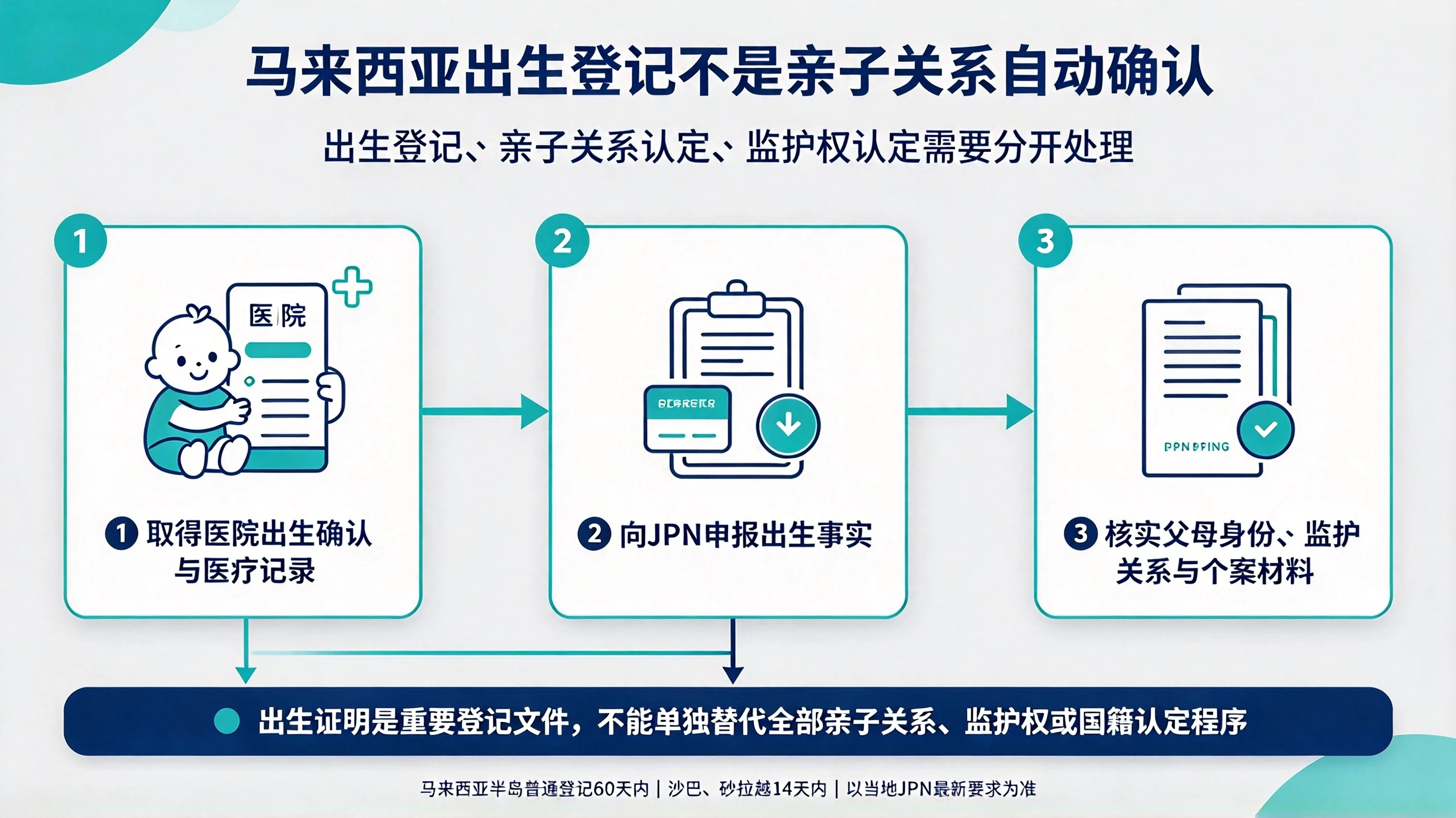
Birth Registration: Declare the fact of birth to the National Registration Department of Malaysia (JPN) and obtain the local birth registration document.
Parent-child relationship and custody determination: Establishing who is legally recognized as the child’s parent or legal guardian, and who has the authority to apply for a passport, process exit procedures, and handle other administrative matters on behalf of the child.
The two cannot be equated.
The ordinary birth registration regulations published by the Japan Patent Office (JPN) allow applications to be submitted by eligible parents, legal guardians, or persons aware of the fact of birth. However, this does not mean that any applicant may freely determine the information on legal parenthood recorded in the birth certificate, nor does it imply that the completion of birth registration automatically resolves disputes over parent-child relationships arising from surrogacy arrangements.
1. Obtain the hospital documents immediately after birth
After the baby is born, family members should inquire with the hospital and properly keep:
Birth confirmation document issued by the hospital;
Maternal hospitalization, delivery, and related medical records;
Passports, visas, or residence documents of both parents;
Marriage certificate (if applicable);
Other birth registration documents required by the hospital.
These materials may be used for Japanese birth registration, verification of parent-child relationships, consular document applications, and subsequent exit procedures.
Do not unilaterally alter, conceal, or fabricate information regarding the pregnant person, genetic parents, or actual caregivers. In cases involving third-party surrogacy, the procedures for submitting relevant materials and handling them by the registration authority must first be verified with JPN and specialized legal counsel.
2. Register the birth with JPN
Malaysia Birth RegistrationIt is handled by the National Registration Office JPN. The deadline for ordinary birth registration varies by region:
Place of Birth | Standard Deadline for Birth Registration | Processing Agency |
|---|---|---|
Peninsular Malaysia | Within 60 days after birth | JPN |
Sabah | Within 14 days after birth | JPN |
Sarawak | Within 14 days after birth | JPN |
The specific application materials, forms, and applicant requirements shall be based on the official JPN website corresponding to the place of birth.
Please note that the timeframes mentioned above are based on general birth registration rules and are not specific processing deadlines for surrogacy cases. If the registration information involves disputes over parentage, inconsistencies in documentation, or requires further verification, the actual processing time may be extended.
In the JPN Customer Service Commitment, ordinary birth registration takes 20 minutes to process when all required documents are complete. However, this service commitment applies only to standard applications with complete documentation and should not be interpreted as implying that birth registrations related to surrogacy can also be completed within 20 minutes.
3. A birth certificate does not mean that the dispute over parent-child relationship has been resolved
Families in particular need to pay attention:
A birth certificate is an important birth registration document, but it cannot solely replace all procedures for establishing parentage, custody, or nationality.
There is no prior guarantee that the intended parents will be registered as the parents on the birth certificate.
The commissioning party’s acquisition of full legal parental status cannot be inferred solely from genetic relationships, commissioning agreements, or payment records.
If the registered information is inconsistent with the actual pregnancy, genetic relationship, or intended parenting arrangement, a local attorney should assess whether further legal proceedings are necessary.
Do not mistake "being able to obtain a birth certificate" for "having already obtained legal custody of the child." This is alsoCross-border surrogacyOne of the most underestimated risks in the case.
5. After the baby is born, how do I apply for legitimate travel documents to return to China?
For families planning to visit China, whether the baby can obtainChinese PassportorTravel Document, it primarily depends on whether the individual holds Chinese nationality and whether the applicant has the status of a legal guardian as prescribed by law.
It cannot be assumed that a baby automatically holds Malaysian citizenship simply because the baby was born in Malaysia; nor can it be determined, without verification, that the baby necessarily holds Chinese citizenship merely because the genetic parents are Chinese citizens.
Step 1: Verify the baby's nationality
According to Article 5 of the Nationality Law of the People's Republic of China, a child born abroad to parents who are both Chinese citizens or one of whom is a Chinese citizen shall, in principle, have Chinese nationality. However, if the parents, or either of them, are Chinese citizens who have settled abroad and the child acquires foreign nationality at birth, the child shall not have Chinese nationality.
Therefore, determining nationality requires at least verifying the following:
Nationality of both parents
Whether the parents were settled abroad at the time of the child's birth;
Foreign residence permits or visas held by the parents at the time of the child's birth;
Whether the child has acquired a foreign nationality by virtue of the law of its place of birth or other applicable rules;
Whether birth certificates and other materials establishing parent-child relationships can support the application.
It is recommended to consult with Chinese embassies or consulates in Malaysia before the baby’s birth to avoid discovering insufficient documentation for nationality determination after the birth.
Step 2: Register the birth in Malaysia and obtain a birth certificate
After completing the birth registration, a formal birth certificate and the required copies should be obtained in accordance with JPN requirements.
If there are any doubts regarding the parental information on the birth certificate, the actual genetic relationship, or the applicant’s guardianship status, it is necessary to first determine whether additional documentation proving parent-child relationships, legal documents, or other certifications are required. Do not assume that the subsequent consular application will be automatically approved simply because the birth certificate has been issued.
Step 3: Apply for a Chinese passport or travel document via the "China Consular" APP
The guidelines for issuing ordinary passports published by the Chinese Embassy in Malaysia apply to Chinese citizens who were born in Malaysia, meet the criteria for recognition of Chinese nationality, and have never held a Chinese passport.
Applications are typically submitted via the "China Consular" APP. The materials published by the embassy include:
Valid passports of both parents;
Malaysian visas of both parents (if applicable);
Foreign residence permits or visas held by the parents at the time of the child's birth;
Parents' marriage certificate
The child's birth certificate or other documents proving the parent-child relationship;
Guardianship proof and application form required for applications by minors;
Additional documents required by the embassy on a case-by-case basis.
Documents not in Chinese or English must be accompanied by translations and relevant certified materials as required by the embassy. Applicants under 16 years of age must be accompanied by at least one legal guardian; in special circumstances, the embassy may require both parents to be present.
Please note that passports and travel documents are not interchangeable options that applicants may freely choose for returning to China; the appropriate document should be determined by the embassy or consulate based on the baby’s nationality and specific circumstances.
Step 4: Wait for review, interview, and certificate issuance
The embassy may request additional documentation, verify parent-child relationships, or conduct interviews. A successful submission through the app does not guarantee that the application has been approved.
According to the passport processing guidelines published by the embassy, after completing the pre-review and interview and receiving all required documents, it typically takes an additional 10 business days for passport issuance. This timeframe does not include birth registration, nationality verification, submission of additional documents, scheduling of interviews, or other administrative procedures.
Therefore, it should not be advertised that the return-to-China documents will be available within 10 working days after the baby’s birth.
Step 5: Confirm Malaysia’s exit procedures and airline requirements
After obtaining a Chinese passport or travel document, you also need to confirm whether the baby’s exit procedures in Malaysia have been completed.
The Malaysian Immigration Department previously issued guidelines for foreigners regarding newborns born in Malaysia who have not yet obtained a passport or valid permit. The procedures involve first registering the birth, applying for travel documents from the relevant embassy or consulate, arranging air tickets, and completing necessary formalities with the Immigration Department. As these guidelines are based on an older version, it is advisable to directly verify the latest requirements with the Malaysian Immigration Department before taking any action; the old FAQ should not be treated as the definitive checklist for current individual cases.
Before departure, you should also confirm with the airline the age restrictions for infants, document requirements, and health certificate requirements. Regulations may vary among different airlines.
6. How many times do the parents need to visit Malaysia in person, and how long is each stay?
For surrogacy arrangements in Malaysia, it is not possible to provide a legally standardized number of parental visits or required stay duration per visit, because Malaysian policy does not permit conventional surrogacy programs to operate through standard procedures.
If the family is already involved in birth registration or applying for a newborn’s identification documents, whether in-person attendance is required depends on the specific matter and the requirements of the relevant authority.
Services | Is it possible to require the person's physical presence? | Important Notes |
|---|---|---|
Hospital Birth Certificate | Subject to hospital requirements and actual circumstances | Confirm in advance the documents available for collection and the authorization method |
JPN Birth Registration | It depends on the applicant’s identity and the submitted materials. | Registration requirements vary by region. |
Verification of Parent-Child Relationship or Custody | It depends on the individual case | May require supplementary documents, interviews, or legal proceedings |
Application for a Chinese Passport or Travel Document | At least one legal guardian must accompany as required; in special circumstances, both may be required. | Subject to the review and processing procedures of the embassy. |
Malaysian Immigration Procedures | Depending on the newborn's identity and specific requirements | Verify with the immigration authorities before departure |
The requirements for minor passport applications published by the Chinese Embassy in Malaysia clearly state that applicants under 16 years of age must be accompanied by at least one legal guardian; in special circumstances, the embassy may require both parents to appear in person.
Therefore, families should not arrange flights and accommodation based solely on intermediaries’ promises such as “parents only need to be present once” or “the entire process can be handled on your behalf after the baby is born.” Instead, they should first confirm with the relevant authorities whether delegated processing is accepted, whether the legal guardian’s personal presence is required, and whether both parents must cooperate.
7. How long does it take from the baby's birth to legally returning home?
This part is most prone to time-related misunderstandings. Birth registration, nationality verification, passport or travel document applications, and Malaysian exit procedures are independent steps handled by different departments; the service commitment for any single step should not be mistaken for the total duration of the entire process.
The actual processing can be broken down into the following stages:
Stage | Main Items | Time Judgment |
|---|---|---|
1. After birth | The hospital issues birth confirmation and medical documents | Subject to the actual date of issuance by the hospital |
2. Birth Registration | Declare to the JPN corresponding to your place of birth | Standard Registration Period: Within 60 days for Peninsular Malaysia; within 14 days for Sabah and Sarawak |
3. Identity Verification | Verify the birth certificate, parent-child relationship, and legal guardian status | Case-by-case handling; no fixed number of days can be predetermined. |
4. Determination of Nationality | Submit materials to the Chinese Embassy and Consulates in Malaysia | Subject to the completeness of the materials and the individual case review |
5. Document Processing | Apply for a Chinese Passport or Travel Document | The issuance of a regular passport typically takes 10 working days after all required materials have been received and the preliminary review and interview are completed. Additional time is required for other procedural steps. |
6. Exit Procedures | Verify Malaysia immigration procedures and airline requirements | Subject to the latest requirements of the competent authorities and airlines. |
Here are three easily confused times:
First, the 20 minutes for JPN does not represent the processing time for all birth registration cases. This commitment applies to standard birth registration applications with complete documentation and does not imply that cases involving surrogacy, parentage verification, or special identity issues can also be completed within 20 minutes.
Second, the embassy’s 10 business days do not start from the baby’s date of birth. They refer to the processing time for issuing a regular passport after the preliminary review, interview, and receipt of all required documents are completed, and do not include prior nationality determination, requests for additional materials, or other reviews.
Third, do not promise that the baby will be able to return home within a fixed number of days after birth. If the information on the birth certificate needs verification, if materials proving parent-child relationships are incomplete, if additional evidence is required for nationality determination, or if immigration procedures need further approval, the overall timeline may be extended.
For babies who have already been born or are about to be born, families are advised to confirm the status of birth registration, document applications, and exit procedures before booking return flights, rather than relying solely on verbal date estimates from agents.
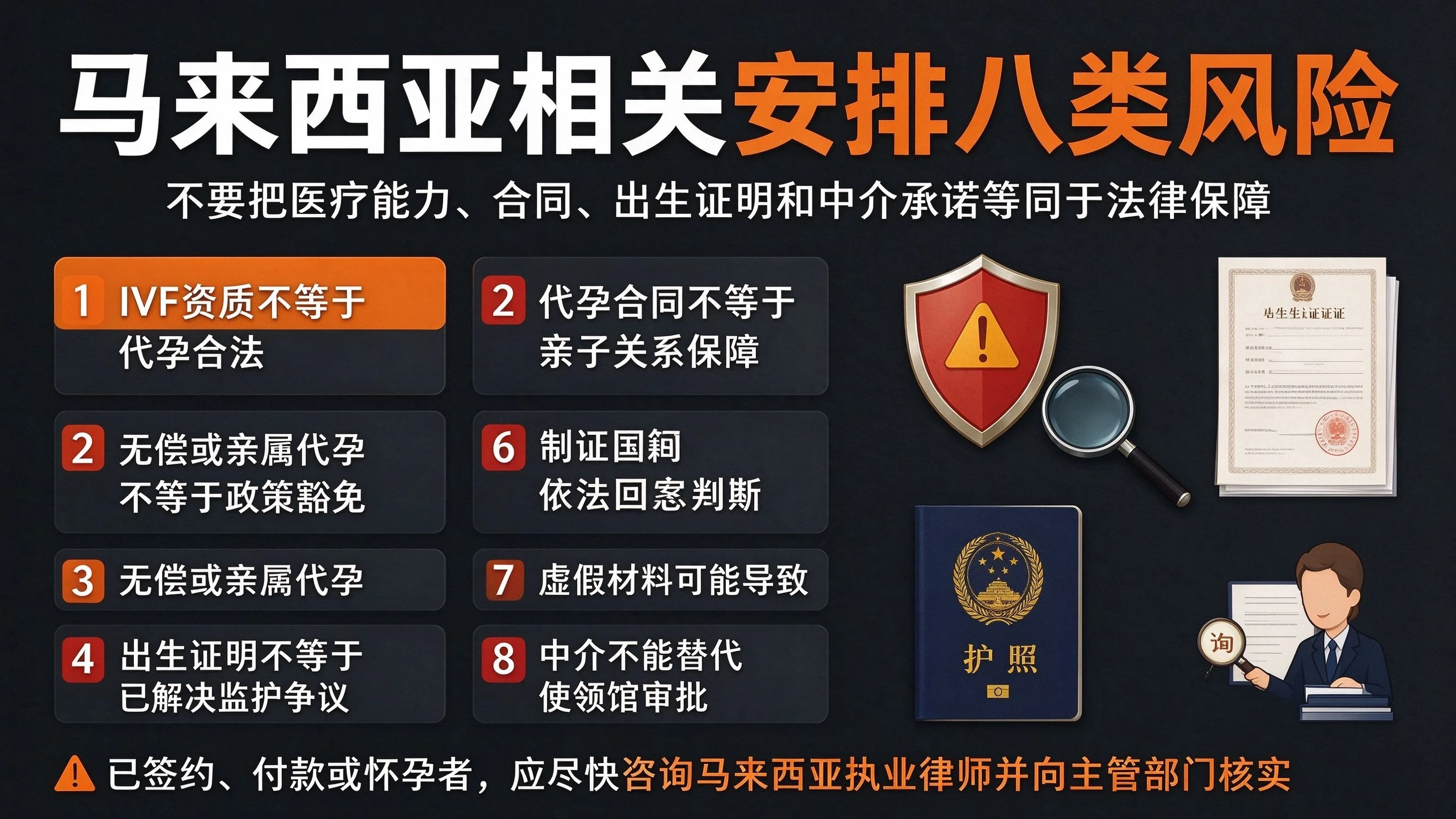
8. The Eight Types of Risks That Require the Most Vigilance in Surrogacy Arrangements in Malaysia
1. Mistaking medical service capabilities for the legality of surrogacy
The ability of a medical institution to perform IVF does not mean it can legally undertake surrogacy. Medical qualifications and the legality of surrogacy arrangements are two distinct issues.
2. Treating surrogacy contracts as a guarantee of parent-child relationships
Malaysia's national ART policy explicitly states that surrogacy agreements are not legally enforceable. A contract does not automatically guarantee the intended parents' legal parentage of the child.
3. Treat altruistic or kinship surrogacy as a policy exemption
The mere absence of payment for surrogacy services cannot be used to conclude that the arrangement is exempt from the ban on surrogacy. A written opinion should be obtained from local counsel, based on the specific facts of the case.
4. Mistakenly believing that a birth certificate can pre-designate the parents
Birth registration is an administrative procedure, while the determination of parent-child relationships and custody involves legal issues. Do not trust promises such as "the birth certificate will definitely list the names of the commissioning parties," which lack official basis.
5. Neglecting the conditions for determining Chinese nationality
The determination of Chinese nationality requires verification of the parents' nationalities, whether they are settled abroad, and whether the child acquired foreign nationality at birth. The possession of a Chinese passport by only one parent is not sufficient to draw a definitive conclusion in all cases.
6. Mistaking the passport issuance time for the total duration of the return-to-home process
Birth registration, verification of parent-child relationships, nationality review, passport or travel document applications, and emigration procedures each follow independent processes. A request for additional documents at any stage may affect subsequent arrangements.
7. Using false or inconsistent materials
The information in birth records, medical records, parentage documentation, marriage certificates, and application forms must be truthful and consistent. Do not heed advice suggesting that "birth certificate details can be adjusted" or that "there is no need to disclose the actual circumstances."
8. Reliance on intermediaries for passport or travel document applications
The Chinese Embassy in Malaysia reminds the public to apply for documents through official channels and to be wary of risks associated with using third-party agents. Agents cannot replace embassies or consulates in determining nationality or approving documents, and submitting false materials may result in application rejection and other legal consequences.
IX. What should be done if the contract has already been signed, payment has been made, or pregnancy has occurred?
For families already involved in relevant arrangements, the priority is to manage legal and documentation risks rather than proceeding according to the timelines provided by intermediaries.
It is recommended to process in the following order:
Step 1: Organize all authentic materials.
including contracts, payment records, medical documents, documentation on the source and transfer of embryos, pregnancy and delivery records, proof of parental identity, marriage certificates, and written commitments provided by intermediaries or medical institutions.
Step 2: Consult a Malaysian practicing lawyer as soon as possible.
Focus on inquiring about the nature of surrogacy arrangements under local policies and laws, the enforceability of agreements, the rights and obligations of all parties involved, birth registration procedures, and any potential legal risks. Do not rely solely on explanations provided by consultants recommended by intermediaries.
Step 3: Contact the place of birth, Japan (JPN), in advance.
If you are pregnant or about to give birth, verify with the JPN authorities in the place of birth the required documents for birth registration, eligibility of applicants, and procedures for handling special cases involving parent-child relationships. Do not make assumptions about the registration outcome.
Step 4: Consult the Chinese Embassy or Consulates-General in Malaysia in advance regarding nationality and document-related issues.
Please provide details on the parents' nationalities, residency status, the expected place of birth of the child, and available documentation proving biological parentage. Inquire whether to apply for a passport or a travel document, what supporting documents are required, and whether both parents must be present in person.
Step 5: Do not conceal facts or create false materials.
Whether for birth registration or consular document applications, it is essential to ensure that all declared information is truthful. For any uncertain documents, you should first consult the competent authorities on how to submit them, rather than altering or fabricating the information yourself.
X. How should one re-evaluate plans for assisted reproductive technology in Malaysia?
If the core need of the family is to solveInfertilityThe issue is not that third-party surrogacy must be used to achieve reproduction; medical treatment and the need for surrogacy can first be assessed separately.
Household Needs | Recommended to prioritize verification |
|---|---|
Hope for a natural pregnancy | Are local IVF, ICSI, and other treatments permitted, and are the medical institutions and physicians qualified and compliant with regulations? |
Requires the use of sperm or egg donation | Does the local jurisdiction permit this type of donation, and what are the applicable conditions and source requirements? |
Embryo donation is required | Is it permitted by local policies, or are there restrictions or prohibitions? |
Unable to conceive naturally due to medical reasons | Do not assume that Malaysia provides surrogacy services; verify the laws of the destination first. |
Already forming an embryo in other countries | Verify the qualifications of the embryo transfer, transportation, and receiving institutions, as well as the regulatory requirements in both locations. |
If a family genuinely requires third-party gestation, it should first select jurisdictions that explicitly permit such arrangements under law, and then conduct a detailed review of local legislation, medical regulations, parentage determination, birth registration, and nationality documentation policies. Decisions must not be based solely on comparisons of medical costs or agency packages.
XI. Common Misconceptions: Six Questions About Surrogacy in Malaysia
Misconception 1: Malaysia has good medical standards—does this mean surrogacy is allowed there?
No. The level of medical care is not directly equivalent to the legality of surrogacy, and Malaysia’s national ART policy explicitly prohibits surrogacy.
Misconception 2: Is surrogacy by a relative without compensation free from restrictions?
This cannot be determined as such. The existing policy cannot be interpreted to mean that relatives or altruistic surrogates are automatically exempted.
Misconception 3: Does a baby automatically acquire Malaysian citizenship simply by being born in Malaysia?
No. Being born in Malaysia does not automatically grant Malaysian citizenship; it must be verified in accordance with the Malaysian Constitution and relevant regulations, including conditions such as the parents’ status.
Myth 4: If the commissioning party's name is listed on the baby's birth certificate, does that mean there are no issues with parentage?
One cannot infer that all issues regarding parentage, custody, and cross-border documentation have been resolved based solely on a birth certificate; these matters must still be assessed in light of specific legal requirements and consular regulations.
Misconception 5: If one parent is a Chinese citizen, can the baby definitely apply for a Chinese passport?
Not necessarily. It is also necessary to verify whether the parents are settled abroad, whether the baby acquired foreign nationality at birth, and other conditions under nationality law.
Myth 6: If the agent promises to handle everything, can you avoid going to Malaysia?
Arrangements should not be made solely based on promises from intermediaries. Japanese authorities, embassies and consulates, and immigration departments may require the legal guardian to appear in person or submit additional documents; compliance with the requirements of the competent authorities shall prevail.
XII. Summary: First confirm legality, then discuss childbirth and document arrangements
Malaysia’s medical resources and geographical convenience do not alter the explicit restrictions imposed by its national ART policy on surrogacy. For families with such needs, the most critical step is not to seek a seemingly time- and effort-saving “surrogacy package,” but rather to first verify whether the proposed arrangements are permitted locally and whether the child’s legal status after birth can be clearly and lawfully established.
For babies already born in Malaysia, birth registration, determination of parent-child relationship, review for Chinese nationality, application for a passport or travel document, and Malaysian exit procedures are interlinked but not interchangeable steps. Any identity dispute or inconsistency in documentation at any stage may affect the final timeline for returning to China.
Please bear in mind that a birth certificate does not mean parentage disputes have been resolved, a surrogacy contract does not constitute legal protection, and the time required for document processing does not represent the entire timeline for returning home. Before making cross-border reproductive decisions, you should first obtain clear advice from local attorneys and relevant competent authorities.
Ministry of Health, Malaysia | National Assisted Reproductive Technology (ART) Policy
Malaysian Medical Council | Medically Assisted Reproduction V2/2025
National Registration Department of Malaysia (JPN) | Birth Services
Malaysia National Registration Department (JPN) | Normal Registration of Birth (Sabah)
Sarawak State Government | Birth Registration
National Registration Department of Malaysia (JPN) | Client Charter
Malaysian Immigration Department | Charter
Chinese Embassy in Malaysia | Issuance of Ordinary Passports
National Immigration Administration of China | Nationality Law of the People's Republic of China
Frequently Asked Questions
The content on this website is general educational material and compiled public information about IVF. It is provided for reference only, does not constitute a basis for diagnosis or medical decision-making, and does not constitute any medical advice or treatment recommendation. For policy and technical requirements, please refer to official publications issued by the relevant authorities and institutions. If you find any content errors, numerical inconsistencies, or outdated information, please contact us so we can verify and update it.