
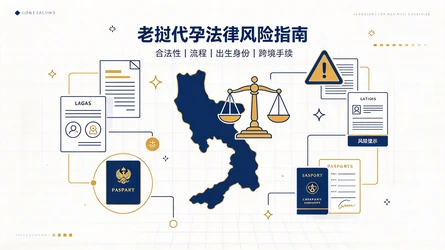
A Comprehensive Analysis of the Legal Landscape and End-to-End Risks of Surrogacy in Laos, Covering Core Stages Including Legal Review, Medical Arrangements, Maternity Management, Birth Registration, and Cross-Border Procedures; Deconstructing Commercial Surrogacy Marketing Traps to Mitigate Cross-Border Legal and Rights Protection Risks.
Read allCore Conclusion First
Commercial surrogacy for foreign clients lacks a legal basis in Laos and constitutes an illegal activity under strict regulatory controls. Laos has restrictive surrogate management rules only in extremely narrow, specific medical circumstances, and these rules do not apply to commercial surrogacy arrangements requested by foreign intended parents. Any surrogacy project initiated without independent legal verification, based on trust in agency advertisements, may expose the intended parents, the gestational carrier, and the resulting child to risks of criminal prosecution, identity-related complications, and human rights violations.
I. Current Legal Status: Commercial Surrogacy Is Fully Illegal Under Strict Regulation
1. Domestic Legislation and Official Law Enforcement Developments
In 2018, Laos officially enacted a decree imposing a comprehensive ban on commercial surrogacy, becoming the latest country in Southeast Asia to shut down its commercial surrogacy market, following Thailand and Cambodia.
In 2021, the Lao Ministry of Health issued Decision No. 2077/MOH on the Management of Surrogacy and Induced Abortion, establishing a regulatory framework for surrogacy practices. The core provision of this document strictly limits the scope of surrogacy, permitting it only in specific circumstances with legitimate medical justifications, while not opening legal channels to foreign commercial surrogacy arrangements.
In 2025, the Lao Permanent Mission to the United Nations explicitly stated in its official remarks that it opposes illegal surrogacy, emphasizing that relevant local agreements may only be implemented under specific circumstances with legitimate medical justification.
In July 2026, Lao police issued an official announcement clearly stating that online advertisements recruiting surrogate mothers seriously violate current Lao laws and regulations. They warned that participating in surrogacy may not only constitute a legal offense but also lead to human trafficking traps, urging the public not to trust such promotions.
2. Risk warnings from international institutions and other governments
Australia’s official travel safety platform, Smartraveller, clearly states that surrogacy is illegal in Laos. There have been arrests and charges related to human trafficking connected to surrogacy arrangements. The platform advises travelers visiting Laos to seek professional legal advice if they are involved in surrogacy.
The UN Committee on the Rights of the Child and the Special Rapporteur on the sale and sexual exploitation of children have both pointed out that unregulated commercial surrogacy in Lao PDR may constitute the sale of children, recommending that Laos adopt specific legislation to prevent the infringement of children's rights by commercial surrogacy.
The Committee on the Elimination of Discrimination against Women (CEDAW) explicitly noted during its review that Laos lacks a legislative framework to prevent the exploitation of surrogate mothers, and that unregulated surrogacy practices exacerbate violations of women's rights.
3. Clarification of Two Major Cognitive Misconceptions
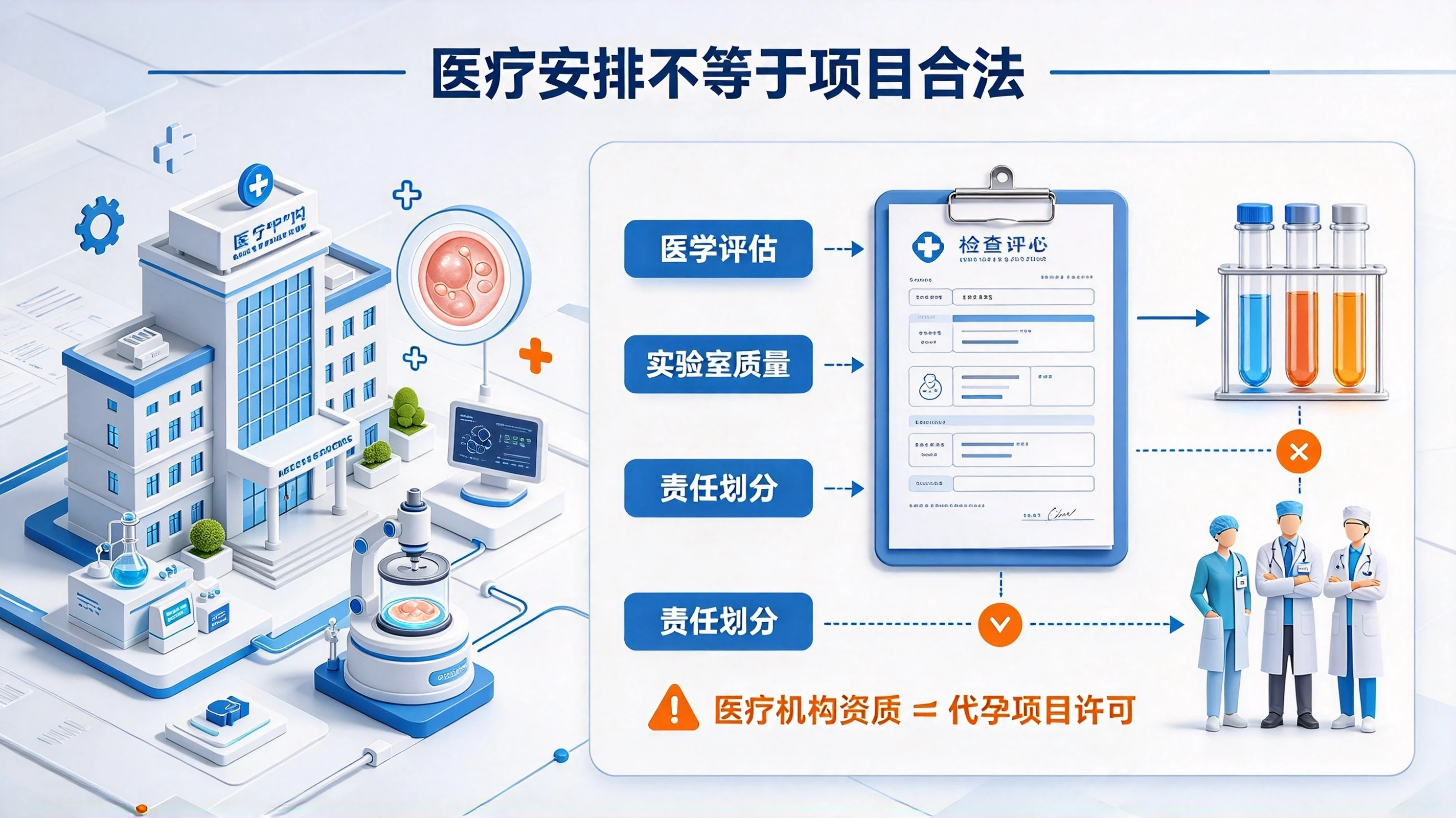
Myth 1: A hospital having assisted reproductive technology qualifications means surrogacy is legal.The practice license of a general medical institution and the qualification for assisted reproductive technology are completely independent from the legality of surrogacy programs. The lawful conduct of surrogacy requires separate legal and administrative authorization, which Laos currently does not grant to foreign commercial commissioning parties.
Myth 2: The existence of regulations equals the legalization of commercial surrogacyLaos’s surrogacy regulations are restrictive and binding norms designed to control surrogacy rather than permit commercial surrogacy; they apply only to strictly defined subjects and circumstances, and commercial surrogacy for foreign clients falls outside the scope of legal permissibility.
II. Project Initiation: Legal Review Must Take Precedence Over All Medical Arrangements
Cross-border surrogacyThe most common decision-making mistake is to pay fees, select an institution, and initiate medical procedures first, only to discover after conception or delivery that core issues such as lack of legal validity and inability to confirm the child’s identity exist. The correct sequence of decisions must strictly adhere to the principle of “legal compliance first”:Independent legal review → Medical indication assessment → Verification of healthcare institution qualifications → Contract and fee compliance review → Confirmation of post-birth identity and cross-border procedures
1. Legal Feasibility Check (Core Prerequisite)
Before signing any agreement or paying any fees, you must require the service provider to provide and independently verify the following documents; projects lacking valid documentation should be terminated immediately:
Local practicing lawyers in Laos regardingSpecific identity of the client and specific project detailsThe written legal opinion issued shall explicitly state that the commercial surrogacy arrangement complies with Lao law.
Official permit or written confirmation issued by the Lao health authorities specifically for this surrogacy project, rather than a general hospital practice license.
Special Legal Opinion on the Protection of Rights and Interests of Pregnant Women, Rules for Birth Registration, Determination of Parent-Child Relationships, and Procedures for Children's Exit from the Country
A statement clarifying the legal qualifications of foreign intended parents participating in surrogacy, confirming that there are no risks related to entry, residence, or law enforcement.
Special Notice: Intermediary contracts, hospital brochures, and institutional cooperation agreements shall not be regarded as legal bases; certificates bearing only the official seal of a hospital do not possess the legal validity of administrative permits.
2. Pre-verification of Legal Identity at Birth
The core risks of surrogacy programs are concentrated in the post-birth phase and must be fully verified before medical procedures begin; they cannot be dismissed with the assurance that “DNA testing will resolve everything.”
How does Lao law determine the legal relationship between a woman who gives birth and her newborn? Is the birthing mother presumed to be the legal mother by default?
Can the commissioning party legally acquire statutory parental status? Is it necessary to undergo judicial proceedings to confirm parent-child relationships or custody rights?
What are the legal rules for recording parental information in birth registrations? Can the commissioning party be directly registered as the parents?
Can genetic paternity test results be directly used in Lao law to amend parental registration and confirm custody rights?
Can newborns legally obtain complete birth registration documents and all official documents required for lawful departure from the country?
The Chinese embassies and consulates in Laos have addressed the nationality determination of children born through surrogacy,Travel DocumentWhat are the review criteria for application documents?
It should be clarified that DNA paternity testing can only establish biological lineage; it does not automatically confer legal parental status or custody, nor can it substitute for the official document verification required for cross-border travel.
III. Medical Assessment: Technical Feasibility Cannot Substitute for Legality
Even if surrogacy arrangements meet legal prerequisites (which foreign commercial commissions currently rarely do), assisted reproductive medicine must still undergo standardized medical assessments, and such assessments should be conducted independently by qualified medical teams, free from intermediary interference.
1. Medical Evaluation by the Client
Routine assessment items include:
Assessment of ovarian reserve, baseline endocrine levels, and uterine status in the female partner.
Routine semen analysis for the male partner; if necessary, perform in-depth tests including sperm morphology and DNA fragmentation.
Reproductive history of both partners, obstetric history, genetic disease history, and infectious disease screening.
History of previous assisted reproductive technology failures,Recurrent implantation failureEtiological analysis of history.
The examination items should be determined by a licensed physician based on medical indications, and the scope of examinations should not be arbitrarily expanded to increase charges.
2. Medical and Rights Assessment for Pregnant Individuals
The assessment of surrogate pregnancies must safeguard the autonomy and right to informed consent of the gestational carrier; any arrangement that restricts personal rights is suspected of being illegal:
A complete history of previous pregnancies and deliveries, reproductive system health status, and screening for chronic diseases and infectious diseases.
Contraindications in pregnancy,High-risk pregnancyA comprehensive assessment of risk factors and a contingency plan for pregnancy risks.
Full informed consent: Pregnant individuals have the right to be fully informed of all medical risks and procedural arrangements, the right to autonomously refuse medical interventions, and the right to obtain independent medical and legal advice.
It is strictly prohibited to restrict the personal freedom, freedom of communication, or right to choose medical care of pregnant individuals, or to confiscate their identity documents, under pretexts such as “unified management” or “pregnancy monitoring.” Such arrangements may violate Lao laws on human trafficking and constitute criminal offenses.
IV. Assisted Reproductive Medicine: Focus on Laboratory Quality and Scope of Liability
The overall level of assisted reproductive medical care in Laos is limited,Embryology LaboratoryQuality varies widely, making it extremely difficult to trace accountability in cross-border healthcare. If the project is confirmed to be legal, the following core matters must be carefully verified.
1. Quality Verification of the Embryology Laboratory
The embryology laboratory is the core of assisted reproduction, directly impacting success rates and sample safety. It requires verification:
Whether there is a dedicated embryo laboratory facility equipped with the full set of compliant devices for embryo culture, cryopreservation, and thawing.
Whether a stable team of professional technicians is in place and whether the personnel hold the corresponding professional qualifications.
Whether a comprehensive quality control system has been established, including real-time monitoring of temperature, gas concentration, and liquid nitrogen storage, as well as emergency response plans for power outages and equipment failures.
Is a strict sample identity verification system implemented, with dual-person review and full traceability throughout the process to prevent sample mix-ups?
Are complete records of sperm, egg, and embryo procedures retained? The client has the right to request all medical files.
2. Division of Medical Liability
Cross-border healthcare is most prone to responsibility shifting, so it must be clearly delineated in the contract:
Liability entities and qualifications of physicians performing ovulation induction, oocyte retrieval, and embryo transfer.
The coordination of responsibilities between the hospital and physicians responsible for prenatal checkups and delivery during pregnancy, and the assisted reproductive technology institution.
Liability for treatment and cost responsibility for risks such as ovarian hyperstimulation syndrome, ectopic pregnancy, miscarriage, and pregnancy complications.
Is there a referral hospital with the capability to treat acute and critical conditions, and are the referral procedures and costs clearly defined?
3. Fees and Contract Specifications
Contracts must itemize costs to avoid hidden charges under "all-inclusive" pricing:
Clearly distinguish between medical expenses, medication costs, laboratory fees, examination fees, hospitalization charges, intermediary service fees, attorney fees, and document processing fees.
ClearEmbryo cryopreservationstorage, and thawing fees, whether included in the package.
Clarify the settlement and refund rules for scenarios such as cycle cancellation, fertilization failure, no available embryos, and transfer failure.
Clarify the parties responsible for covering the costs of additional examinations, emergency medical care, and treatment of complications.
Clearly define the respective responsibilities of medical institutions and intermediary agencies, including the accountability pathways and dispute resolution mechanisms in the event of disputes.
Special Notice: Promotional claims such as “guaranteed success,” “live birth guaranteed,” and “success on the first embryo transfer” are all false promises. Outcomes of assisted reproductive technology are influenced by multiple factors, including age, ovarian reserve, sperm quality, embryo quality, and uterine conditions. No legitimate medical institution provides absolute guarantees regarding outcomes.
V. Management During Pregnancy: Balancing Continuity of Care and the Rights of Pregnant Individuals
Antenatal care is not simply about "attending scheduled prenatal checkups"; it is a comprehensive matter involving medical safety, accountability, and the protection of human rights.
1. Core Matters of Medical Management
Identify the designated hospitals for prenatal checkups and delivery, and verify their obstetric practice qualifications and emergency medical capabilities.
Prenatal check-up records, ultrasound reports, and medication records must be fully preserved; the commissioning party has the right to access all medical files.
Clearly define the criteria for identifying high-risk pregnancies, preterm births, and obstetric complications, as well as the referral procedures and responsible parties.
The mode of delivery shall be determined by the obstetrician based on medical assessment of the mother and infant. It is strictly prohibited to force a cesarean section or prematurely terminate pregnancy to accommodate the schedule of the commissioning party.
2. Red Lines for the Rights of Pregnant Women
The following activities are suspected of violating Lao laws, and serious cases constitute crimes related to human trafficking, requiring heightened vigilance:
Restricting pregnant women’s freedom of movement and communication, confiscating their identity documents, and prohibiting contact with family members.
Forcing pregnant individuals to reside in designated facilities, without allowing them to independently choose their accommodation or medical care providers.
Forcing medical procedures without the consent of pregnant individuals, or concealing medical risks.
Deducting fees on the grounds of breach of contract, threatening personal safety, and coercing pregnant individuals to continue or terminate their pregnancies.
VI. Stages of Labor: Verify Hospital Capabilities and Birth Document Compliance in Advance
The delivery stage is a critical point where risks are concentrated and likely to erupt; therefore, all preparatory measures must be implemented in advance, and reliance on verbal promises from intermediaries should be avoided.
1. Verification of hospital capabilities for childbirth
Verify the hospital's legal practice qualifications and confirm that its obstetric services include surrogacy delivery (if legally permitted).
Confirm that the hospital has the capability to perform neonatal resuscitation, treat preterm infants, and manage emergency and critically ill pregnant women and new mothers, as well as necessary referral pathways.
Confirm in advance the settlement methods and responsible parties for all costs related to delivery, cesarean section, newborn hospitalization, and transfers.
2. Advance confirmation of birth documents
Define the format, content, and legal validity of formal medical birth records that hospitals are authorized to issue.
Verify in advance, through local counsel, the competent authority for local birth registration, the eligible applicants, the required documents, the procedural steps, and the statutory time limits.
Clarify the legal recording rules for parental information in birth registrations, and strictly prohibit the registration of parental information through false documents; otherwise, it may result in the invalidity of the birth certificate or even violate laws related to document forgery.
VII. Key Post-Birth Issues: Distinguishing Medical Records, Legal Identity, and Cross-Border Procedures
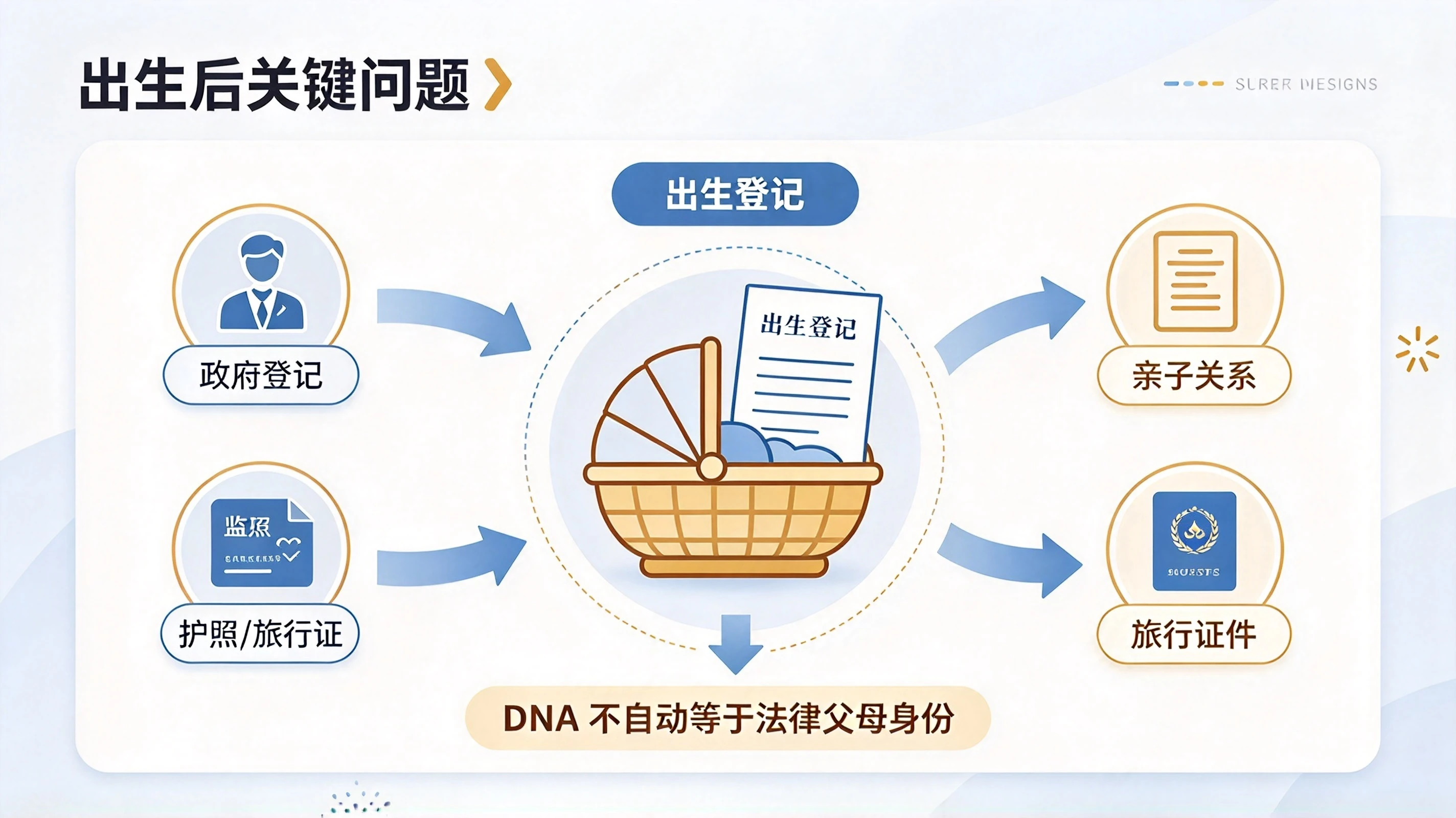
After the child is born, it is essential to clearly distinguish between three categories of documents and matters of different nature, without confusing them:
Table
Matter / Document | Core Role | Key Considerations |
|---|---|---|
Hospital Birth Medical Record | Record the time and place of delivery, as well as the basic health status of the newborn | For medical certification only; not equivalent to an official birth registration document issued by the government. |
Official Birth Registration Documents | Proof of Birth Facts and Legal Identity Information | The registration entity and parental entries must strictly comply with local laws; false registrations are invalid and illegal. |
Proof of Parent-Child Relationship | Proof of biological or legal parent-child relationship | DNA testing is merely biological evidence and does not automatically equate to legal parenthood or custody. |
Custody / Judicial Documents | Confirmation of Legal Guardianship and Authority to Act on Behalf of the Child | Whether judicial proceedings are required, along with the duration and requirements of such procedures, must be verified on a case-by-case basis through legal review. |
Cross-border Travel Documents | For exit, entry, and international travel | It requires dual review by the Lao competent authorities and Chinese embassies or consulates, with stricter standards for surrogacy cases. |
Legal consequences within China
Special note to the Chinese client:
Surrogacy is explicitly illegal in China and is not protected by Chinese law.
The Chinese Ministry of Foreign Affairs has explicitly stated that the document requirements for routine travel permits do not apply to Chinese citizens.Surrogacy AbroadFor children born through surrogacy, the determination of nationality and application for travel documents are subject to strict case-by-case review, with no guarantee of approval.
Obtaining travel documents through false materials or by concealing the fact of surrogacy may constitute illegal activity, potentially resulting in the invalidation of such documents and inability to register household registration (hukou) upon return to China.
8. Time Planning: No fixed cycle; high uncertainty throughout the entire process
Surrogacy in LaosDue to questions about the project's legality, there is no standard fixed cycle. Any promises such as "guaranteed pregnancy within X months" or "mandatory return home within X days after birth" are unreliable. The actual timeline is influenced by the following multiple factors:
The time required for legal review and confirmation by the competent authorities (if approval is not obtained, the project will be terminated directly).
Whether medical evaluation requires supplementary examinations or pretreatment.
Whether to cancel the assisted reproductive cycle and whether repeated ovarian stimulation and embryo transfer are needed.
Whether complications, premature birth, or other abnormalities occurred during pregnancy.
Whether birth registration requires supplementary materials or involves judicial procedures.
Judicial confirmation period for parent-child relationships and custody rights.
The review period for determining Chinese nationality and processing travel documents, as well as whether supplementary supporting materials are required.
It is recommended to divide the project into six stages: legal review, medical assessment, medical implementation, pregnancy and childbirth, birth registration and identity verification, and exit documentation. Each stage should have clearly defined completion criteria and exit mechanisms, rather than focusing solely on the overall timeline.
9. Frequency of Visits to Laos and Attendance Requirements: There are no uniform standards; they depend on the specific procedures.
There are currently no official regulations that explicitly specify the number of visits or length of stay required for foreign intended parents to participate in surrogacy in Laos; actual requirements depend entirely on medical needs, legal procedures, and document verification.
The medical institution may require the principal to appear in person to complete the examination and sign the informed consent form.
If judicial confirmation of parent-child relationships or guardianship is involved, relevant personnel may be required to appear in person.
Chinese embassies and consulates require the legal guardian to accompany minors in person for the issuance of travel documents, but intended parents through surrogacy do not automatically qualify as legal guardians.
Special Note: If the surrogacy program itself is illegal, frequent travel to Laos may expose you to risks such as entry scrutiny, denial of entry, or investigation by Lao law enforcement authorities.
X. Identifying High-Frequency Risk Promotions: All Six Types of Promises Are Unreliable
Laos permits commercial surrogacy for foreignersDemand that the counterparty provide clear legal basis and competent authority authorization for foreign commercial mandates; verbal explanations, online screenshots, and intermediary contracts are invalid.
As long as the hospital is qualified, the project is legal.Hospital practice licenses, assisted reproductive technology (ART) qualifications, and the legality of surrogacy arrangements are entirely separate matters. Surrogacy requires specific legal authorization, which Laos currently does not grant to foreign commercial surrogacy programs.
"Doing DNA can bring children back to the country."DNA testing can only establish biological kinship; it cannot substitute for legal determination of parent-child relationships, proof of custody, or verification of travel documents, and certainly cannot resolve issues related to nationality determination.
Birth certificates can list the parents' names upon request.Birth registration must strictly comply with local laws and factual circumstances. False registration constitutes suspected forgery of official documents, rendering the documents invalid and potentially subjecting individuals to legal liability; subsequent household registration and nationality applications cannot be processed.
All-inclusive pricing, with absolutely no additional charges.Legitimate projects must break down costs into detailed line items, as “all-inclusive” packages often hide numerous scenarios for additional charges, such as treatment for complications, neonatal hospitalization, expedited document processing, and repeated cycles.
"Can return to the country within a few days after birth"Children traveling abroad must complete multiple statutory procedures, including birth registration, identity verification, and travel document applications. The review process is even more stringent in surrogacy cases, making it impossible to guarantee the timeline; any short-term promises made by intermediaries are entirely unfounded.
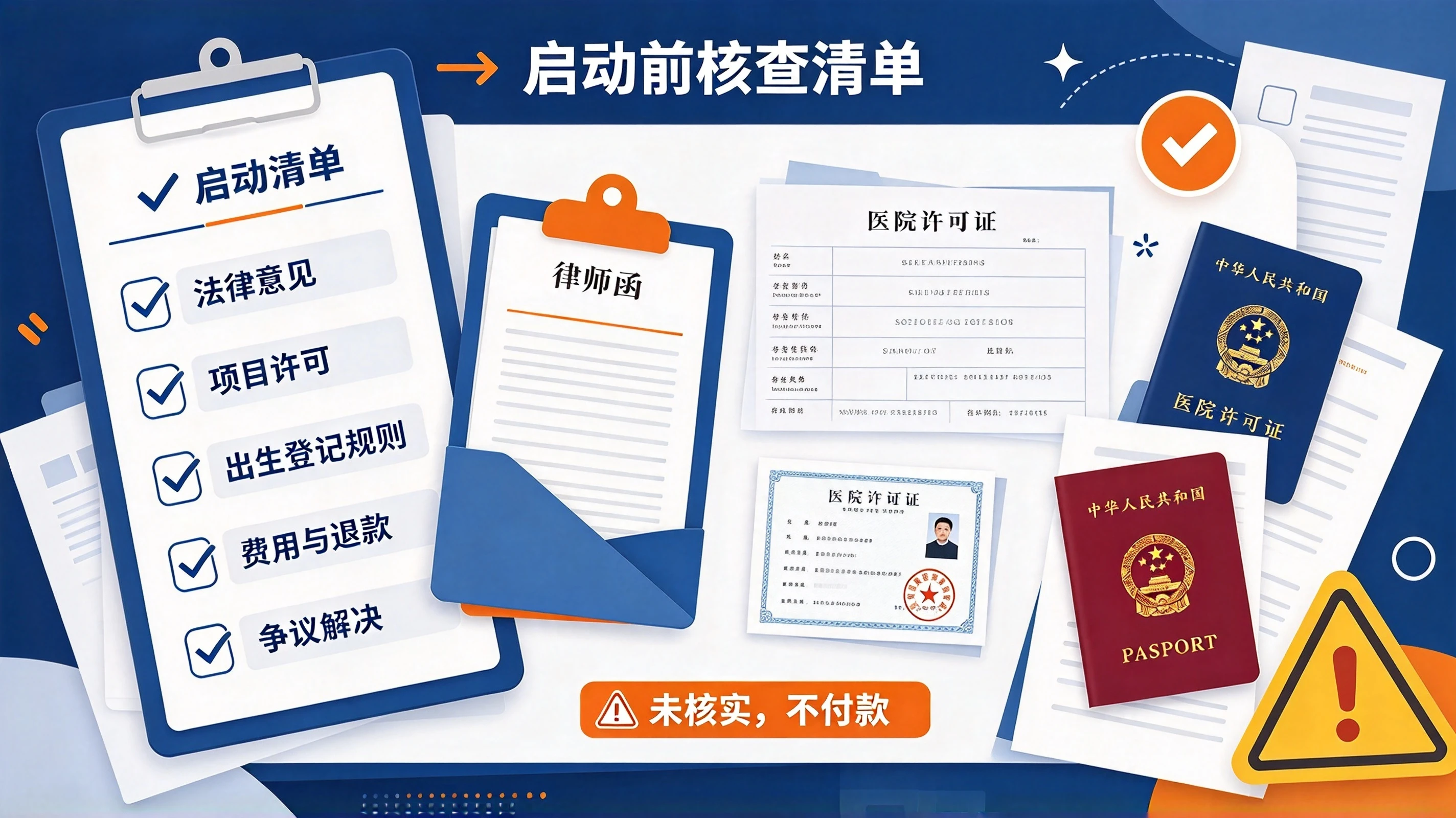
XI. Pre-Launch Compliance Checklist
Before signing any contract or making any payment, you must complete each item of the verification checklist one by one; do not initiate any items that fail verification.
A written legal opinion issued by a locally qualified lawyer in Laos regarding the specific project has been obtained, confirming that the participation of foreign clients is lawful.
The official licensing documents from the Lao health authorities for this specific surrogacy program have been verified.
The practice qualifications of verified medical institutions and the scope of their licenses for surrogacy-related assisted reproductive technologies have been reviewed.
The informed consent, medical care, and personal rights of confirmed pregnant individuals are fully protected, with no arrangements restricting their personal freedom.
The responsible parties and cost-sharing arrangements for prenatal check-ups, delivery, and neonatal emergency care have been clearly defined.
The applicant for birth registration, the rules governing parental entries, and the complete procedural workflow have been verified by a local attorney.
The judicial procedures, timelines, and costs potentially involved in confirming parentage and obtaining custody have been clearly identified.
The nationality determination and travel document application policies for children born through surrogacy have been verified with the Chinese Embassy in Laos.
The contract clearly specifies the fee breakdown, refund policies, medical risks, allocation of responsibilities, and dispute resolution mechanisms.
I am aware of China's legal regulations on surrogacy and understand the potential risks related to identity, household registration (hukou), and other issues upon returning to China.
Conclusion
At the core of assessing a surrogacy program in Laos lies not whether intermediaries can arrange medical services, prenatal care, or delivery, but rather whether the program itself has a legal foundation and whether, after the child’s birth, identity confirmation can be completed in accordance with the law and cross-border placement smoothly achieved.
Based on existing official legislation, enforcement trends, and international advisories, commercial surrogacy for foreign clients has no legal standing in Laos. Claims of “lenient policies” or “legal surrogacy” are merely marketing rhetoric used by intermediaries. Proceeding with such projects before the legal pathway is officially confirmed may not only result in financial losses but also expose gestational carriers to exploitation risks, leave children born through such arrangements in identity dilemmas, and cause intended parents to violate relevant laws in both Laos and China, thereby facing severe legal consequences.
Frequently Asked Questions
The content on this website is general educational material and compiled public information about IVF. It is provided for reference only, does not constitute a basis for diagnosis or medical decision-making, and does not constitute any medical advice or treatment recommendation. For policy and technical requirements, please refer to official publications issued by the relevant authorities and institutions. If you find any content errors, numerical inconsistencies, or outdated information, please contact us so we can verify and update it.