
2026 Latest Policy Interpretation: A comprehensive analysis of the rules for determining Chinese and U.S. nationality for children born through surrogacy in the United States, state-law parentage requirements, cross-border document processing procedures, and the impact of Executive Order 14418—helping cross-border families effectively plan their legal status.
Read allPolicy Review Date: October 30, 2026
For families considering surrogacy in the United States, the child's nationality and legal status after birth is a core issue that must be assessed in advance as part of the overall reproductive plan.
Many prospective parents are most concerned about the following: If a child is born in the United States, does it automatically acquire U.S. citizenship? If both parents are Chinese citizens, can the child hold dual Chinese and American nationality? Will the parents’ possession of U.S. green cards affect the process of obtaining ChineseTravel Document? Will the use of donor sperm, donor eggs, or a situation where neither parent has a genetic connection to the child affect the child's nationality and household registration upon returning to China?
These issues may seem simple, but they actually involve U.S. federal nationality law and parent-child relationship laws in various U.S. states,Nationality Law of Chinaand the document processing systems of both China and the United States. In particular, in 2026,Birthright citizenship in the United StatesNew changes in relevant policies, including Supreme Court rulings, presidential executive orders, proposed implementation plans by federal agencies, and related litigation, have introduced new uncertainties into the issuance of documents for children born through commercial surrogacy.
This article analyzes six dimensions—acquisition of U.S. citizenship, transmission of citizenship by descent for children born abroad, parental rights under state laws in the United States, determination of Chinese nationality, cross-border documentation procedures, and typical family scenarios—to help families planning surrogacy in the United States gain early insight into legal rules and risk boundaries.
Core principle: A child’s acquisition of nationality, determination of legal parentage, and household registration upon return to China are three distinct yet interrelated legal issues. One should not focus solely on the place of birth or the parents’ nationality, but instead make a comprehensive assessment by taking into account the place of birth, source of gametes, genetic and gestational relationships, parental status, and applicable law.
I. The nationality of a child born via surrogacy in the United States is determined primarily by the place of birth.
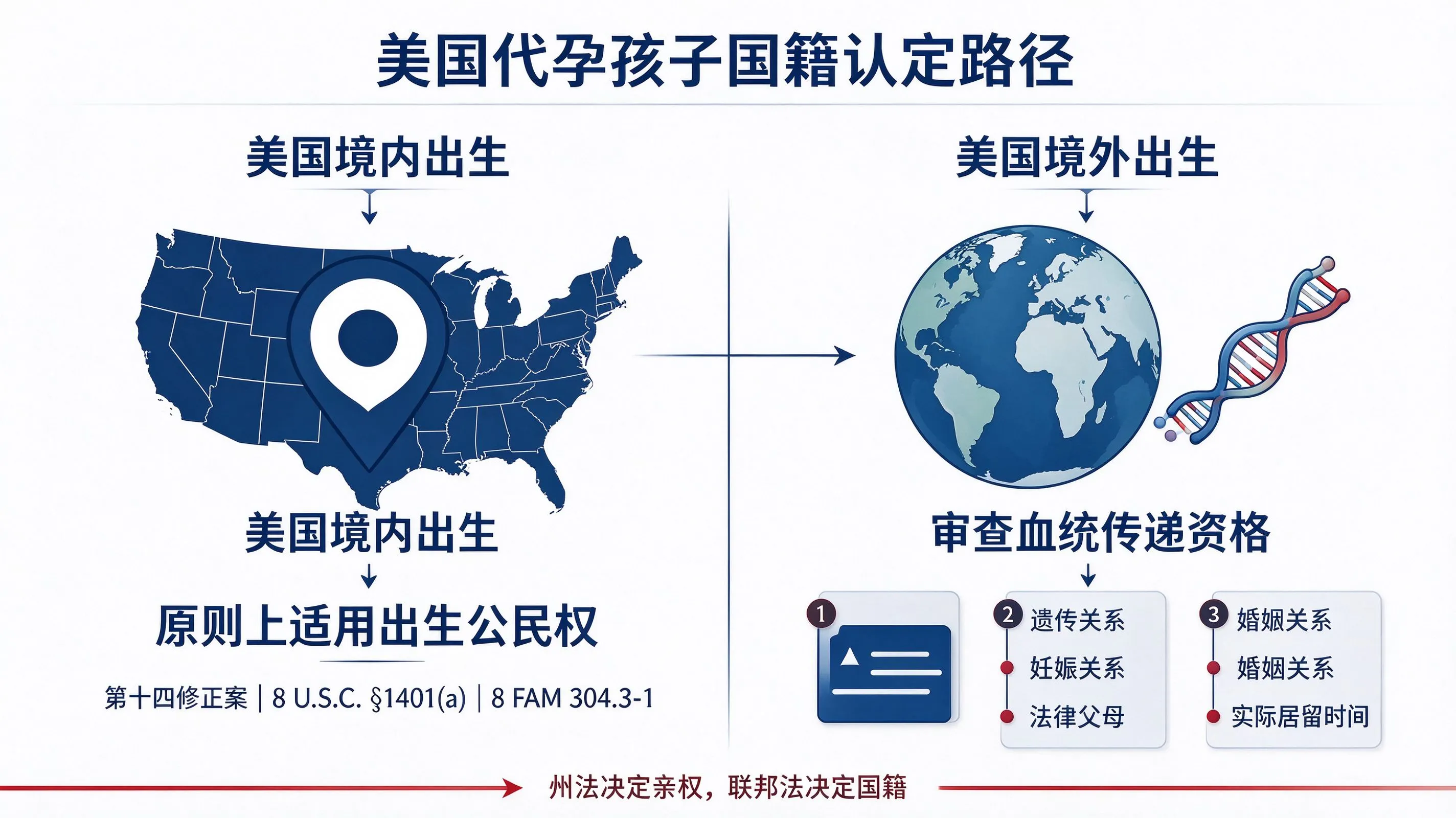
There are two primary legal pathways for acquiring U.S. citizenship:
Birthright citizenship (Jus Soli)Children who meet the eligibility requirements and are born in the United States acquire U.S. citizenship at birth in principle.
Principle of Jus SanguinisA child born outside the United States acquires U.S. citizenship through a U.S. citizen parent who meets the requirements of U.S. law.
These two systems differ significantly in their applicable rules and review priorities for surrogacy programs.
1. Child born in the United States: Birthright citizenship applies in principle
The core legal basis for determining U.S. citizenship is the first clause of the Fourteenth Amendment to the U.S. Constitution, which stipulates in its Citizenship Clause:
All persons born or naturalized in the United States, and subject to the jurisdiction thereof, are citizens of the United States and of the State wherein they reside.
This principle is commonly known as birthright citizenship. Section 301 of the U.S. Immigration and Nationality Act (INA), codified at 8 U.S.C. §1401(a), further clarifies that a person born in the United States and subject to its jurisdiction generally acquires U.S. citizenship at birth. The U.S. Supreme Court also affirmed the fundamental principle of jus soli (citizenship by place of birth) in its 1898 decision in United States v. Wong Kim Ark.
The U.S. Department of State’s 8 FAM 304.3-1 specifically addresses the citizenship of children born through assisted reproductive technology (ART) or surrogacy, clearly stating that children born in the United States are not subject to any change in the general rules governing birthright citizenship solely due to the use of ART or surrogacy.
Therefore, under normal circumstances:
Intended parents of Chinese nationality throughSurrogacy in the United States, the child is born in the United States and, in principle, acquires U.S. citizenship at birth;
Other foreign prospective parents who use surrogacy in the United States: their children, born in the U.S., generally acquire American citizenship at birth;
Whether the parents hold U.S. green cards is not a general prerequisite for birthright citizenship;
The use of the intended parents' own sperm and eggs, or gametes donated by a third party, generally does not alter the usual jus soli rules;
Gestational surrogacyand traditional surrogacy, nor would it alter the general principle of jus soli solely because of differences in the method of conception.
Special attention is required: birthright citizenship does not apply under exactly the same rules to all U.S. territories and individuals with special statuses. For example, nationality laws in U.S. possessions may differ; special rules also apply to foreign diplomats and their families who enjoy corresponding diplomatic immunities. If you plan to give birth in a U.S. state or Washington, D.C., the aforementioned jus soli analysis generally applies; if you plan to give birth in a U.S. territory, you should separately verify the local nationality rules.
Legal basis: Fourteenth Amendment to the U.S. Constitution; 8 U.S.C. §1401(a); U.S. Department of State, 8 FAM 304.3-1.
2. 2026 Supreme Court Ruling: Parents' Temporary Visas Do Not Automatically Affect Their Children's Birthright Citizenship
On January 20, 2025, the Trump administration signed Executive Order 14160, attempting to restrict U.S.-born children of parents who are illegally or temporarily residing in the country from acquiring citizenship; the order subsequently triggered multiple federal lawsuits.
On June 30, 2026, the U.S. Supreme Court ruled in *Trump v. Barbara* (No. 25-365), confirming that parents’ illegal or temporary immigration status does not automatically deprive their children born in the United States of birthright citizenship under the Fourteenth Amendment.
The significance of this ruling lies in the fact that a child born in the United States cannot be denied U.S. citizenship solely because the intended parents hold tourist, student, or work visas, or lack permanent residency status in the United States.
However, it is essential to draw a clear distinction: Trump v. Barbara primarily addresses birthright citizenship in cases involving parents with illegal or temporary residency status, and does not provide a final resolution on all legal disputes related to the 2026 commercial surrogacy administrative policy. This ruling should not be interpreted as eliminating all policy risks associated with nationality document applications for children born through commercial surrogacy.
3. 2026 EO 14418 Executive Order: New Policy Uncertainty Surrounding Commercial Surrogacy
On August 6, 2026, President Trump signed Executive Order 14418, *Continuing to Protect the Meaning and Value of American Citizenship*, which was published in the Federal Register on August 11, 2026.
Section 2 provides that where neither parent is a U.S. citizen, if the parents obtained birthright citizenship through commercial transactions or fraud as specified in the Executive Order, the federal executive branch will restrict the issuance of documents recognizing the child’s U.S. citizenship. Section 2(c) of the Executive Order explicitly enumerates relevant circumstances, including:
Parents arrange for the child's mother to enter the United States to give birth through commercial transactions;
Parents engage in commercial transactions with surrogate mothers who give birth within the United States.
This means that commercial surrogacy has been explicitly brought within the scope of the administrative policies targeted by Executive Order 14418. However, its legal structure requires precise understanding: the executive order does not simply stipulate that "all children born via commercial surrogacy in the United States are ineligible for U.S. citizenship," but rather subjects such commercial transactions to conditions it defines, including the "purchase or acquisition of birthright citizenship." The order’s scope of application, specific interpretations, and constitutional challenges regarding its compatibility with the Fourteenth Amendment remain under judicial review.
For prospective parents of Chinese nationality, two things need to be considered simultaneously:
The fundamental protections for birthright citizenship under the U.S. Constitution and current laws;
Potential practical obstacles to document issuance and increased documentary requirements resulting from identity document reviews conducted by federal executive departments pursuant to Executive Order 14418.
One should neither equate Executive Order 14418 with the constitutional amendment that has already revoked birthright citizenship for children born via surrogacy, nor overlook the practical risks it may pose to the processing of U.S. passports and other identity documents.
4. Current Implementation Status of EO 14418
The U.S. Department of State released the passport implementation document for Executive Order 14418 in September 2026, which explicitly labels itself as a Proposed Implementation Plan and states that the guidance related to the executive order is prospective in nature and subject to judicial orders and other legal obligations.
The proposed rule suggests that for minor passport applications where neither parent is a U.S. citizen, the parents may be required to submit separate statements under legal liability to help determine whether any circumstances listed in the Executive Order are involved.
Key Conclusion:
The original text of the executive order is a formal presidential executive order;
The passport implementation document is part of the proposed implementation plan and has not yet become a formally effective federal administrative regulation;
The actual application rules must be cross-checked against the State Council requirements and court orders in effect at the time of application.
5. Do the relevant lawsuits protect all commercial surrogacy families?
On September 2, 2026, the U.S. District Court for the District of Maryland issued a preliminary injunction against certain enforcement actions under Executive Order 14418 in *CASA Inc. v. Trump*. However, this injunction only protects the specific litigation class certified by the court; it does not automatically extend the same protections to all commercial surrogacy families.
The specific group involved in this case primarily concerns children born to parents who were illegally or temporarily residing in the United States, as addressed in prior birthright citizenship litigation; it cannot be broadly interpreted to encompass all foreign-national families whose children are born in the U.S. through commercial surrogacy. The government subsequently filed motions to lift or suspend the injunction, and related disputes remain pending in judicial proceedings.
Furthermore, the status of preliminary injunctions may vary across different federal judicial districts in the United States, and there is no uniform nationwide conclusion regarding a stay of enforcement. As of October 30, 2026, the legal disputes concerning Executive Order 14418 have not yet been finally resolved.
Practical advice for intended parents: Before signing the final surrogacy agreement and scheduling embryo transfer, have it reviewed by a qualified local attorney in the United States:
The latest legal status of EO 14418 and the scope of judicial injunctions
Whether relevant court injunctions apply to the specific circumstances of individual families;
Whether commercial surrogacy agreements may be included within the scope of review under the executive order;
Latest U.S. Department of State requirements for passport and identity document applications;
What additional supporting documents may be required when applying for a passport after the child's birth?
II. Child Born Outside the United States: Review of U.S. Citizen Parent’s Eligibility to Transmit Citizenship
If a child is born outside the United States, the fact that the surrogacy arrangement was organized by a U.S. agency does not automatically confer U.S. citizenship. In such cases, the provisions of the Immigration and Nationality Act governing the acquisition of U.S. citizenship for children born abroad must be applied.
Primary legal authorities: INA §301, i.e., 8 U.S.C. §1401; INA §309, i.e., 8 U.S.C. §1409; and the U.S. Department of State’s 8 FAM 304.3: Assisted Reproductive Technology and Acquisition of United States Citizenship at Birth.
In overseas surrogacy cases, the U.S. Department of State typically conducts a comprehensive review of five key factors: genetic relationship, gestational relationship, legal parentage, marital status, and actual duration of residence in the United States.
1. Do the U.S. citizen parents have a genetic or gestational relationship with the child?
This is the core determining factor for a foreign-born child born via surrogacy to obtain U.S. citizenship, and it falls into three categories:
The first is genetic connection, which refers to a biological link between the child and a U.S. citizen father or mother, such as when a U.S. citizen father provides sperm or a U.S. citizen motherEgg donationchild. If other legal conditions are met, such a genetic relationship can constitute the basis for transmission by bloodline.
The second type is the gestational connection, which refers to the relationship between a woman who actually carries and gives birth to a child and that child. However, the U.S. Department of State does not simply look at who became pregnant or gave birth; it also examines whether the woman who physically delivered the child was recognized as the legal mother under the laws of the child’s place of birth at the time of birth. For example: if a U.S. citizen woman becomes pregnant and gives birth using donated eggs, she may meet the requirements for transmitting U.S. citizenship provided that she is legally recognized as the child’s mother at the time of birth and satisfies other statutory conditions. Conversely, if she acts merely as a gestational surrogate but is not considered the legal mother under the laws of the child’s place of birth, the fact that she carried and delivered the child alone will not suffice to establish her ability to transmit U.S. citizenship.
The third category involves cases with no genetic or gestational relationship. If the intended U.S. citizen parents neither provided sperm or eggs nor actually carried and gave birth to the child, the child cannot be granted U.S. citizenship solely on the basis of their status as "intended parents."
However, for a qualifying marital relationship, if one U.S. citizen parent has a genetic or gestational connection to the child that meets the requirements, the other parent may also participate in the transmission of nationality under applicable legal rules, even without a direct genetic or gestational connection, provided that all applicable marriage, parental relationship, and other statutory requirements are satisfied.
2. Both parents are U.S. citizens, and the child was born overseas
For children born to parents who were both U.S. citizens at the time of birth and whose circumstances satisfy the applicable marriage rules, Section 301(c) of the Immigration and Nationality Act (INA) generally applies, with review focusing on:
At least one party resided in the United States before the child's birth;
At least one party must have a qualifying genetic or gestational connection to the child;
Both parties can demonstrate a genuine parent-child relationship with the child;
The relevant marriage and parent-child relationships comply with U.S. legal requirements.
3. One parent is a U.S. citizen, the other is a foreign national, and the child was born abroad.
For children born after November 14, 1986, INA Section 301(g) typically applies. U.S. citizen parents generally must have:
Have been physically present in the United States for a cumulative period of at least five years;
At least two of those years must have been after the age of 14.
In addition to the duration of residence, a concurrent review is required to assess whether the U.S. citizen parent has a qualifying genetic or gestational relationship; whether both parties hold legally recognized parental status; whether a qualifying marital relationship exists; and whether a genuine parent-child relationship can be established.
4. How can an unmarried U.S. citizen father transmit citizenship?
For unmarried U.S. citizen fathers, review is typically required under Section 309 of the INA. For children born abroad on or after November 14, 1986, the following requirements generally must be met:
By clear and convincing evidence proving the biological relationship between the father and the child;
The father was already a U.S. citizen at the time of the child's birth;
The father has provided written consent to offer financial support for the child until the child reaches the age of 18 (except in circumstances prescribed by law as exceptions);
The father has established paternity through legally recognized means (legal acknowledgment, sworn declaration, or court judgment) while the child was under 18 years of age;
A U.S. citizen father must have been physically present in the United States for at least five years prior to the child's birth, including at least two years after reaching the age of 14.
5. How does an unmarried U.S. citizen mother transmit nationality?
This issue requires special attention to the child’s date of birth and cannot be addressed with a one-size-fits-all approach. According to the current U.S. Department of State guidance on nationality acquisition:
Date of Birth | Actual residence requirements typically applicable to unmarried U.S. citizen mothers |
|---|---|
:--- | :--- |
December 24, 1952 – June 11, 2017 | Reside continuously and actually in the United States or its possessions for one year prior to the child’s birth |
June 12, 2017 and thereafter | Before the child's birth, having accumulated five years of actual physical presence in the United States or its territories, with at least two of those years occurring after the age of 14. |
Supplementary note: The rule for the second period stems from the U.S. Department of State’s adjustment to its administrative implementation following the Supreme Court’s decision in Sessions v. Morales-Santana; however, the statutory text of 8 U.S.C. §1409(c) still requires “one year of continuous physical presence.” Final determinations in individual cases are subject to the adjudication by consular officers.
In addition, if gestational surrogacy is involved, it is further necessary to verify whether the individual who actually carries the pregnancy qualifies as a legal mother under applicable requirements.
6. Will donating sperm or eggs affect U.S. citizenship?
Yes. The U.S. Department of State's 8 FAM 304.3-5 explicitly stipulates:
An anonymous sperm or egg donor cannot confer U.S. citizenship to a child solely on the basis of their own U.S. citizenship.
For example, if a foreign-intended couple engages in surrogacy outside the United States using an anonymous sperm donor who is a U.S. citizen, the child cannot acquire U.S. citizenship solely on the basis of the institution’s claim that the donor holds U.S. citizenship. Even if the donor is not anonymous or his identity is later confirmed, this does not necessarily mean the child will acquire U.S. citizenship; further review must still be conducted in accordance with Department of State guidelines.
For families using third-party gametes, it is recommended to fully retain the following: sperm donor source and related records; egg donor source and related records; embryo culture and transfer records; medical documents from the fertility clinic; surrogacy agreements; and documents regarding parentage and marital status.
DNA testing can be used to establish biological relationships, but it cannot substitute for other legal requirements such as U.S. citizenship, actual periods of residence, marriage, and legal parent-child relationships.
III. Surrogacy Laws in U.S. States: Determining the Legal Parents of the Child Is Equally Important
The acquisition of U.S. citizenship is governed by federal law, while the validity of surrogacy agreements, establishment of parentage, pre-birth orders, and birth certificate registration are primarily regulated by state laws. Therefore: a child’s birth in the United States does not automatically confer legal parenthood on the intended parents; acquiring citizenship and establishing legal parentage are two distinct legal issues.
Surrogacy laws vary significantly across U.S. states: some fully recognize commercial gestational surrogacy, others permit only altruistic surrogacy, and a few take a negative stance toward surrogacy agreements. Selecting the state of birth is one of the core legal decisions in a surrogacy program.
The difference between gestational surrogacy and traditional surrogacy
In the United States, surrogacy is primarily divided into two forms, each with entirely different legal rules:
Gestational SurrogacyThe surrogate mother is responsible only for pregnancy and childbirth, does not provide her own eggs, and the embryo may be formed from the intended parents’ own sperm and eggs or from third-party donated sperm or eggs. The surrogate mother typically has no genetic relationship with the child.
Traditional Surrogacy: In traditional surrogacy, the surrogate mother not only carries the pregnancy but also provides her own eggs, thereby sharing a genetic relationship with the child. This arrangement involves the surrogate’s biological maternity, making the determination of parentage more complex.
Different states have varying regulations regarding traditional surrogacy contracts, surrogacy compensation, and parentage, so the legal procedures for gestational surrogacy cannot be directly applied.
2. What is the purpose of a Pre-Birth Order (PBO)?
Pre-birth orders are a crucial type of court document in the U.S. surrogacy process, typically issued by courts before the child’s birth to establish the intended parents’ legal parentage under applicable state law and to address the parental rights of the surrogate mother and her spouse.
Depending on state-specific regulations, once a qualifying pre-birth order is obtained, the child’s birth certificate can be directly registered to list the intended parents. Its primary functions include:
Confirm in advance the legal parental rights of the intended parents;
Clarify whether the surrogate mother and her spouse have legal parentage of the child;
To provide a legal basis for birth certificate registration;
Provide support for obtaining passports and other identity documents for children.
It is important to note that pre-birth orders are not available in all states and may not be accessible to all family structures. Different states may impose varying restrictions on the following matters: whether intended parents must be married; whether single intended parents or same-sex couples are permitted; whether at least one intended parent must have a genetic connection to the child; whether foreign residents are eligible to apply; and whether traditional surrogacy is supported.
Some states do not recognize pre-birth orders, requiring parentage to be established through a paternity lawsuit after the child is born, which correspondingly increases the procedural timeline and evidentiary requirements.
3. Why do state laws affect surrogacy programs?
Taking the Illinois Gestational Surrogacy Act as an example, this law sets relatively specific statutory requirements for surrogacy arrangements. As of October 30, 2026, Section 750 ILCS 47/20 of the Illinois statutes requires that both the surrogate mother and the intended parents meet different conditions:
Surrogate mothers are typically required to be at least 21 years old, have a history of at least one successful delivery, complete medical and psychological evaluations, obtain independent legal representation, and meet legally mandated insurance coverage requirements;
Prospective parents must meet the requirements stipulated by state law regarding age, relevant medical conditions, psychological evaluations, and independent legal representation.
Under Article 15 of the Act, where a surrogacy agreement substantially complies with the prescribed requirements, the intended parents may acquire legal parentage at the time of the child’s birth, and the surrogate mother and her spouse do not automatically become the child’s legal parents by virtue of giving birth.
Note: Some pages on the Illinois General Assembly's official website are subject to access restrictions from outside the United States, and relevant regulations were amended on December 12, 2025, with further revisions continuing into 2026. Eligibility for surrogacy arrangements cannot be determined simply by relying on outdated descriptions or online classifications of Illinois as a "surrogacy-friendly state."
The core principle for choosing a state is to prioritize states with clear legal rules, mature parentage confirmation procedures, and the ability to accommodate specific family structures.
IV. Surrogacy in the United States by Chinese Parents: Does the Child Have Chinese Nationality?
For Chinese prospective parents, U.S. citizenship is only one aspect; the other core issue is whether the child meets the conditions for acquiring Chinese nationality as stipulated by Chinese law after birth. The primary legal basis for this is Articles 3 and 5 of the Nationality Law of the People’s Republic of China.
1. What does Article 5 of China's Nationality Law stipulate?
Article 5 of the Nationality Law of the People's Republic of China stipulates:
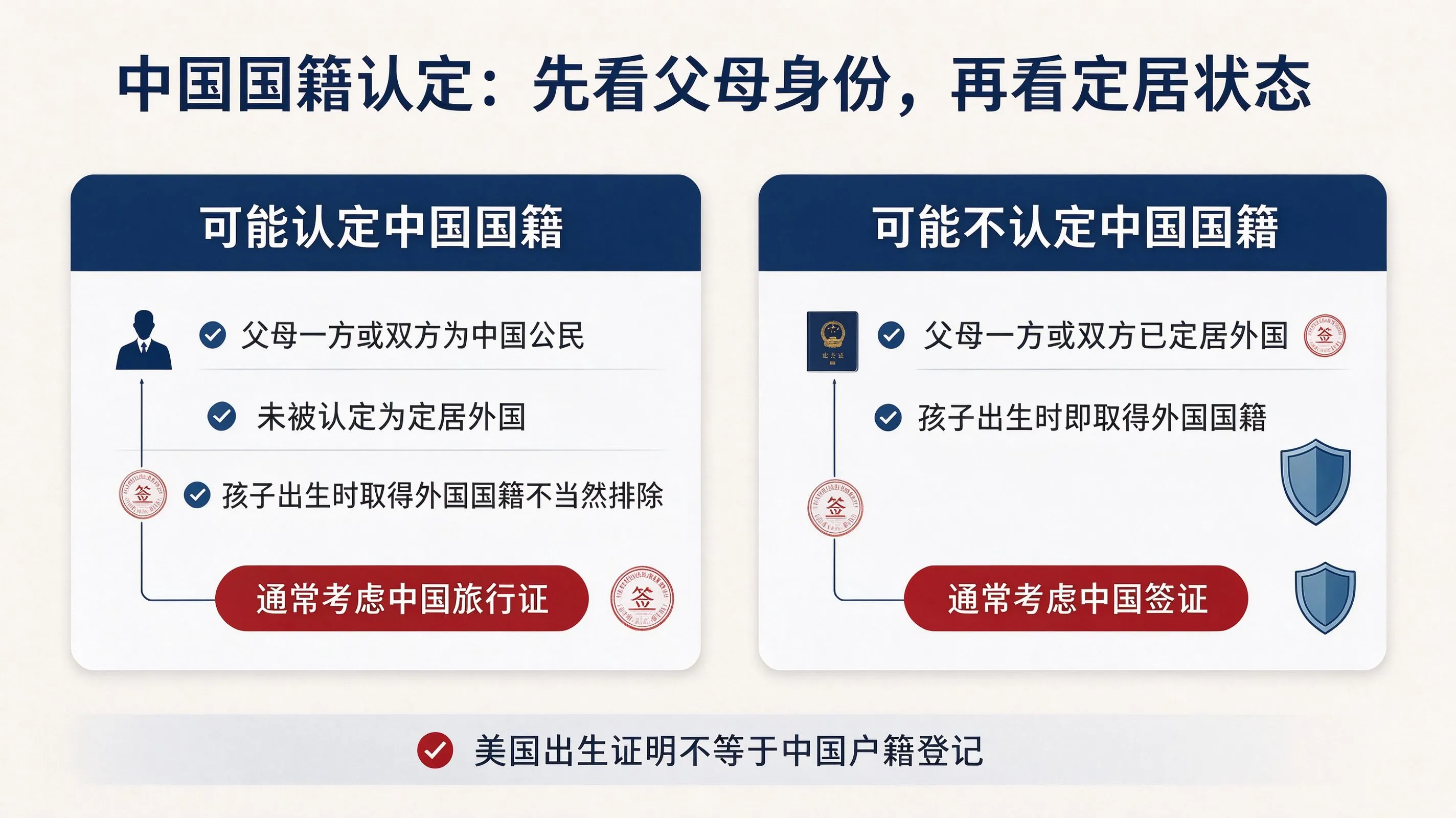
Where one or both parents are Chinese citizens and the child is born abroad, the child has Chinese nationality; however, where one or both parents are Chinese citizens who have settled abroad and the child acquires foreign nationality at birth, the child does not have Chinese nationality.
This law contains two key dimensions of judgment:
Whether one or both of the parents, in the legal sense, are Chinese citizens at the time of the child's birth;
Whether the Chinese-nationality parents have settled abroad, and whether the child acquired foreign nationality at birth.
Therefore: a child born in the United States and acquiring U.S. citizenship does not mean that all children of Chinese-national families are recognized as foreigners by China; nor does having Chinese-citizen parents guarantee that a child acquires Chinese nationality under all circumstances.
2. Does a U.S. Green Card affect the child's Chinese nationality?
It will have an impact, but you cannot simply lump all residence statuses together.
The official visa guidelines issued by Chinese embassies and consulates in the United States explicitly state as an example: If one or both parents are Chinese citizens who have settled abroad (for instance, holding a U.S. permanent resident card/green card), and their child acquires foreign nationality at birth in the United States, the child may not possess Chinese nationality and should apply for a visa to enter China as a foreign citizen.
Key boundary:
A long-term U.S. green card is one of the circumstances of “settling abroad” listed by Chinese diplomatic missions and consulates in the United States;
Holding a non-immigrant visa, such as a tourist, student, or work visa, does not in itself establish that one has settled abroad;
The determination of Chinese nationality is not as simple as "holding a green card means losing Chinese nationality"; rather, it requires meeting both conditions simultaneously: "parents settled abroad" and "the child acquired foreign nationality at birth."
3. What is the difference between a travel document and a visa?
For children of Chinese descent born in the United States, two scenarios typically need to be distinguished: those determined to hold Chinese nationality apply for Chinese travel documents as Chinese citizens; those determined not to hold Chinese nationality apply for visas to enter China as foreign nationals.
Preliminary assessments of common scenarios are as follows, with final determinations subject to the conclusions of the competent Chinese authorities:
Parents' Status | Preliminary assessment of Chinese nationality | Standard document orientation |
|---|---|---|
:--- | :--- | :--- |
Neither of the Chinese-national parents has been recognized as having settled abroad. | The child may have Chinese nationality. | Chinese Travel Document |
If one or both parents who are Chinese nationals have settled abroad, the child acquires U.S. citizenship at birth. | The child may not have Chinese nationality. | China Visa |
When a family is formed by a Chinese national and a foreign national, the Chinese national is not deemed to have settled abroad. | The child may have Chinese nationality. | Chinese Travel Document |
The Chinese national has settled abroad, and the child acquired U.S. citizenship at birth. | The fifth exception may apply | China Visa |
4. Pre-legal issues for surrogacy families: Who does Chinese law recognize as the child's parents?
This isCross-border surrogacyThis is a critical yet frequently overlooked issue within families. Article 5 of the Nationality Law employs the concept that "both parents or at least one parent are Chinese citizens." Therefore, in surrogacy cases, a prerequisite must first be resolved: Under Chinese law and relevant rules on the application of laws involving foreign elements, can the intended parents be recognized as the child’s legal parents?
Pre-birth orders, birth certificates, and parentage judgments issued by U.S. courts may serve as important evidentiary materials, but they do not automatically imply that Chinese courts or administrative authorities must recognize parental status in full accordance with the laws of the relevant U.S. state.
China currently has no dedicated, unified law governing the determination of parent-child relationships for all overseas surrogacy families. When foreign-related parent-child relationships are involved, Article 25 of the Law of the People's Republic of China on the Application of Laws to Foreign-Related Civil Relations must be applied: personal and property relations between parents and children are generally governed by the law of their common habitual residence; in the absence of a common habitual residence, the law that is more favorable to protecting the rights and interests of the weaker party shall apply, choosing either from the law of one party’s habitual residence or the law of that party’s country of nationality.
It should also be noted that Chinese judicial practice generally holds surrogacy agreements to be void as they violate public order and good morals. Parent-child relationships are not determined directly by the terms of such agreements, but rather through a comprehensive assessment considering the fact of birth, genetic ties, intentions regarding upbringing, and the principle of the best interests of the child.
5. How does Chinese judicial practice view the parent-child relationship of children born through surrogacy?
The Shanghai High People's Court previously published the case of Luo Rong et al. and Xie XX v. Chen XX, a dispute over guardianship rights, whose core rules in the judicial analysis include:
The identity of the birth mother is established based on the fact of childbirth.
Determine the identity of the biological father based on genetic relationships and acknowledgment behavior;
Under specific marital circumstances and actual conditions of upbringing and education, it may be determined that the spouse of an intended father forms a step-parent-child relationship with the child involving a duty of support.
This case is of reference value, but it should be specifically noted that it is a local reference case published by the Shanghai High People's Court, rather than a judicial interpretation uniformly applicable nationwide, and cannot serve as a unified conclusion for all cross-border surrogacy cases. Empirical studies of publicly available relevant court judgments in 2025 also indicate that the determination of parent-child relationships for children born via surrogacy involves various factors, including genetic relationships, birth facts, actual upbringing, marital status, and the best interests of the child, with no unified adjudication framework yet established for all such cases.
Therefore, for families in which neither of the intended parents has a genetic connection to the child, particular attention should be paid to assessing in advance the issues related to proving parent-child relationships under Chinese law.
6. China does not recognize dual nationality. Must children choose a single nationality at age 18?
It should not be interpreted this way.
Article 3 of the Nationality Law of the People's Republic of China explicitly states that "the People's Republic of China does not recognize dual nationality for Chinese citizens," but this does not mean that all children born in the United States, whose nationality status involves determinations under both Chinese and U.S. law, are required to automatically choose one nationality upon reaching the age of 18.
If a child is determined to have Chinese nationality, China shall handle their nationality and documents in accordance with Chinese law and shall not recognize the legal status of holding foreign nationality while being a Chinese citizen.
If a child does not have Chinese nationality under Exception 5, the relevant procedures for traveling to China shall be handled as a foreign citizen.
Article 9 of the Nationality Law only stipulates that Chinese citizens who have settled abroad and voluntarily acquire foreign nationality automatically lose their Chinese citizenship; it does not imply that all children of Chinese descent born in the United States are subject to an automatic choice procedure at age 18.
V. Bringing a Surrogacy-Born Child Back to China: Nationality, Parent-Child Relationship, and Household Registration Must Be Handled Separately
For Chinese-nationality families, a child obtaining a U.S. birth certificate, a U.S. passport, or a Chinese Travel Document does not automatically entitle them to register their household registration (hukou) upon returning to China. Nationality documentation, legal parent-child relationships, and domestic household registration are three separate procedures.
1. China's regulations on the management of domestic surrogacy medical activities
Article 3 of China's current Administrative Measures on Human Assisted Reproductive Technology stipulates that medical institutions and medical personnel shall not perform surrogacy technologies in any form. Article 22 specifies the administrative sanctions and legal liabilities that may be imposed for related illegal activities.
It should be noted that this administrative measure primarily governs the implementation of human assisted reproductive technologies by medical institutions and healthcare professionals within mainland China. One cannot infer solely from this provision that every Chinese intended parent arranging surrogacy abroad will necessarily face identical administrative or criminal liability. The specific legal responsibilities involved in overseas surrogacy must be assessed individually based on the actual conduct, applicable laws, and relevant facts.
2. A U.S. birth certificate does not mean that household registration in China has been completed.
A birth certificate issued by a U.S. state government can serve as proof of the child’s date and place of birth, as well as the parental information recorded in the document; however, this does not mean that Chinese household registration authorities must treat it as the definitive basis for all issues concerning parent-child relationships.
When registering the child's household registration (hukou) in China, the following may need to be verified: the determination of the child's Chinese nationality; the birth certificate and its authentication method (Apostille); the legal validity of the US court judgment regarding parentage; the legal parental relationship between the intended parents and the child; whether a genetic relationship exists and relevant proof thereof; and the specific requirements for birth registration imposed by local public security authorities.
One cannot simply promise that “having a U.S. birth certificate guarantees household registration” or that “having a Chinese Travel Document ensures the processing of hukou registration.”
3. What needs to be assessed in advance for surrogacy arrangements where neither party has a genetic link?
If the option of using third-party sperm donation, third-party egg donation, and a surrogate mother is adopted, with neither intended parent having a genetic connection to the child, it is recommended to conduct legal assessments in both the United States and China in advance.
On the U.S. side: If a child is born in the United States, general birthright citizenship rules do not require intended parents to have a genetic connection to the child; however, administrative policies on commercial surrogacy, state laws on parental rights determination, and passport review must each be considered separately. If the child is born outside the United States, genetic relationship, gestational relationship, and legal parentage must be verified in accordance with the U.S. Department of State’s guidelines on assisted reproductive technology (ART); U.S. nationality cannot be acquired solely based on the status of the intended parents.
Chinese Perspective: If neither of the intended parents has a genetic link to the child, additional legal and factual evidence may be required for parentage recognition in China. Household registration authorities in some Chinese cities require proof of paternity testing; if neither parent has a genetic connection, custody or parentage may need to be confirmed through litigation before household registration can be processed. Practical standards vary significantly across different provinces and cities, so it is essential to verify requirements with the public security and health departments in the location where registration is planned.
The absence of a genetic connection is a risk factor that requires careful assessment, but it does not directly imply that obtaining a travel document or registering residency is impossible.
6. What U.S. and Chinese documents need to be obtained after the child is born?
After the birth of a child, families typically need to process the following documents and certificates in sequence.
1. U.S. Birth Certificate
After the child is born, the hospital submits birth registration information to the relevant state government department. If a pre-birth order or parentage judgment under applicable state law has been obtained, the birth certificate can typically be registered with the intended parents in accordance with the relevant court documents and state law.
A birth certificate is a foundational document for applying for a U.S. passport and handling other identity-related matters, but it does not constitute a court judgment establishing parentage, nor does it guarantee that other countries will recognize parental status in the same manner.
2. U.S. Court Parent-Child Relationship Documents
Depending on the state of residence and family circumstances, you may need to prepare: a pre-birth order (PBO); a post-birth parentage judgment; a surrogacy agreement; and custody or other ancillary legal documents.
These documents are primarily used to confirm who the child's legal parents are and whether the relevant individuals have legal custody and consent rights.
3. U.S. Passport
Children who meet the eligibility requirements for U.S. citizenship may apply for a U.S. passport in accordance with the law. The U.S. Department of State stipulates that, when applying for a passport for children under 16 years of age, the following are typically required: the child must appear in person; both parents or legal guardians must appear in person; if one parent cannot appear, a compliant consent form or other documentation must be submitted; and in special circumstances, court orders or custody documents must be provided. Passports issued to children generally have a validity period of five years.
Special attention is required for surrogacy families: If, under the laws of the child’s birthplace, the surrogate mother remains the legal parent of the child, her consent may be required when applying for a child’s passport, or you may need to submit a court order and other alternative documentation that satisfies U.S. Department of State requirements. Do not assume that all passport application procedures can be completed smoothly solely on the basis that the intended parents have already obtained a U.S. birth certificate for the child.
4. CRBA: Required for U.S. citizen children born abroad
If a child is born outside the United States but meets the legal requirements for transmission of U.S. citizenship, you may apply for a Consular Report of Birth Abroad (CRBA) at the nearest U.S. embassy or consulate to certify that the child acquired U.S. citizenship at birth abroad.
It must be clarified that a CRBA is not a birth certificate issued by the child’s place of birth; a CRBA does not equate to a court judgment on parentage; and a CRBA does not directly determine how other countries should recognize the child’s legal parents.
In surrogacy cases, the U.S. Department of State typically registers on the Consular Report of Birth Abroad (CRBA) only those American citizen parents who have a genetic or gestational connection to the child. Whether a spouse without such genetic or gestational ties can be listed depends on a comprehensive assessment of factors including marital status and proof of legal parent-child relationship; in some cases, direct listing is not permitted. If, under the laws of the child’s birthplace, the surrogate mother remains the legal mother, her consent may also be required when applying for a U.S. passport.
5. Social Security Number (SSN)
The Social Security Number is primarily used for identity verification, taxation, healthcare, and other administrative purposes within the United States. Some hospitals can assist parents in applying for a Social Security Number during the birth registration process. However, a Social Security Number is not proof of citizenship and cannot serve as a substitute for a U.S. passport.
6. Chinese Travel Document or Visa
Children shall apply for the corresponding documents based on the determination of their nationality by the competent Chinese authorities: those with Chinese nationality shall apply for travel documents as Chinese citizens; those without Chinese nationality shall apply for visas to enter China as foreign nationals.
When processing relevant children's documents, Chinese embassies and consulates in the United States may require the submission of: the child's birth certificate; parents' passports and proof of their Chinese nationality; documentation regarding the parents' foreign permanent residency status at the time of the child's birth; parents' marriage certificates and other documents proving legal parent-child relationships; and any additional materials required by the embassy or consulate.
Surrogacy families face stricter review standards when applying for travel documents or visas compared to families who conceive naturally. Embassies and consulates may require additional supporting materials, such as surrogacy agreements, court orders establishing parentage, and paternity/maternity test reports, which can also extend the processing time. Requirements may vary by jurisdiction and individual case; therefore, it is advisable to check the latest requirements of the relevant embassy or consulate before submitting an application.
7. Apostille is required for U.S. documents to be used in China.
On November 7, 2023, the Convention Abolishing the Requirement of Legalisation for Foreign Public Documents officially entered into force in China. For U.S. public documents subject to this convention that are intended for use in China, it is generally sufficient to obtain an Apostille; traditional consular legalization procedures are no longer required.
Commonly required documents include: U.S. birth certificates, U.S. court judgments on parent-child relationships, and other official U.S. documents needed for use in China.
Special attention is required: An Apostille only certifies the formal authenticity of signatures, seals, and other formal elements of public documents; it does not imply that Chinese competent authorities must recognize all substantive legal relationships recorded in the documents. For example, a U.S. court’s confirmation of the parental rights of intended parents does not mean that Chinese competent authorities automatically acknowledge such parent-child relationships; the relevant documents still require substantive review in accordance with Chinese laws and the specific procedures involved.
VII. Four Typical Family Scenarios: What Are the Differences in Determining U.S. Citizenship for Children?
The following are hypothetical cases intended to facilitate understanding of legal rules and do not represent final nationality determinations made by the competent authorities for specific families.
Case 1: A Chinese married couple, neither holding a U.S. green card, using their own sperm and eggs for surrogacy in the United States
U.S. citizenship: A child born in the United States is generally eligible for birthright citizenship under U.S. law; however, due to the involvement of commercial surrogacy, additional assessment is required regarding the applicability and risks of Executive Order 14418, as well as documentation requirements.
Chinese Nationality: If neither parent is deemed to be settled abroad at the time of the child’s birth, the child may possess Chinese nationality pursuant to Article 5 of the Nationality Law. It is necessary to confirm the application procedure for a Chinese Travel Document with the relevant consular jurisdiction.
Parent-child relationship: Although the use of one's own sperm and eggs can establish genetic evidence, the surrogate mother’s fact of delivery, parentage judgments under U.S. state laws, and legal determinations under Chinese law still require separate verification.
Case 2: A Chinese-national couple, where one spouse has already obtained a U.S. permanent resident card (green card) and the other does not have a green card
U.S. Citizenship: In principle, the child is eligible for birthright citizenship under U.S. law; however, the policy risks associated with commercial surrogacy require separate assessment.
Chinese nationality: If one Chinese-national parent had already settled abroad at the time of the child’s birth, and the child acquired U.S. citizenship at birth, the exception under Article 5 of China’s Nationality Law—which denies Chinese nationality—may apply. Particular attention should be paid to confirming the appropriate pathway for obtaining a Chinese visa.
Practical advice: Verify in advance your parents’ permanent residency status, the legal relationship at the time of your child’s birth, and the recognition requirements of Chinese embassies and consulates. Do not wait until after your child is born to determine which type of document to apply for.
Case 3: A Chinese married couple, with no genetic connection to either party, using third-party sperm donation, egg donation, and surrogacy.
U.S. citizenship: If the child is born in the United States, the general birthright citizenship rules do not require the intended parents to have a genetic relationship with the child; however, risks associated with commercial surrogacy administrative policies and passport applications remain. If the child is born outside the United States, eligibility for U.S. citizenship must be reassessed based on the actual genetic, gestational, and legal parent-child relationships.
Chinese nationality: It still requires determination based on the settlement status of Chinese-national parents, the foreign nationality acquired by the child at birth, and the legal parent-child relationship.
Household Registration upon Return to China: Since neither party has a genetic connection to the child, this may increase the difficulty of proving parentage and registering the household in China. It is recommended that you consult a Chinese lawyer specializing in cross-border parentage before embryo transfer and verify the required documentation with the relevant authorities at your intended place of registration.
Case 4: One party is a U.S. citizen and the other is a Chinese citizen, with the child born via surrogacy outside the United States
U.S. Citizenship: A child does not automatically acquire U.S. citizenship solely because one parent is a U.S. citizen; it is necessary to verify whether the U.S.-citizen parent has a qualifying genetic or gestational relationship with the child, the parents’ marital status, the duration of actual physical presence in the United States, the legal maternal status of the surrogate, and the legal relationship between the intended parents and the child. For cases meeting the requirements of Section 301(g) of the Immigration and Nationality Act (INA), additional residency conditions typically apply, including five years of physical presence in the United States, at least two of which must have occurred after the age of 14.
Chinese nationality: Further determination is required based on whether the Chinese-nationality parents are settled abroad and whether the child acquired foreign nationality at birth.
Families in this category should complete the U.S. citizenship eligibility review before embryo transfer, rather than attempting to apply retroactively after the child’s birth.
VIII. Eight Legal Checks Recommended Before Surrogacy in the United States
For cross-border surrogacy families, nationality planning should not be treated as a post-birth add-on. It is recommended to complete the following checks before signing the final surrogacy agreement and proceeding with embryo transfer:
Determine the country and region where the child is planned to be born: Clarify whether it is within the U.S. mainland, a U.S. territory, or another country, as different locations may be subject to different nationality rules.
Verify the sources of sperm and oocytes: Clearly specify whether gametes from the intended parents or third-party donors are used, and maintain complete records of gamete sourcing, embryo formation, and transplantation.
Establish genetic and gestational relationships: Determine which intended parent(s) provided the sperm or egg, and which woman actually carried and gave birth to the child; this verification is especially important if the child was born outside the United States.
Establishing U.S. Birth State and Parentage Laws: Pre-verify local requirements for commercial surrogacy, pre-birth orders, court judgments on parentage, and birth certificate registration.
Verify the parents' marital status and U.S. citizenship: For children born outside the United States, the parents' marriage, U.S. citizenship, and actual periods of residence in the U.S. may directly affect the acquisition of nationality.
Verify the residency status of Chinese-national parents: Pay particular attention to whether they have obtained permanent residency in a foreign country, and confirm with Chinese embassies or consulates in advance regarding the appropriate path for obtaining travel documents or visas.
Plan ahead for parentage and household registration documentation under Chinese law: do not rely solely on U.S. birth certificates and court judgments, especially in families using third-party gametes where neither parent has a genetic connection to the child.
Establish an independent legal team comprising at least a U.S. assisted reproductive technology (ART) and surrogacy attorney, a U.S. nationality or immigration law attorney, a Chinese attorney specializing in foreign-related nationality and parent-child relationship issues, and reproductive medicine professionals; intended parents and surrogate mothers should each retain independent legal counsel to avoid conflicts of interest.
IX. Conclusion
The determination of the nationality of children born via surrogacy in the United States is not a simple matter of place of birth, but rather a complex legal issue shaped by U.S. federal nationality laws, state parentage laws, Chinese nationality law, and cross-border documentation systems. Overall, five core principles should be observed:
First, children born in the United States are, in principle, entitled to birthright citizenship. However, Executive Order 14418 of 2026 introduces new administrative policy restrictions concerning specific commercial transaction scenarios. Its judicial review status and implementation require ongoing monitoring, and it would be inappropriate to categorically conclude that it has either "no impact at all" or is "completely ineffective."
Second, for children born outside the United States, strict scrutiny is required regarding the U.S. citizen parent’s eligibility to transmit citizenship. Genetic relationships, gestational relationships, legal motherhood, marital status, and actual periods of physical presence may all affect the acquisition of nationality, and conclusions cannot be drawn solely on the basis that “the parents are U.S. citizens.”
Third, parentage laws in each U.S. state determine how intended parents establish legal parentage. Pre-birth orders, post-birth parentage judgments, and birth certificates should be planned before initiating a surrogacy program, with state selection being the core legal decision.
Fourth, Chinese nationality must be determined independently under the Nationality Law of the People's Republic of China. Factors such as whether the parents have settled abroad, whether the child acquired foreign nationality at birth, and how Chinese law defines the status of the child’s parents may all affect the pathway for obtaining a travel document or visa.
Fifth, nationality documents, legal parent-child relationships, and domestic household registration are distinct procedures. Obtaining a U.S. passport or a Chinese Travel Document does not mean that all procedures for returning to China have been completed.
For families preparing for surrogacy in the United States, what truly matters is not trusting promises such as "guaranteed U.S. citizenship," "guaranteed Chinese travel documents," or "guaranteed household registration upon return to China." Instead, they should verify legal eligibility from the outset of the project, select an appropriate birth location, determine the source of gametes, and carefully plan for parentage recognition and documentation in both China and the United States.
Final Principle: First, confirm legal eligibility before formulating a birth plan; first, establish the legal parent-child relationship before arranging for birth registration and nationality documents; consider not only the child’s status at birth but also their long-term residence and legal rights in both China and the United States.
Disclaimer: This article is intended solely for general legal education and reference in cross-border family identity planning. It does not constitute specific legal advice for any particular family, nor does it guarantee that any surrogacy arrangement will result in U.S. citizenship, Chinese travel documents, visas, or Chinese household registration (hukou). U.S. federal laws, administrative policies, and court rulings may continue to evolve, and parentage laws vary by state; matters concerning Chinese nationality and hukou also require review by competent authorities based on the specific facts of each case. For actual surrogacy arrangements, individuals should consult separately with attorneys licensed in the relevant U.S. jurisdiction and with specialized lawyers familiar with cross-border parentage, nationality, and hukou issues under Chinese law. Some overseas official pages may be subject to regional access restrictions or page parsing issues; if a link cannot be opened, please verify the content through the latest publicly available text from the corresponding official channels. Local procedural standards in China vary by region; please adhere to the requirements specified by the competent authorities at the time of application.
U.S. National Archives: The Fourteenth Amendment to the United States Constitution
United States Code: 8 U.S.C. §1401, Acquisition of United States Citizenship
U.S. Supreme Court: Trump v. Barbara, No. 25-365, decided June 30, 2026
The White House, United States: Executive Order EO 14418, August 6, 2026
U.S. Department of State: Proposed Implementation Plan for Passport Processing under EO 14418
U.S. District Court: CASA Inc. v. Trump, Judgment Document dated September 2, 2026
U.S. Department of State: Acquisition of U.S. Citizenship by Children Born Abroad
U.S. Department of State: Assisted Reproductive Technology and Surrogacy Abroad
U.S. Department of State: Passport Application Requirements for Children Under 16
Illinois General Assembly: Gestational Surrogacy Act
Illinois General Assembly: 750 ILCS 47/15, Legal Parentage of Intended Parents
National Immigration Administration: Nationality Law of the People's Republic of China
Chinese Embassy in the United States: Instructions for Passport and Travel Document Processing
Frequently Asked Questions
The content on this website is general educational material and compiled public information about IVF. It is provided for reference only, does not constitute a basis for diagnosis or medical decision-making, and does not constitute any medical advice or treatment recommendation. For policy and technical requirements, please refer to official publications issued by the relevant authorities and institutions. If you find any content errors, numerical inconsistencies, or outdated information, please contact us so we can verify and update it.