
Don't blindly choose overseas IVF providers based on reputation alone. Learn how to scientifically screen reliable international fertility centers by evaluating credentials, embryo laboratories, success data, costs, and cross-border risks—while avoiding marketing traps.
Read allI. Cross-Border Reproductive Healthcare: Don’t Let “Reputation Rankings” Replace Professional Judgment
When domestic treatments repeatedly fail,Complex infertilityFactors, or existenceEgg donationWhen special needs such as sperm donation and genetic testing arise, many families turn their attention to overseas reproductive clinics. Frequently appearing in search results are terms like “top-tier US reproductive centers” andJapan IVFBaby HospitalAssisted Reproductive Technology in ThailandStatements such as “top institution” and “number one global success rate” can easily lead decision-making into the trap of prioritizing reputation.
First, it is essential to clarify a core fact:There is no unified, authoritative global ranking of clinical capabilities for reproductive medicine centers.. Medical regulatory systems, patient age demographics, treatment indications, statistical definitions of success rates, and legal environments vary significantly across countries. A high success rate published by a particular institution may not be applicable to your specific condition; similarly, a large number of international patients does not directly equate to stronger clinical capabilities.
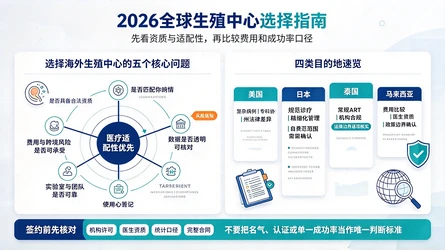
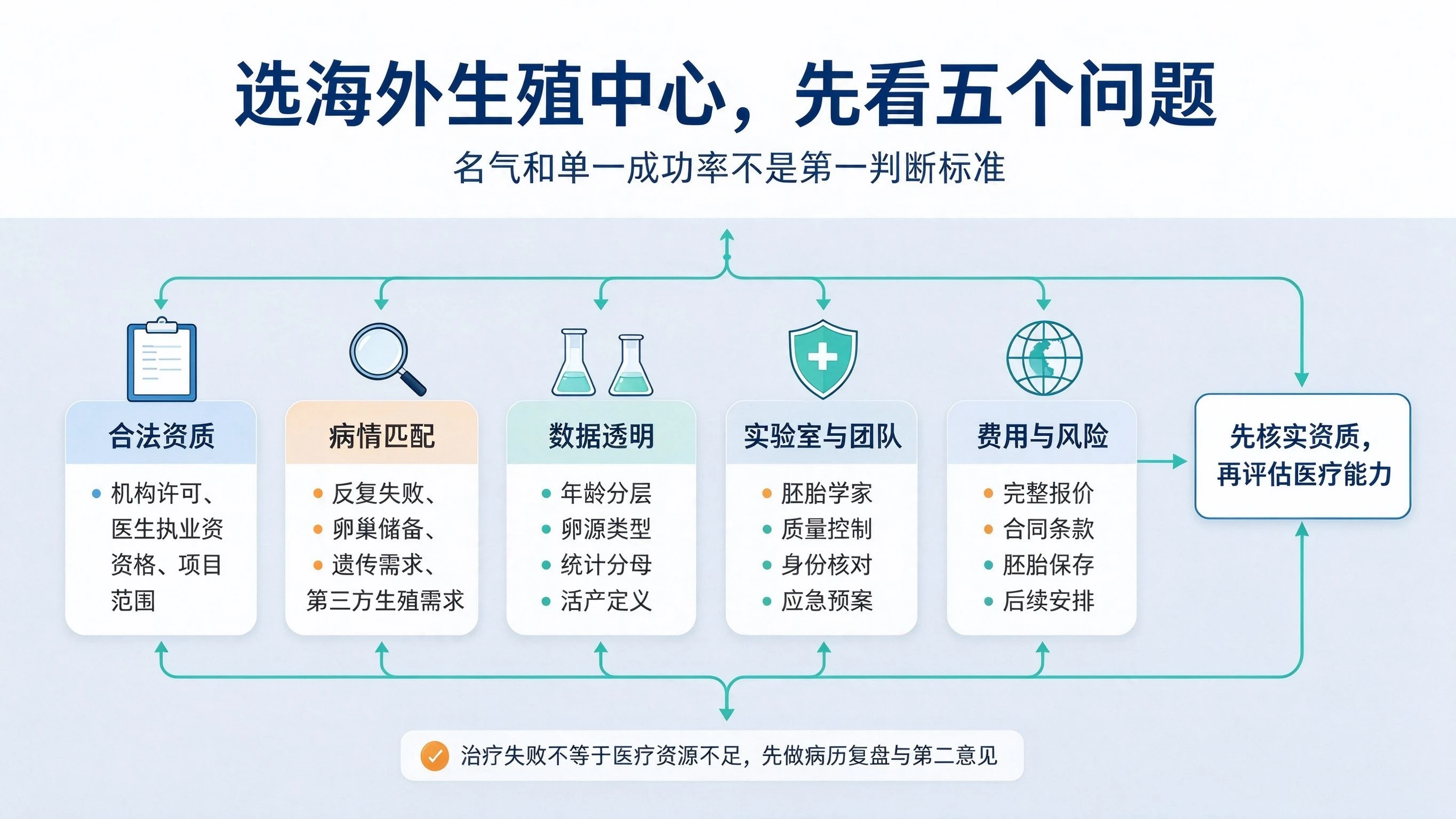
Choosing an overseas reproductive center essentially means answering five core questions:
Does the institution possess the legitimate qualifications to carry out the corresponding assisted reproductive technologies?
Are you truly skilled at handling cases that are highly similar to your condition?
Is the success rate data complete and traceable, and can the statistical methodology be verified?
Embryology LaboratoryIs the clinical team and quality management system reliable?
Are the total treatment costs, legal risks, and subsequent arrangements within an acceptable range?
This article does not center on "global hospital rankings." Instead, it establishes a practical screening methodology based on five dimensions—healthcare suitability, laboratory quality, data transparency, cost structure, and cross-border risks—to help families planning cross-border medical care make informed decisions.
II. Conduct a self-assessment first: Do you really need to seek treatment overseas?
Overseas reproductive healthcare is not inherently superior to local medical care. When deciding whether to go abroad, the first step is to assess whether your current local medical resources truly cannot meet your treatment needs.
1. In which cases can you seek a second opinion overseas?
In the following scenarios, it is advisable to first seek a remote second opinion from overseas institutions; however, this does not necessarily mean that treatment must be sought abroad:
Table
Specific circumstances | Key areas for consultation |
|---|---|
Multiple embryo transfers without achieving clinical pregnancy | Reassess embryo quality, uterine environment, and transfer protocols; review past treatment records |
Significantly diminished ovarian reserve with a low expected number of oocytes retrieved | Individualized ovarian stimulation protocols, oocyte retrieval strategies, and embryo accumulation plans |
Severe oligoasthenospermia and azoospermia in the male partner | Andrological Specialist Assessment, Sperm Retrieval Methods, and Indication Evaluation for ICSI |
Clarify the family history of genetic diseases | Genetic counselingPGT-M Applicability and Test Plan Design |
Requires egg or sperm donor support | Review the local legal framework, donor screening criteria, and informed consent procedures |
Complex cases require multidisciplinary assessment. | Multidisciplinary Consultation on Reproductive Medicine, Genetics, Andrology, and Related Specialties |
Special distinction is required:"Treatment failure" does not equal "insufficient medical resources."Embryo transfer failure may involve multiple factors, including embryonic chromosomal abnormalities, uterine structure, endometrial status, the transfer procedure itself, and even chance. Changing countries or hospitals does not guarantee that the issue will be completely resolved. Before deciding on cross-border treatment, it is recommended to organize complete records of previous tests and treatments and seek a targeted second opinion. If a doctor can clearly explain the possible causes of failure and propose an evidence-based adjustment plan, changing the country for medical care may not be necessary immediately.
2. Don't treat "number of failures" as a hard criterion for going abroad
The online claims that "one must go abroad after two failures" or "switch hospitals if three cycles fail to result in implantation" are not universally applicable medical standards. Whether to adjust the treatment pathway should be based on a comprehensive assessment of the following factors:
Female Age and Ovarian Reserve
Previous ovarian stimulation protocols and outcomes of oocyte retrieval, fertilization, and blastocyst formation
Has the embryo undergone genetic testing?
Complete evaluation results of the uterine cavity and endometrium
Semen analysis and necessary urological evaluation
Previous Number of Transplants, Embryo Type, and Corresponding Pregnancy Outcomes
What truly matters is never "how many times a treatment has failed," but whether the doctor conducted a standardized review after each failure and whether there was a clear basis for adjustment in the subsequent treatment.
III. Overview of Major Global Destinations: Matching Needs Is More Important Than "Choosing a Country"
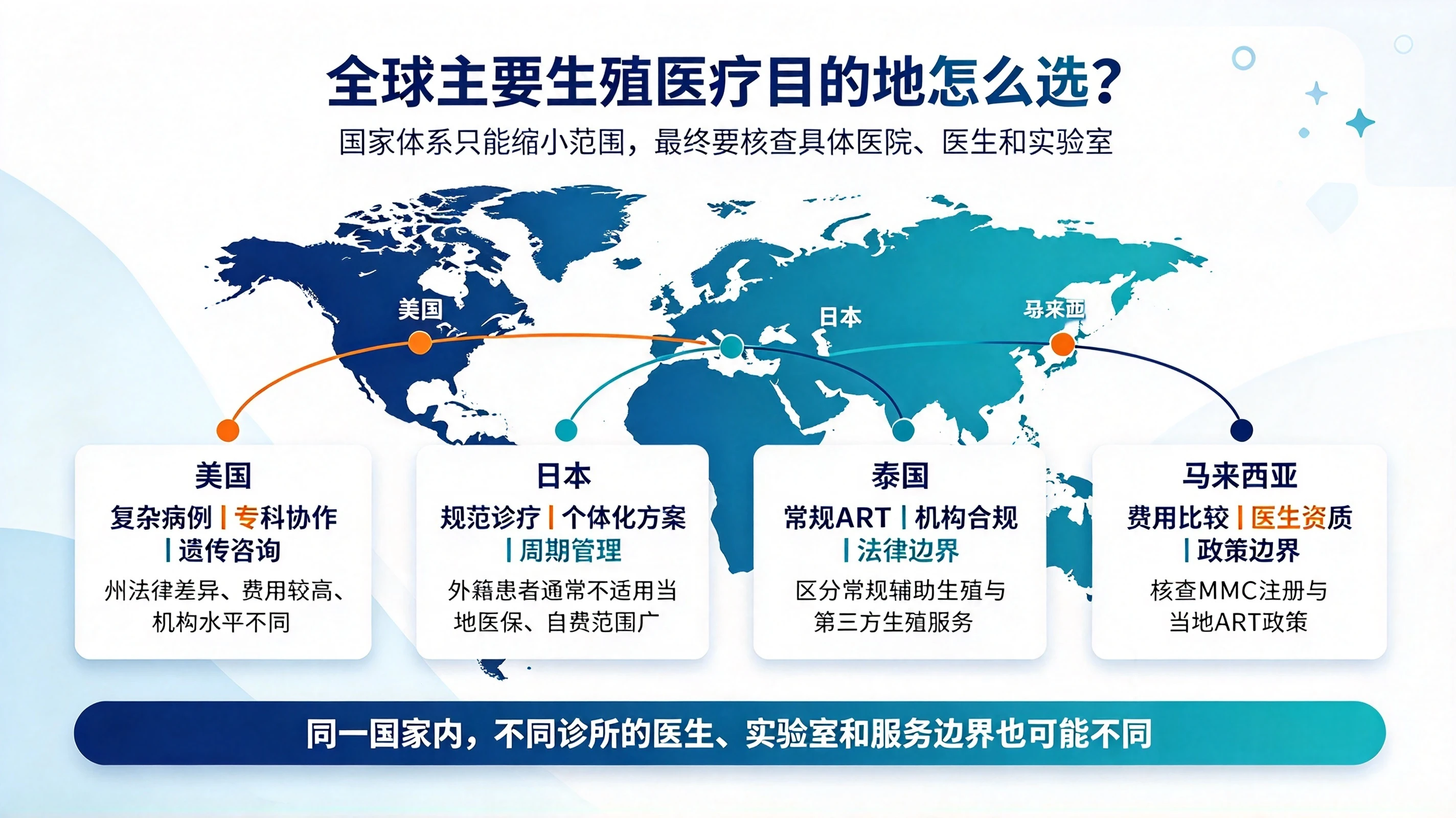
Assisted reproductive systems vary significantly across countries. When making a choice, one should comprehensively evaluate medical capabilities, legal restrictions, costs, language barriers, and cross-border management, rather than relying solely on institutional marketing claims.
1. United States: Suitable for complex cases and comprehensive multidisciplinary collaboration
The United States has a mature assisted reproductive medical system,Reproductive EndocrinologyThere is a clear division of professional responsibilities with infertility specialists, embryology laboratories, genetic counseling services, andrology departments, and third-party reproductive service providers. Most centers can cover routine cases.IVF, ICSI, embryo freezing and thawing, PGT, egg and sperm donation, and third-party assisted reproductive services in compliance with local laws.
When selecting a U.S. institution, focus on these three key 2026 latest regulations:
Data and Advertising RegulationThe Federal Trade Commission (FTC) explicitly requires that all assisted reproductive technology advertisements must simultaneously disclose live birth rates along with the corresponding sample sizes; promoting only clinical pregnancy rates without clarifying the statistical methodology constitutes misleading consumers, with a maximum fine of $50,000 per violation. The CDC releases its annual full-scope ART report in February each year, covering all registered clinics nationwide and using live birth as the statistical endpoint.SARTMember clinic data are updated annually in April, using clinical pregnancy as the core milestone; these two metrics must not be conflated. Patients can directly download age-stratified live birth data for the corresponding clinics from the CDC website for verification.
Medical and Laboratory StandardsThe 2026 ASRM guidelines stipulate that no more than two embryos may be transferred per cycle; clinics in violation will have their SART membership revoked. Embryology laboratories must hold both CAP and CLIA certifications, and starting in 2026, a new mechanism of continuous on-site inspections will be implemented, with non-compliant laboratories suspended from accepting international patients.
Entry and Legal DifferencesIn 2026, U.S. Customs and Border Protection will implement electronic pre-screening for imported embryos and gametes, requiring the submission of FDA approval numbers, clinic certifications, and temperature control records at least 30 days in advance. Regulations governing third-party assisted reproductive technologies vary significantly across states; while states such as California and Nevada are more permissive regarding related contracts, others like Texas and Louisiana impose strict restrictions. It is therefore inaccurate to assume that these practices are uniformly legal throughout the United States.
Target AudienceIndividuals with complex assisted reproductive needs, requiring a comprehensive multidisciplinary collaborative framework, or those seeking to evaluate egg donation, sperm donation, and third-party reproductive services within the local legal framework.
2. Japan: Suitable for those who prioritize standardized care and refined management
Japan has an early-developed assisted reproductive technology (ART) sector, with mature obstetrics-gynecology and reproductive medicine specialty systems. It has accumulated extensive experience in ovulation induction protocol management, embryo culture, cryopreservation-thawing transfer, and individualized treatment. Clinical workflows are standardized, and there is a strong emphasis on personalized cycle management for patients.
Two key points of understanding need to be clarified regarding seeking medical treatment in Japan:
Medical Insurance and CostsSince 2022, Japan has included certain assisted reproductive technology (ART) procedures in its public health insurance system. However, this coverage is limited to individuals under the age of 43 at the start of treatment. Specifically, for patients under 40, up to six embryo transfers per pregnancy are reimbursable, while those aged 40–43 are eligible for reimbursement of up to three transfers per pregnancy. This benefit applies only to Japanese nationals and permanent residents; foreign patients are not eligible. Additionally, some advanced medical technologies and specialized services require full out-of-pocket payment. Advanced medical subsidies introduced by certain local governments in 2026 similarly do not apply to international patients.
Policies and ServicesIn 2026, Japan extended its medical visas to allow multiple entries over three years, with a maximum stay of 90 days per visit, accommodating the schedule for repeated consultations. All accredited hospitals are required to provide international patients with equivalent medical liability insurance, offering coverage up to ¥20 million. For third-party reproductive services such as egg donation, Japanese law imposes strict restrictions; there is no policy of “full liberalization,” and compliance must be verified on an institution-by-institution basis.
Target AudienceTargeting individuals who value standardized specialty care and refined cycle management, and who are comfortable with local healthcare processes, language arrangements, and cost levels.
3. Thailand: Strictly distinguish between medical services and legal boundaries
Thailand was once a popular destination for assisted reproductive technologies in Southeast Asia,BangkokIVF and ICSI are available at multiple institutions in cities such asEmbryo cryopreservationwith certain genetic testing services, but legal regulation in this field requires particular attention.
The legal status of assisted reproductive technology in Thailand in 2026 requires clarification on three key points:
The current legal framework remains unchanged.The core legislation remains the Children Born through Assisted Reproductive Technologies (Protection) Act 2015, which typicallyIVF/ICSI (In Vitro Fertilization/Intracytoplasmic Sperm Injection)In principle, it is intended for legally registered married couples; commercial surrogacy constitutes a clear violation of the law.
The amendment has yet to take effectIn July 2026, a public consultation on the draft amendment to the Official Open Act was launched, proposing to change the term "husband and wife" to "spouse," permitting limited third-party surrogacy for foreign spouses, and allowing the export of gametes/embryos after approval. However, as of October 2026, the draft remains in the legislative process, has no legal force, and the proposed amendments should not be treated as implemented policies.
Practical implementation follows a dual-track approachFollowing the Ministry of Health’s March 2026 update to certain implementation guidelines, selected compliant private fertility centers may accept foreign female patients who present a passport and notarized declaration, with the upper age limit relaxed to 50 years. However, public institutions and hospitals affiliated with religious organizations continue to strictly enforce the “married couples” requirement; therefore, it is advisable to confirm the admission policies of the target facility in writing in advance.
When selecting a Thai institution, you must verify: whether the medical facility is legally registered; whether it holds permits for the specific treatment procedures offered; whether the attending physician possesses valid professional qualifications; whether the embryo laboratory is affiliated with a legitimate medical institution; whether services involving third parties comply with legal requirements; and whether fees and patient rights are clearly defined in a written contract.
Target AudienceIndividuals with clear, routine assisted reproductive needs who have confirmed that their circumstances comply with local current laws and institutional eligibility requirements.
4. Malaysia: Focus on verifying institutional standards and service boundaries
Malaysia has multiple medical institutions that offer services such as IVF, ICSI, and embryo cryopreservation. Some centers cater to international patients and provide lower costs compared to those in Europe and North America. However, when making a choice, one should not focus solely on Chinese-language services and package prices; verifying professional qualifications must be the top priority.
Key Regulatory Points to Watch in 2026:
The second edition of the Assisted Reproductive Technology (ART) Guidelines, issued in 2025 by the Malaysian Medical Council (MMC), has been fully implemented. It explicitly prohibits the commercial trade of gametes and embryos, requires all reproductive centers to establish comprehensive systems for sample identity verification and traceability, and mandates that cross-institutional and cross-border transport of gametes or embryos comply with national ART policies.
Public medical institutions and the official LPPKN fertility subsidy program are exclusively available to married local residents. Private facilities may serve international patients, but their treatment programs must comply with local ethical standards and policy boundaries, and service models from other countries cannot be directly applied.
You can verify the practicing registration details and actual practice locations of the attending physician through the official system of the Malaysian Medical Council to avoid the promotional trap of "nominal experts."
Target AudienceIndividuals who wish to compare standard assisted reproductive services in Southeast Asia and ensure that the treatment programs comply with local policy requirements.
5. Quick Reference Guide for Destination Selection
Table
Destination | Core examination focus | Special Considerations for 2026 |
|---|---|---|
United States | Specialty division of labor, complex cases, genetic counseling, and service systems | New FTC advertising regulations, variations in state laws, pre-screening for embryo importation, and high costs |
Japan | Standardized diagnosis and treatment, individualized plans, and cycle management | Health insurance does not apply to foreign patients; language barriers exist; and the scope of self-pay items is broad |
Thailand | Compliance of Routine Reproductive Services and Institutional Qualifications | In 2015, the primary legislation remained in effect, draft amendments had not yet been implemented, and patient admission rules varied across institutions. |
Malaysia | Healthcare institution standards, physician qualifications, and fee structures | Implementation of the New MMC Guidelines, Boundaries of Third-Party Services, and Different Rules for Public vs. Private Institutions |
National-level system characteristics can only help narrow the scope of screening; they cannot replace individual verification of specific hospitals, doctors, and laboratories.
IV. Six-Dimensional Assessment System: Evaluating the True Strength of a Reproductive Center
When selecting a hospital, it is recommended to conduct a tiered assessment across six dimensions to avoid being misled by a single promotional claim.
1. Legal Qualifications: A Baseline, Not a Bonus
The credibility of an institution depends first and foremost on whether it possesses the legal qualifications to provide the corresponding medical services, which is a non-negotiable baseline.
Medical Institution Qualifications: Whether a valid practice license issued by the local health authority is held, whether the licensed entity matches the actual clinical service provider, whether the advertised diagnostic and treatment services fall within the scope of legally permitted services, and whether medical activities are conducted under the name of a consulting company.
Medical Practice Qualification: Whether the attending physician holds a valid local license to practice, possesses specialized training in reproductive endocrinology, obstetrics and gynecology, or andrology, and can provide verifiable educational and training credentials; whether the treatment plan is explained by the physician actually responsible for care, rather than being consistently communicated by sales personnel. In the United States, the medical director of a SART-member clinic must be a board-certified reproductive endocrinologist certified by the American Board of Obstetrics and Gynecology (ABOG).
Laboratory Qualifications: Whether the management entity, personnel qualifications, quality control systems, and emergency protocols of the embryology laboratory are comprehensive. For example, CAP accreditation for reproductive laboratories in the United States can serve as a reference for quality management, but CAP certification does not guarantee success rates; JCI is a comprehensive healthcare safety accreditation for medical institutions and does not imply that all technical indicators of an embryology laboratory are superior to those of its peers.
2. Medical Team: Focus on the actual practitioners, not just their expert titles
The team at the reproductive center includes reproductive endocrinologists, andrologists, genetic counselors, embryologists, and other specialists. When screening, it is essential to clarify the core issues:
Who is responsible for the initial assessment and designing the ovulation induction protocol?
Who performs the egg retrieval and embryo transfer procedures?
Is there a fixed doctor following up throughout the treatment cycle?
Is there a multidisciplinary discussion mechanism for complex cases?
When treatment abnormalities occur, who makes the clinical decisions?
Professional titles, academic credentials, and publication counts can serve as references but do not directly prove efficacy in treating specific types of cases. More valuable criteria for judgment are whether the physician can clearly explain the rationale behind their recommended treatment plan—and the medical reasons for not selecting alternative options—by taking into account your age, ovarian reserve, and medical history. If a provider emphasizes only “high success rates” or “state-of-the-art technology” without addressing individual circumstances, exercise caution when making your choice.
3. Embryo Laboratory: Prioritizing Quality Management Over Equipment
The embryology laboratory is responsible for core functions including oocyte handling, fertilization, embryo culture, assessment, and cryopreservation, making it a critical link in the assisted reproduction chain. When evaluating such laboratories, do not focus solely on the "number of imported devices," but rather pay attention to their systematic management capabilities:
Table
Verification Dimensions | Core Focus |
|---|---|
Staffing | Embryologist qualifications, role assignments, and ongoing training and education mechanisms |
Cultivation Environment | Real-time monitoring of temperature, gas concentration, and incubator environment with closed-loop control |
Quality Management | Regular equipment maintenance, internal quality control and external quality assessment, and documentation of anomalies with corrective actions |
Identity Verification | Identification system and double-check procedures for sperm, ova, and embryos |
Cryopreservation | Liquid nitrogen storage management, liquid level monitoring and alarms, and backup plans for liquid nitrogen and power supply |
Emergency Management | Standardized procedures for handling scenarios such as power outages, equipment failures, and liquid nitrogen anomalies |
Traceability | Is the complete record of the entire process—from fertilization, culture, and cryopreservation to embryo transfer—available for review? |
Particular emphasis must be placed on embryo identification and traceability systems. Laboratories must not only ensure high-quality embryo culture but also guarantee accurate sample identification, comprehensive documentation of all procedures, and contingency plans for anomalies. Years of experience and equipment costs do not directly equate to success rates; ultimately, what matters is whether quality management systems are effectively implemented.
4. Success Rate: Don't Be Misled by a Single Percentage
Success rates are the most closely watched yet most easily distorted metric in marketing. Different institutions may use entirely different statistical methodologies:
Clinical pregnancy rate per stimulation cycle
Live birth rate per egg retrieval
Clinical pregnancy rate / live birth rate per embryo transfer
Cumulative live birth rate per oocyte retrieval cycle (including subsequentFrozen Embryo Transfer)
These metrics are not equivalent. For example, the success rate calculated per transplant cycle excludes canceled cycles and patients with no transferable embryos from the denominator, resulting in values significantly higher than those from full-cycle statistics.
When comparing hospitals, at least verify the following information:
Group by ageAge is the core factor influencing treatment outcomes in oocyte donation; success rates without age stratification have no reference value.
Egg source typeThe outcomes of autologous oocytes and donor oocytes differ significantly and should not be conflated.
Statistical denominator: Is it an egg retrieval cycle or a transfer cycle, and does it include canceled cycles?
Ending Definition: Whether it is the clinical pregnancy rate or the live birth rate, the two cannot be equated
Cumulative or single: Whether it includes the results of subsequent frozen embryo transfers
Sample sizeWhen the number of cycles is too small, the percentage fluctuates significantly and lacks statistical significance.
We recommend requesting stratified data from the hospital that matches your specific situation, for example: “What is the cumulative live birth rate per initiated egg retrieval cycle for patients similar to me in age, using their own eggs, and with the same diagnosis? Does the statistic include canceled cycles and subsequent frozen embryo transfers?” If the institution cannot explain its methodology and only provides vague high success rates, these figures should not be used as a basis for decision-making.
5. Patient Management: Check if someone is truly responsible for your treatment
Cross-border treatment involves communication across time zones, remote submission of reports, medication guidance, and travel arrangements; patient management capability is an essential component of medical care. Please confirm the following: whether there is a designated medical contact person; whether a written treatment plan is provided; whether test results are communicated in a timely manner; whether physicians review and monitor reports during ovarian stimulation; whether emergency contact channels are available for abnormal situations; whether complete medical records and laboratory data can be provided; and whether follow-up arrangements are made after treatment.
Please note that Chinese-speaking customer service representatives, translators, and medical coordinators can only assist with communication; they cannot substitute for doctors in making diagnoses, adjusting ovarian stimulation medications, or deciding on embryo transfer protocols. All clinical decisions must be made by physicians who are licensed to practice medicine in the relevant jurisdiction.
V. Technology Selection: More projects are not necessarily better; effectiveness lies in targeted solutions
Many clinics promote techniques such as PGT, ICSI, blastocyst culture, assisted hatching, embryo glue, and ERA. However, the number of technologies offered does not necessarily equate to better treatment outcomes. The key is whether a technique is appropriate for your specific medical condition and supported by sufficient evidence-based research.
1. Conventional Basic Technologies
IVF (Conventional In Vitro Fertilization): In vitro natural fertilization of eggs and sperm, suitable for conditions such as tubal factors, ovulatory disorders, endometriosis, and mild male factor infertility; not all patients require additional embryo manipulation.
ICSI (Intracytoplasmic Sperm Injection): Injecting a single sperm directly into an egg to achieve fertilization, primarily used for specific indications such as severe male factor infertility or prior fertilization failure. In the absence of clear medical indications, ICSI does not yield higher success rates than conventional IVF and is not a mandatory procedure.
Blastocyst Culture and Frozen-Thawed Embryo TransferBlastocyst culture can further screen for embryonic developmental potential, but not all embryos reach the blastocyst stage, and patients with a limited number of embryos may face the risk of having no embryos available for transfer. The decision to adopt this approach should be based on a comprehensive assessment of patient age, embryo quantity, developmental status, and laboratory capabilities.
2. Genetic Testing: Strictly Differentiate Types, Avoid Blind "Screening"
Preimplantation Genetic Testing (PGT) is divided into three categories, each with entirely different purposes and applicable scenarios; it should not be broadly referred to as "embryo screening."
PGT-A: Detects chromosomal number abnormalities in embryos. The official committee opinion of the American Society for Reproductive Medicine (ASRM) from 2024 clearly states:Current evidence does not support the use of PGT-A as a routine screening procedure for all IVF patients; 2026 ASRMRecurrent implantation failureThe consensus further notes that,PGT-AIt cannot improve the live birth rate in patients with recurrent implantation failure, and its routine use is not recommended.
PGT-MTargeted testing for known monogenic genetic disorders holds significant clinical value when there is a clear family history of inheritance.
PGT-SR: For risk detection related to chromosomal structural rearrangements, suitable for individuals with chromosomal translocations.
3. Niche and Add-on Items: Ask for Evidence First, Then Decide Whether to Pay
IVM (In Vitro Maturation of Immature Oocytes)It is applicable only to a subset of specific patients and is not an alternative for all individuals with diminished ovarian reserve; it requires confirmation of the institution’s clinical experience and criteria for evaluating indications.
Additional procedures such as ERA, embryo glue, assisted hatching, and immunotherapyThe 2026 ASRM consensus does not recommend endometrial receptivity analysis (ERA), endometrial mechanical injury, or immunotherapy as routine interventions for recurrent implantation failure, due to insufficient high-quality evidence supporting their clinical benefits.
For any additional service, ask three questions: Why is this technology necessary for my condition? What reliable clinical evidence supports its effectiveness in patients like me? Would omitting it significantly affect treatment outcomes? If the provider cannot explain the indications and evidence, but only emphasizes "high-end" or "improved implantation rates," proceed with caution.
VI. Cost Accounting: Breaking Free from the Hidden Pitfalls of "Low-Cost Packages"
Overseas IVF costs are far from a simple package price. Some clinics only list the base IVF fee, while medications, ICSI, blastocyst culture, freezing, and embryo transfer are billed separately. This may appear low-cost initially, but total expenses can rise significantly upon completion of the full treatment cycle. It is recommended to calculate costs based on the entire treatment pathway.
1. Full-Cycle Cost Verification Checklist
Table
Expense Category | Details to be confirmed |
|---|---|
Initial Diagnosis and Examination | Does it include basic hormone tests, ultrasound, and a complete set of male examinations? |
Ovulation-stimulating drugs | Is it included in the package, and are there price differences for different dosages? |
Monitoring costs | Are ultrasound, blood tests, and follow-up visits billed separately? |
Oocyte retrieval procedure | Are surgery, anesthesia, and postoperative observation all included? |
Fertilization method | Is there a price difference between conventional IVF and ICSI? |
Embryo culture | Does it include blastocyst culture, and is there an additional charge for extended culture? |
PGT Testing | Charged per embryo or as a package deal? Is there an additional fee for biopsy? |
Embryo cryopreservation | Does it include the first freezing, and how long is the free storage period? |
Embryo transfer | Does it include endometrial preparation, thawing, and transfer procedures? |
Subsequent Storage | Annual renewal fee standards and payment methods after the overdue period |
Cross-border expenditure | Transportation, accommodation, translation services, visa fees, and local follow-up appointment costs |
2. Establish a three-tier budget to avoid funding gaps
It is recommended to prepare the budget based on three criteria:
Basic BudgetBase fees for one egg retrieval, conventional fertilization, and one embryo transfer
Expected Budget: Add costs for medication adjustments, embryo freezing, possible genetic testing, and subsequent transfers
Risk Contingency Budget: Covering unexpected situations such as cancellation cycles, no transplantable embryos, the need for another egg retrieval, and extended overseas stays
3. Beware of marketing traps that promise "guaranteed success" or "a guaranteed baby."
Assisted reproductive outcomes are influenced by multiple factors, including age, gamete quality, embryonic chromosomal status, and uterine environment; no institution can unconditionally guarantee successful pregnancy and live birth. If you encounter advertisements claiming "guaranteed success" or "refund upon failure," be sure to verify the following:
Is the guaranteed specific outcome clinical pregnancy, fetal heart activity, or live birth?
Are there any prerequisite restrictions regarding age, ovarian reserve, or number of embryos?
Is acceptance of egg donation or a specific treatment plan mandatory?
Is there a limit on the number of cycles after failure?
Are expenses such as medication, testing, and accommodation included in the refund scope?
Under what circumstances do exemption clauses apply?
Whether the contract terms have legal effect in the local jurisdiction
The "guarantee of success" at the marketing level does not equate to a guarantee of medical outcomes.
VII. Five Core Risks in Cross-Border Medical Care That Must Not Be Overlooked
1. Blurring the boundaries of responsibility between intermediaries and medical institutions
Some overseas reproductive services are delivered jointly by hospitals, intermediaries, translation companies, and local partner institutions. It is essential to clarify: who signs the medical contract, to whom fees are paid, whether intermediaries receive referral commissions, and whether medical treatment plans are determined by doctors or by intermediaries. Intermediaries can provide translation and travel assistance, but they cannot assume clinical responsibility on behalf of hospitals, nor can they interfere with diagnostic and treatment decisions.
2. Equating certification with guaranteed quality of medical care
International certifications, laboratory accreditations, and medical partnerships can serve as preliminary verification leads; however, it is necessary to confirm the certifying body, the scope of accreditation, its validity period, whether it covers the actual treatment facility and embryo laboratory, and that records are verifiable on the certifying institution’s official website. A hospital’s general healthcare accreditation cannot be directly equated with specific technical advantages in its reproductive laboratory, nor does it guarantee treatment success rates.
3. Ignoring the risks associated with embryo preservation and cross-border transportation
Embryo cryopreservation involves identity verification, storage conditions, liquid nitrogen management, and emergency response plans. If cross-border embryo transfer is required, the following must be confirmed in advance:
Do both institutions agree to the embryo transfer?
Are the embryo preservation records complete and compliant?
Are additional legal documents and official approvals required?
Does the transit agency possess professional qualifications?
How to monitor temperature control and status during transportation
Liability and Compensation for Transportation Failure or Embryo Damage
The party responsible for bearing the forwarding fees
Do not proceed with embryo transfer without first verifying the conditions at the receiving hospital.
4. Unclear responsibilities and procedures for handling treatment failure
Before signing the contract, the following scenarios should be addressed in writing: cancellation of the cycle during ovarian stimulation, absence of mature oocytes after egg retrieval, fertilization failure, no embryos developing to a transplantable stage, failure of embryo thawing, non-pregnancy after transfer, and occurrence of medical complications. Additionally, the delivery method and timeline for medical records, laboratory reports, and treatment summaries must be clearly specified.
5. Focusing solely on treatment while neglecting subsequent legal and identity issues
Overseas Assisted Reproductive TechnologyIt involves not only medical procedures but also birth certificates, determination of parent-child relationships, nationality,Travel Documentlegal matters such as document authentication. In particular, regarding egg donation, sperm donation, and third-party assisted reproduction, regulations concerning genetic parents, legal parents, and birth registration vary significantly from country to country. Be sure to verify the child’s legal status and the procedures for obtaining necessary documents before treatment begins; do not wait until a successful pregnancy is achieved to address these issues.
8. Practical Tools: Hospital Screening Scorecard and Key Questions for Consultations
1. Reproductive Center Screening Score Sheet
If 3–5 target institutions have been shortlisted, you can use the following framework for quantitative comparison. The weights serve as decision-making references and are not official rating criteria;Compliance is a veto item and cannot be offset by high scores in other areas..
Table
Evaluation dimensions | Suggested Weight | Core Verification Content |
|---|---|---|
Medical Qualifications and Compliance | 20% | Institutional practice license, physician qualifications, and legality of medical services |
Medical Team Capabilities | 20% | Professional background, experience with similar cases, and ability to explain treatment plans |
Quality of the Embryo Laboratory | 20% | Staffing, Quality Management, Identity Verification, Emergency Protocols |
Success Rate Transparency | 15% | Age stratification, statistical criteria, sample size, live birth data |
Fees and Contract Specifications | 15% | Complete Quote, Refund Policy, and Disclosure of Hidden Fees |
Patient Management Services | 10% | Remote communication efficiency, medical record delivery, and follow-up mechanisms |
Each dimension can be scored from 1 to 5, with the total score calculated based on weighted values; if qualification compliance requirements are not met, candidates are directly excluded.
2. 8 Questions to Ask the Doctor Directly During a Face-to-Face Consultation
Given my age, ovarian reserve, and past treatment records, what do you consider to be the most critical challenge in current treatment?
What are the key differences between your recommended plan and my previous treatment regimen?
Why are you recommending conventional IVF or ICSI to me? What are the medical reasons for not choosing the other option?
Is PGT recommended? If so, which specific type, and what is the corresponding medical rationale?
For patients with a similar situation to mine, can the hospital provide live birth data categorized by age and egg source?
Which teams are responsible for egg retrieval, embryo culture, cryopreservation, and embryo transfer, respectively?
If there are no transferable embryos in this cycle, how will the costs be settled, and what complete records will the hospital provide?
If treatment fails, will a formal treatment summary and recommendations for the next steps be provided?
A doctor who can clearly answer these questions by referencing specific cases is far more valuable than one who merely displays rankings and success rate figures.
IX. Pre-Signing Checklist: Document Verification and Risk Mitigation Confirmation
Before paying a deposit or signing a contract, it is recommended to obtain at least the following three types of documents:
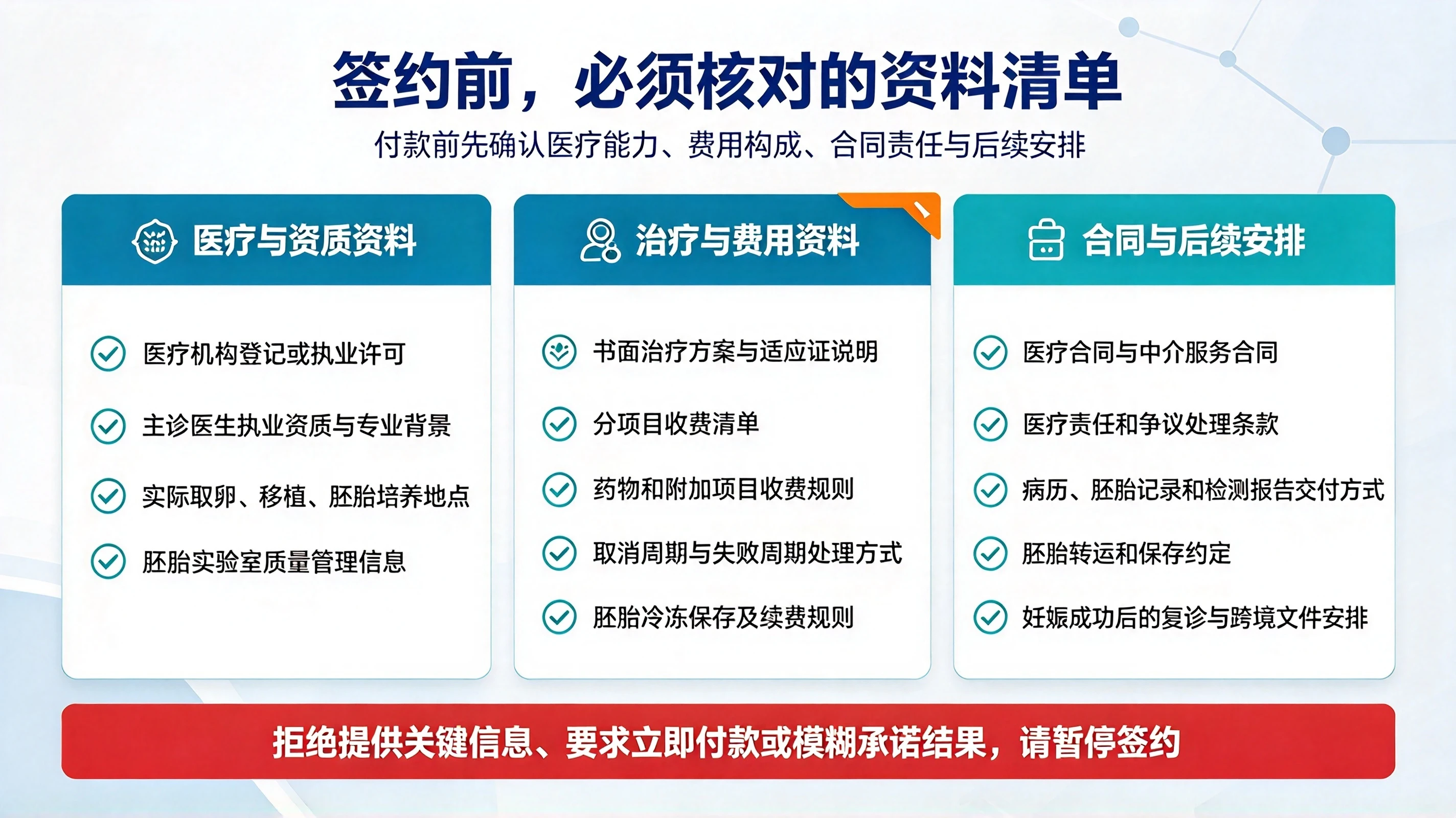
1. Medical and Qualification
Legally Registered Medical Institution / Practice License
Proof of the Attending Physician's Professional Qualifications and Background
The specific locations for egg retrieval, embryo transfer, and embryo culture
Documents Related to Quality Management and Accreditation of Embryo Laboratories
2. Treatment and Costs
Written Treatment Plan and Indication Statement
Itemized Fee Schedule
Billing Rules for Medications and Additional Items
Fee Handling Rules for Canceled and Failed Billing Cycles
Rules for Embryo Cryopreservation and Renewal Standards
3. Contract and Follow-up Arrangements
Formal Medical Service Contracts and Intermediary Service Contracts (if applicable)
Medical Liability Determination and Dispute Resolution Clauses
Delivery methods for medical records, embryo records, and test reports
Agreements Related to Embryo Transfer and Preservation
Legal Opinion on Donor/Third-Party Reproduction
Post-Pregnancy Follow-up and Cross-Border Document Processing Arrangements
If the institution refuses to provide key qualification information, declines to explain its fee structure, or demands immediate payment without a full understanding of the plan, it is advisable to suspend signing the contract.
Conclusion
Choosing an overseas reproductive medicine center should not be a contest centered on reputation, technological gimmicks, and success rate figures. Truly trustworthy institutions must possess legitimate and compliant medical credentials, provide clear explanations of individualized treatment plans by their physicians, maintain traceable embryo laboratory management systems, and be willing to transparently disclose the methodology behind success rates, cost structures, and potential risks.
For every family, what matters most is never finding the hospital that claims the highest success rate, but rather a medical institution that can explain treatment challenges based on your actual medical records, clearly articulate the rationale behind its protocols, and take responsibility throughout the entire course of treatment and subsequent management.
The core principles of cross-border medical care are always: first verify qualifications, then assess medical capabilities; first clarify legal boundaries, then compare costs; and first understand how success rates are calculated, before deciding to sign a contract. This approach holds far more practical value than any globally unverified ranking.
Frequently Asked Questions
The content on this website is general educational material and compiled public information about IVF. It is provided for reference only, does not constitute a basis for diagnosis or medical decision-making, and does not constitute any medical advice or treatment recommendation. For policy and technical requirements, please refer to official publications issued by the relevant authorities and institutions. If you find any content errors, numerical inconsistencies, or outdated information, please contact us so we can verify and update it.
