

A London IVF pitfall-avoidance guide written for Chinese families, breaking down the truth behind HFEA success rates, the real total cost of IVF, and the decision logic between fresh embryos, frozen embryos, and PGT-A—helping you calculate the cost of trial and error and make a rational decision.
Read allIf you’ve already browsed a few “beginner’s guides” to IVF in London, you likely know the basics: single-cycle costs range from £3,000–£5,000, live birth rates for women under 35 are around 40%, regulation by the HFEA is transparent, and a standard visitor visa suffices. This information is accurate, but it hardly helps you make the core decision: whether it’s worth committing a budget of RMB 80,000–180,000—and irreversible ovarian time—to London, and how to do so while minimizing the cost of trial and error.
This handbook does not restate the surface-level figures found everywhere; instead, it deconstructs three decision points that most guides gloss over lightly—the statistical metrics for success rates, the hidden structure of pricing, and the applicability boundaries of technology choices—helping you build your own framework for judgment before walking into any clinic.
I. First, Calculate the "Cost of Trial and Error": The Core Value of IVF in London Is Not a "Higher Success Rate"
Many people’s first expectation when considering IVF in London is “a higher success rate,” but this is precisely where unrealistic expectations most often arise. Official UK data show that the cumulative live birth rate over six cycles, adjusted for prognosis, is approximately 65%, while the live birth rate for a single cycle is only about 29.5% (HFEA). This means that for most patients, the essence of the first cycle is “information gathering”: your response to ovarian stimulation, the number of eggs retrieved, and the developmental potential of embryos are variables that can only be truly assessed after the first round.
Approach the first cycle as a “test round” when planning your budget and psychological expectations, rather than treating it as a “decisive battle.” London’s core advantage over domestic options has never been a guarantee of success, but rather its more transparent information structure: HFEA-mandated reporting of comprehensive cycle data, publicly accessible price lists, and genuine differences in treatment protocols across clinics provide you with an opportunity that is sometimes difficult to obtain domestically—the chance to clearly evaluate all options before committing irreversible ovarian resources.
In other words, London is not a “better test tube,” but rather a “test tube environment with more symmetric information.” The premium you pay for London is essentially payment for regulation, transparency, and safety baselines, not for “miracles.”
II. How to Correctly Interpret Success Rates: HFEA Data Is a Screening Tool, Not a Ranking for Choosing the Best
The HFEA (Human Fertilisation and Embryology Authority in the UK) requires every clinic to report comprehensive cycle data, which indeed represents a structural advantage of London over domestic options. However, many Chinese patients’ first reaction upon receiving this data is to seek out “the clinic with the highest live birth rate,” an approach that fundamentally misunderstands the intended purpose of the HFEA data.
1. First, align the metrics: the “success rate” you’re seeing may not mean the same thing at all
The "success rates" advertised by different clinics may be calculated using vastly different statistical methodologies:
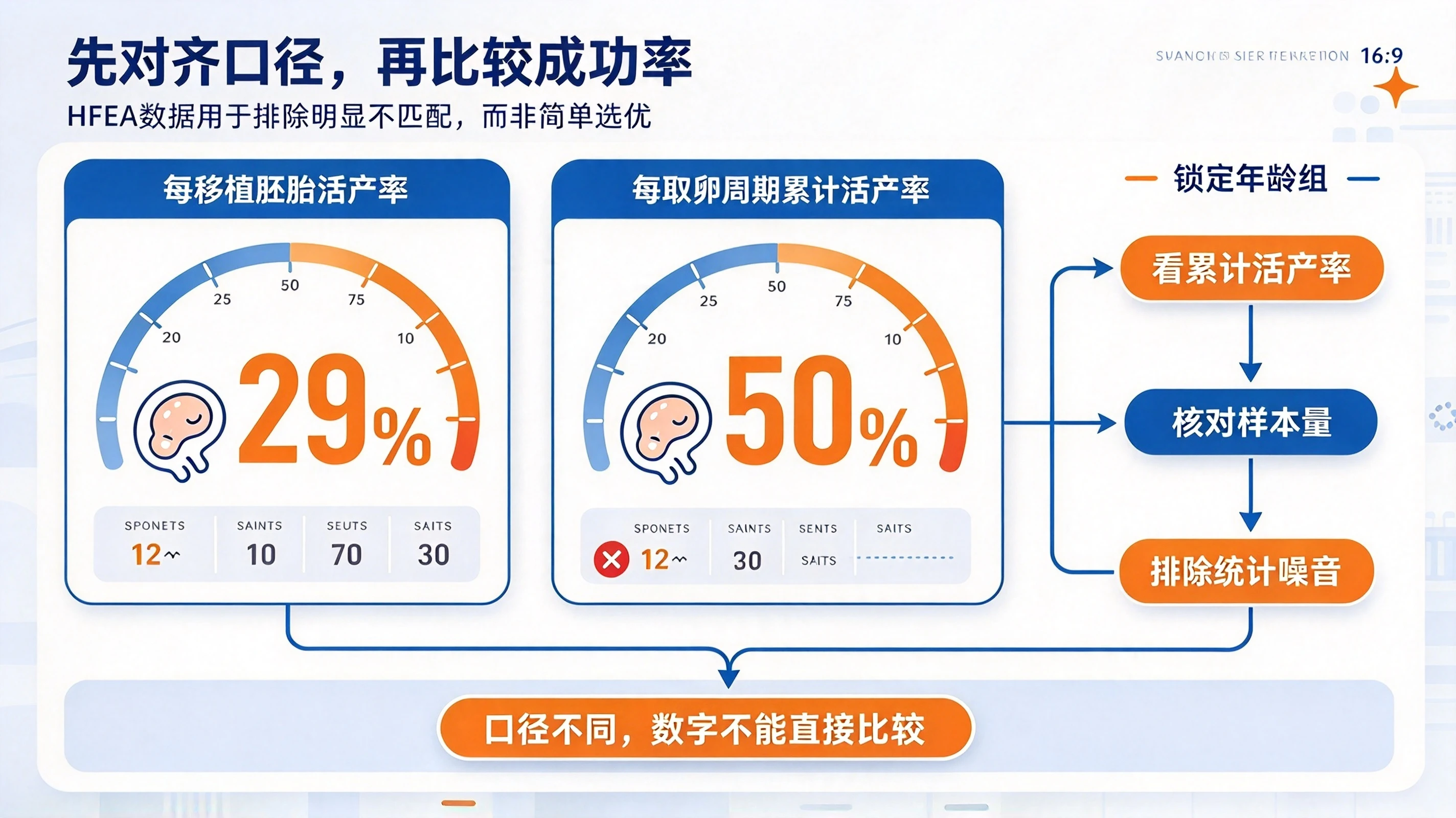
Live birth rate per embryo transferred: The numerator is the number of live births, and the denominator is the total number of transferred embryos. This yields more favorable figures but masks the cycle losses due to “no embryos available for transfer.”
Live birth rate per oocyte retrieval cycleThe numerator is live birth events, and the denominator is all egg retrieval cycles, including subsequent ones.Frozen Embryo TransferThe cumulative outcome, closer to “the probability of eventually holding a baby after paying for one round of ovarian stimulation,” as defined by the HFEA.
Differences by age groupThe live birth rate aggregated across all ages has little reference value, as age is the primary variable affecting success rates.
Taking as an example the public data from three clinics in London for 2025–2026:
Lister Fertility: Under 38, excluding egg donation andPGT-AThe "live birth rate per embryo transferred" is 39%; includedPGT-A TestingAfter embryo development, the same indicator rose to 44%.
Care Fertility London: The metric for the same age group and comparable criteria is only 27%. Imperial C...
The Evewell: The live birth rate per embryo transfer across all age groups is 47%, nearly 70% higher than the HFEA national average of 28%; however, this data has not been broken down separately for younger age groups.
This is not a case of any clinic lying; rather, discrepancies in statistical definitions, patient demographics, and treatment types have led to divergent figures. Before comparing across clinics, you must first ensure that you are comparing data on the same dimension.
2. Correct Use of HFEA Data: For "Exclusion," Not for "Optimization"
The HFEA explicitly states that most clinics are roughly comparable in quality, and small differences in success rates usually stem from variations in the types of patients treated; furthermore, a single clinic’s rates cannot directly predict your individual chance of success.
Its true value lies in helping you eliminate obviously mismatched options:
If you are 42 years old with an AMH level below 1.0, and a clinic reports high overall live birth rates across all ages but has an extremely small sample size and very wide confidence intervals for the 40–42 age group, then its "high success rate" is merely statistical noise for you.
If the gap between a clinic’s “live birth rate per embryo transferred” and “live birth rate per egg retrieval cycle” is too large, it indicates a high cycle cancellation rate or a high proportion of cycles with no embryos available for transfer, warranting caution regarding patient selection bias.
Practical advice: In the clinic search tool on the HFEA website, select your age group and prioritize viewingCumulative Live Birth Rate per Oocyte Retrieval Cycle, this metric more accurately reflects your true return on investment; if the cycle volume for a specific age subgroup is low, directly reduce the decision weight of that data.
III. The Dark Side of Pricing: Between the advertised price and the actual amount paid lies an entire list of add-ons
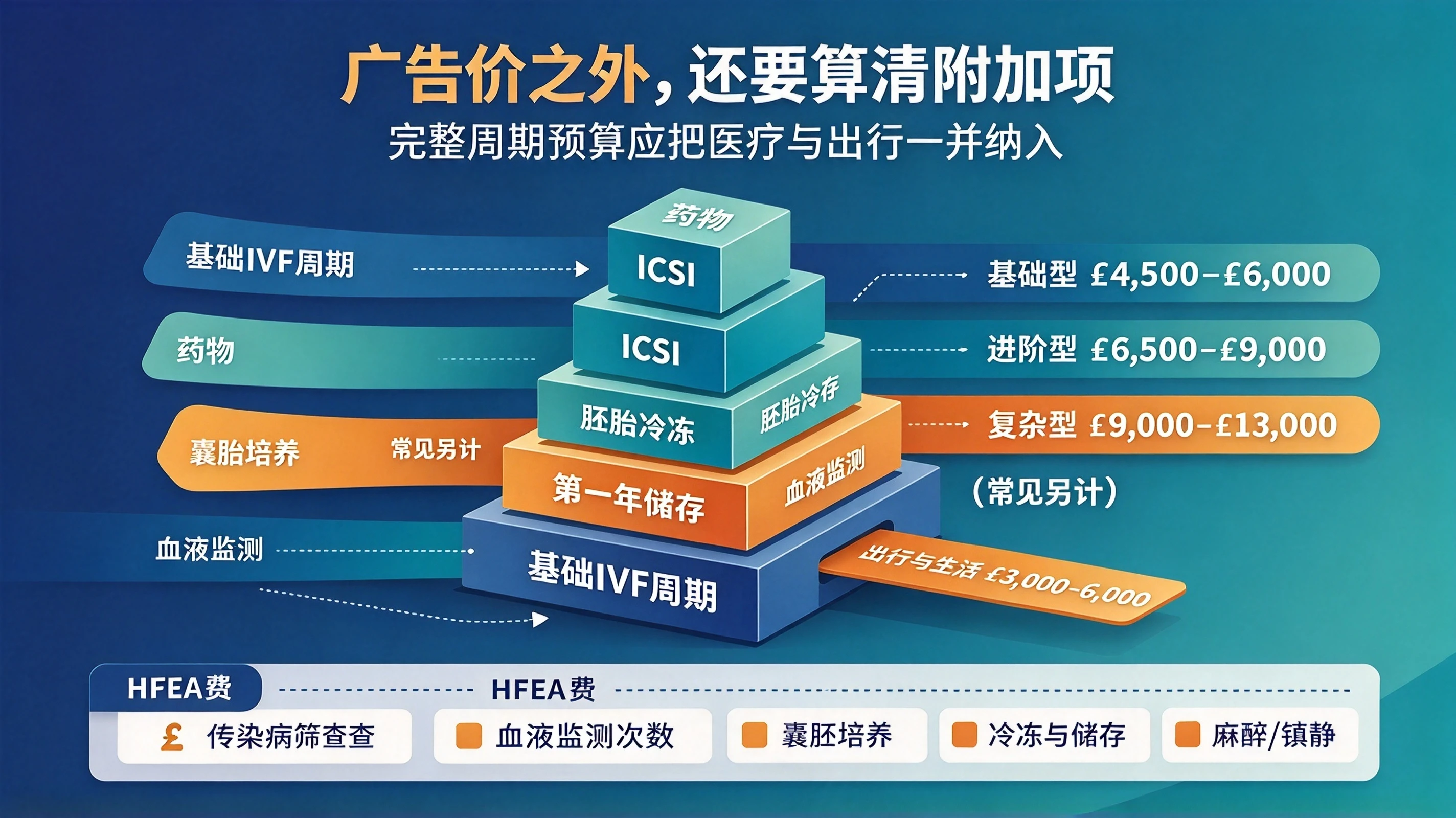
Pricing at London clinics follows a highly typical “à la carte” structure: the base cycle price appears modest, but nearly all core modules essential for completing a full cycle are unbundled and billed separately.
1. The "fluff" in advertised prices: Basic packages only cover "half the journey"
Based on the foundations of three mainstream clinicsIVFPeriod as an example:
Care Fertility London: Basic cycle £3,940, including sedation and ultrasound scans; however, HFEA regulatory fees, infectious disease screening, blastocyst culture, time-lapse imaging,Embryo cryopreservationAll other Imperial C...
Lister Fertility: The basic cycle costs £3,850, including HFEA fees; however, blood monitoring, blastocyst culture, embryo freezing, and infectious disease screening are charged separately.
The Evewell: Total package price for the sample cycle is £6,594, including ultrasound and anesthesia.Fresh embryo transferHFEA fees, blastocyst culture, and time-lapse imaging may appear more expensive, but they actually include far more services than the previous two options.
Once the most basic add-ons are included, a complete cycle that involves egg retrieval, culture to the blastocyst stage, and freezing of surplus embryos typically results in actual out-of-pocket expenses in London ranging from£6,000–£8,500intervals, rather than the £4,000 figure advertised. Industry data from 2026 shows that the median total cost of a single IVF cycle in London is 50–70% higher than the base package price.
2. Checklist of items that must be confirmed individually as "not included"
When consulting, do not ask “How much does IVF cost?” Instead, directly request written confirmation on whether the following items are included:
Are HFEA regulatory fees included in the package?
Are both parties' infectious disease screenings (HIV, Hepatitis B, and Hepatitis C) included?
How many blood monitoring sessions are included during ovarian stimulation? What is the additional cost per session beyond the included number?
Is there an additional fee for blastocyst culture?
Is time-difference imaging a default configuration or an optional add-on?
Is embryo freezing and the first year of storage included?
Is the anesthesia/sedation fee for egg retrieval billed separately?
If there are no transferable embryos in this cycle, is there a refund or discount policy?
This list won’t help you find the “cheapest clinic,” but it can help you avoid the most common dilemma: discovering mid-cycle that your budget is rapidly eroded by add-on fees, forcing you to choose between “paying more” and “abandoning this cycle.”
3. A More Subtle "Second Bill": Unsubstantiated Add-ons
More concerning than basic add-ons are the numerous "value-added" services that lack reliable evidence. The UK House of Lords debate on fertility regulation in June 2026 explicitly noted that the HFEA’s traffic-light ratings are merely advisory, and that regulators have no enforcement powers, meaning many services labeled red (indicating insufficient evidence) continue to be widely marketed in clinical settings.
Industry research shows that more than 70% of IVF patients pay for add-on services, most of which lack high-quality evidence supporting improved live birth rates and some may even pose risks. Common high-cost, low-evidence add-ons include endometrial microbiome analysis, embryo glue, immunotherapy packages, and various “ovarian rejuvenation” treatments.
A core criterion for judging whether a clinic is trustworthy: does it proactively tell you "which procedures you don't need," rather than just listing what it can sell to you?
IV. Boundaries of Technical Choices: Fresh vs. Frozen Embryos, PGT-A—There Is No Default Correct Option
Chinese guidelines often gloss over technology choices with a single sentence: “Remaining embryos can be cryopreserved, and frozen embryo transfer does not require another round of ovarian stimulation.” However, the decision between fresh or frozen embryos, and whether to perform PGT-A, represents critical junctures that directly impact success rates and costs. The answer depends entirely on your individual circumstances.
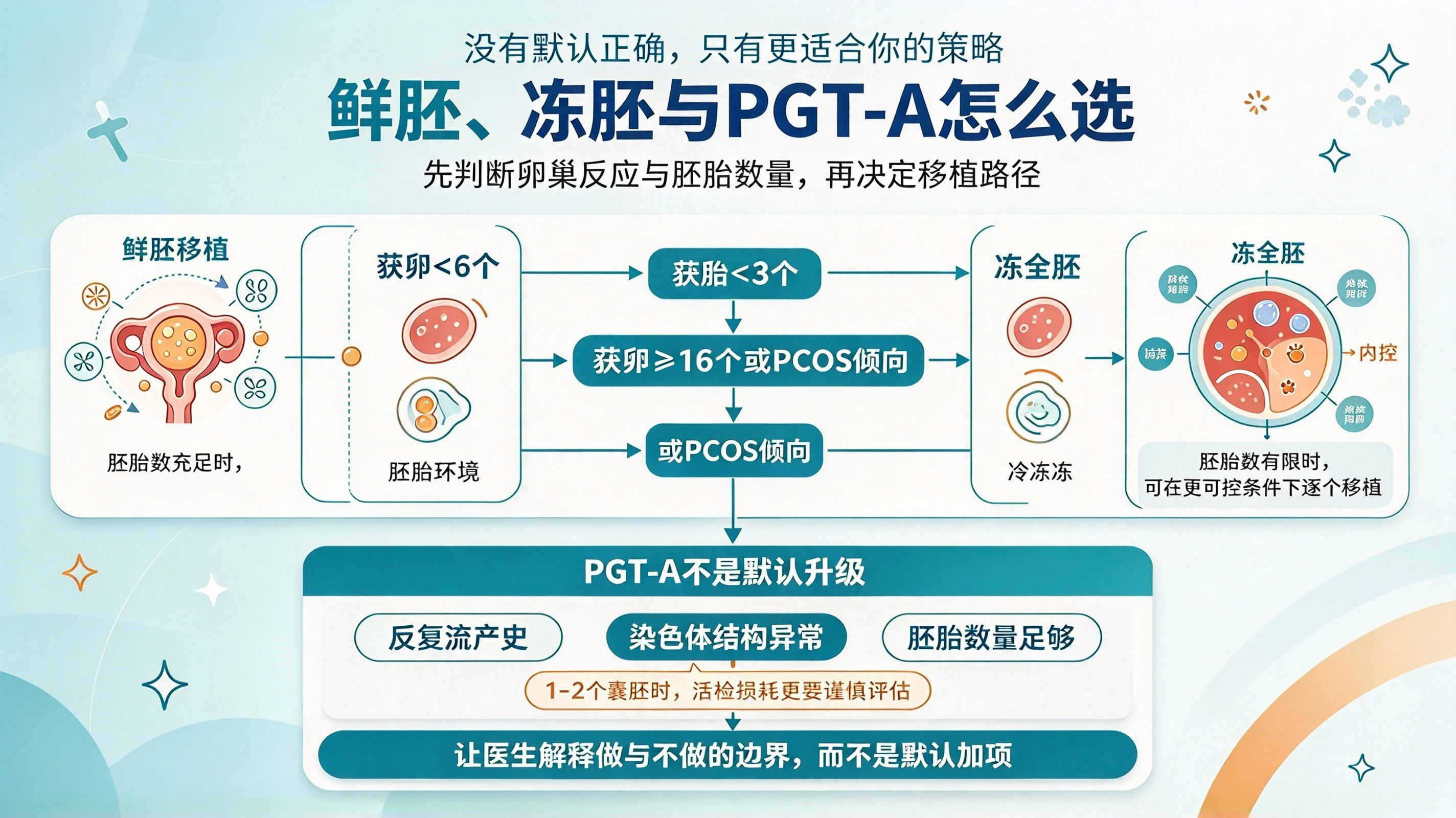
1. Fresh Embryo vs. Frozen Embryo: It’s Not About Which Is Better, But Which Category You Fall Into
A UK single-center matched-cohort study of over 9,000 transplants published in 2026 provided a more nuanced conclusion than “frozen embryos are better.” PubMed:
Poor responders (fewer than 6 oocytes retrieved)There is no significant difference in live birth rates between fresh embryo transfer and the first frozen embryo transfer (26% vs. 27%).
Low-yield cycle (fewer than 3 embryos)The live birth rate was significantly higher with the freeze-all embryo strategy (38% vs. 29%), with more pronounced benefits observed in patients aged over 38.
Cycles in high responders (≥16 oocytes retrieved) or with ≥5 embryosFresh embryo transfer showed a trend toward higher live birth rates, although the difference did not reach statistical significance.
The E-Freeze randomized controlled trial conducted in the United Kingdom also demonstrated that the healthy infant rate was lower in the frozen whole-embryo transfer group (20.3%) than in the fresh embryo transfer group (24.4%), indicating that routine freezing of whole embryos does not improve live birth outcomes ORA.
Decision logicFirst, assess your ovarian response type based on AMH and antral follicle count, then determine the embryo transfer strategy.
In cases of expected low response and limited embryo numbers, transferring embryos one by one in a more controlled endometrial environment after freezing all embryos may be a better option.
Expected high response (e.g.PCOSTendency): The core value of freezing all embryos is to reduce the risk of ovarian hyperstimulation syndrome, rather than to directly improve the live birth rate.
Normal response and sufficient number of embryos: Fresh embryo transfer is more efficient in terms of time and cost, with live birth outcomes no worse than those of frozen embryo transfer.
2. PGT-A: Not an "upgrade," but an option that requires justification of its necessity
Many patients assume that PGT-A is a "premium option" that improves success rates, but authoritative guidelines conclude the opposite.
The NICE 2026 fertility guidelines explicitly recommend:Do not routinely offer PGT-A testing to improve live birth rates.
In the HFEA traffic light system, PGT-A is rated asRed Rating(Evidence does not support improved outcomes), with a green rating only for the "reduced risk of miscarriage" dimension.
The appropriate use cases for PGT-A are very limited:
A clear history of recurrent miscarriage, with the etiology strongly suggestive of chromosomal abnormalities;
Known chromosomal structural abnormalities;
Obtaining a sufficient number of blastocysts (typically ≥5) in a single egg retrieval provides room for selection during screening.
If only 1–2 blastocysts are obtained per cycle, the biopsy procedure for PGT-A itself may compromise already limited embryos, and the "certainty" it offers may not statistically justify this cost. During counseling, do not ask, "Should I have PGT-A?" Instead, ask: "Given my age, medical history, and expected number of retrieved oocytes, what are the estimated cumulative live birth rates with and without PGT-A? What is the evidence base for these estimates?"
V. The Underlying Logic of Clinic Selection: Don't Trust Rankings; Look for Aligned Incentives
There is no absolute "best" clinic in London, only varying degrees of fit. Do not use size, reputation, or rankings as filters; instead, assess whether a clinic aligns with your interests based on the following three dimensions.
1. First Layer: Price Transparency and the Willingness to "Subtract"
A good clinic proactively discloses the full cost and may even tell you which procedures are unnecessary. A bad clinic attracts patients with low initial prices, then incrementally adds extra charges during treatment.
Reverse test question: "Based on my situation, which additional projects do you not recommend I undertake? Why?"
Observation points: Whether the other party proactively mentions the HFEA traffic light ratings, and whether they can clearly distinguish between items with "evidence-based" support and those with "insufficient evidence".
2. Second Tier: Don’t just look at private options; the NHS self-pay route is an undervalued baseline option
London's IVF market is not a binary "NHS vs. private" structure, but rather a three-tier system:
Purely commercial private clinics: Flexible services and fast patient intake, but with a strong marketing orientation;
Self-funded fertility services under NHS trusts: a more conservative evidence-based culture, greater restraint in offering add-on procedures, typically higher pricing transparency, and no need for the long waiting times associated with NHS-funded pathways.
NHS-funded pathway: Free for eligible patients, but with long waiting times and limited availability.
If you are deeply concerned about avoiding overtreatment, the self-pay pathway of NHS hospital trusts is worth consulting as a benchmark; even if you ultimately choose private care, it can help you establish a reference point for identifying "necessary procedures."
3. The third layer: Attitude toward "failure" best reveals the clinic's true character
IVF decisions are rarely one-time events. If one cycle is unsuccessful, you may need a second or third round, adjust the treatment plan, or even considerEgg donationYour relationship with the clinic is not a transaction, but a fiduciary relationship that may last for months or even years.
Reverse-test question: "If no transferable embryos are available after egg retrieval, how do you handle billing? Under what circumstances would you recommend that I pause rather than immediately proceed to the next cycle?"
Core judgment: A clinic willing to discuss with you “when to stop” is more worthy of your body and budget than one that only urges you to “keep going.”
The last question that requires no clinic and only self-reflection: If this cycle fails, am I still willing to return here and discuss the next steps with the same doctor? If the answer is no, then regardless of how impressive their data may be, that clinic is not the right choice for you.
6. Action Checklist: Six Steps to Complete Before Traveling to the UK
Calculate total cost, not advertising priceRequest written all-inclusive quotes from three clinics using an add-ons checklist, ensuring that medications (£800–£2,700), ICSI (£1,000–£1,800), blastocyst culture, and cryopreservation are all included.
Look up the cumulative live birth rate for the corresponding age group: Go to the HFEA website, filter by your age group, and check the live birth rate per egg retrieval cycle; ignore data aggregated across all ages.
Predict ovarian response and rehearse transplantation strategy: Based on AMH/AFC, determine whether you are a low/normal/high responder, and discuss with your doctor in advance the rationale for the corresponding transfer protocol.
Proactively justify the necessity of PGT-A: Not performed by default, unless your doctor can provide evidence-based benefits tailored to you personally.
Reserve for the “Second Cycle Reserve”It’s not because the first round is guaranteed to fail, but because you only get your real data after the first round. Reserving budget allows you to make rational adjustments based on that data, rather than being held hostage by the budget.
Prioritize the schedule of "splitting frozen embryo transfers into two separate trips."For the first trip to the UK, complete ovarian stimulation and egg retrieval within two weeks; freeze the embryos and return home for recovery. One to two months later, make a second one-week trip to the UK for frozen embryo transfer. This approach offers more stable success rates, reduced physical burden, and greater flexibility in scheduling.
Human Fertilisation and Embryology Authority (HFEA) - Choose a Fertility Clinic
HFEA – Treatment Add-On Ratings
HFEA - Fertility Treatment 2023: Trends and Figures
NICE Guideline NG257: Fertility Problems: Assessment and Treatment
UK Parliament – House of Lords debate: Adequacy of the law on the regulation of fertility treatment
The Evewell - IVF Clinic London
Frequently Asked Questions
The content on this website is general educational material and compiled public information about IVF. It is provided for reference only, does not constitute a basis for diagnosis or medical decision-making, and does not constitute any medical advice or treatment recommendation. For policy and technical requirements, please refer to official publications issued by the relevant authorities and institutions. If you find any content errors, numerical inconsistencies, or outdated information, please contact us so we can verify and update it.