
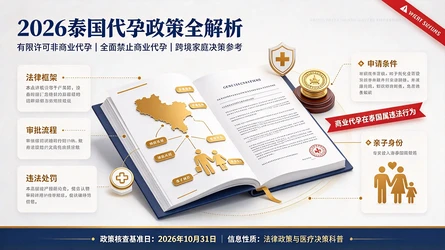
Drawing on Thailand's current laws and embassy advisories as of October 2026, this article explains the rules governing Thailand's strictly limited non-commercial surrogacy, the application and approval requirements, the legal consequences of violations, and the cross-border identity risks, providing affected families with an informative policy reference.
Read allThis article is compiled based on Thailand’s current laws, publicly available government administrative regulations, and related policy materials that can be verified as of October 31, 2026. It is provided solely for general legal and policy education regarding assisted reproduction and for general decision-making reference. It does not constitute legal advice or medical advice for any specific family. Laws and related regulations concerning surrogacy in Thailand may change. Specific application eligibility, administrative authorizations, medical implementation, and determination of a child’s legal identity and status shall be subject to the Thai laws in effect at the time of application, official documents from the competent authorities, and case-by-case approval outcomes. If Chinese nationality, parentage, or cross-border document processing is involved, separate consultation with the relevant Chinese authorities and qualified legal counsel should be sought.
Preface
In recent years,Cross-Border Assisted Reproductive TechnologyIt has gradually become a focus of attention for families facing fertility challenges. Thailand, with its mature healthcare system and geographical advantages, was once a popular destination for international assisted reproductive services. However, since the enactment of specific legislation in 2015, surrogacy regulation in Thailand has entered a phase of strict standardization; it is neither "fully open" nor "completely prohibited."
Thailand’s Marriage Equality Law officially came into force in 2025, and public consultations on amendments to laws related to assisted reproduction were launched in 2026, with policies undergoing dynamic adjustment. The Embassy of China in Thailand has issued repeated reminders clearly stating that commercial surrogacy is illegal in Thailand. Based on Thailand’s currently effective laws, official public information, and advisories from the Chinese Embassy in Thailand, this article systematically reviews relevant issues across dimensions including the legal framework, eligibility requirements, approval procedures, legal risks, and parentage, providing families with a compliance-oriented reference for decision-making.
I. The Core Legal Framework of Thailand's Surrogacy Policy
1.1 Core Legislative Basis
The core law governing surrogacy regulation in Thailand isLaw on Protection of Children Born Through Assisted Reproductive Technology (B.E. 2558, 2015),the law officially took effect on July 30, 2015, and isAssisted Reproductive Technology in ThailandDedicated legislation in the field of surrogacy, with the core content covering:
Medical Implementation Standards and Institutional Licensing for Assisted Reproductive Technologies
Legal Eligibility of the Intended Parents and the Surrogate
Administrative Approval Procedures for Surrogacy
Prohibition Clauses on Commercial Surrogacy and Illegal Intermediaries
Legal Determination of the Parent-Child Relationship of Children Born through Surrogacy
Criminal and Administrative Penalty Standards for Illegal Acts
The core principle of this law is to bring third-party reproduction under strict medical and administrative regulation, with the protection of children's rights and women's rights as the starting point of legislation, rather than opening surrogacy to marketization.
1.2 Legal Characterization of Surrogacy
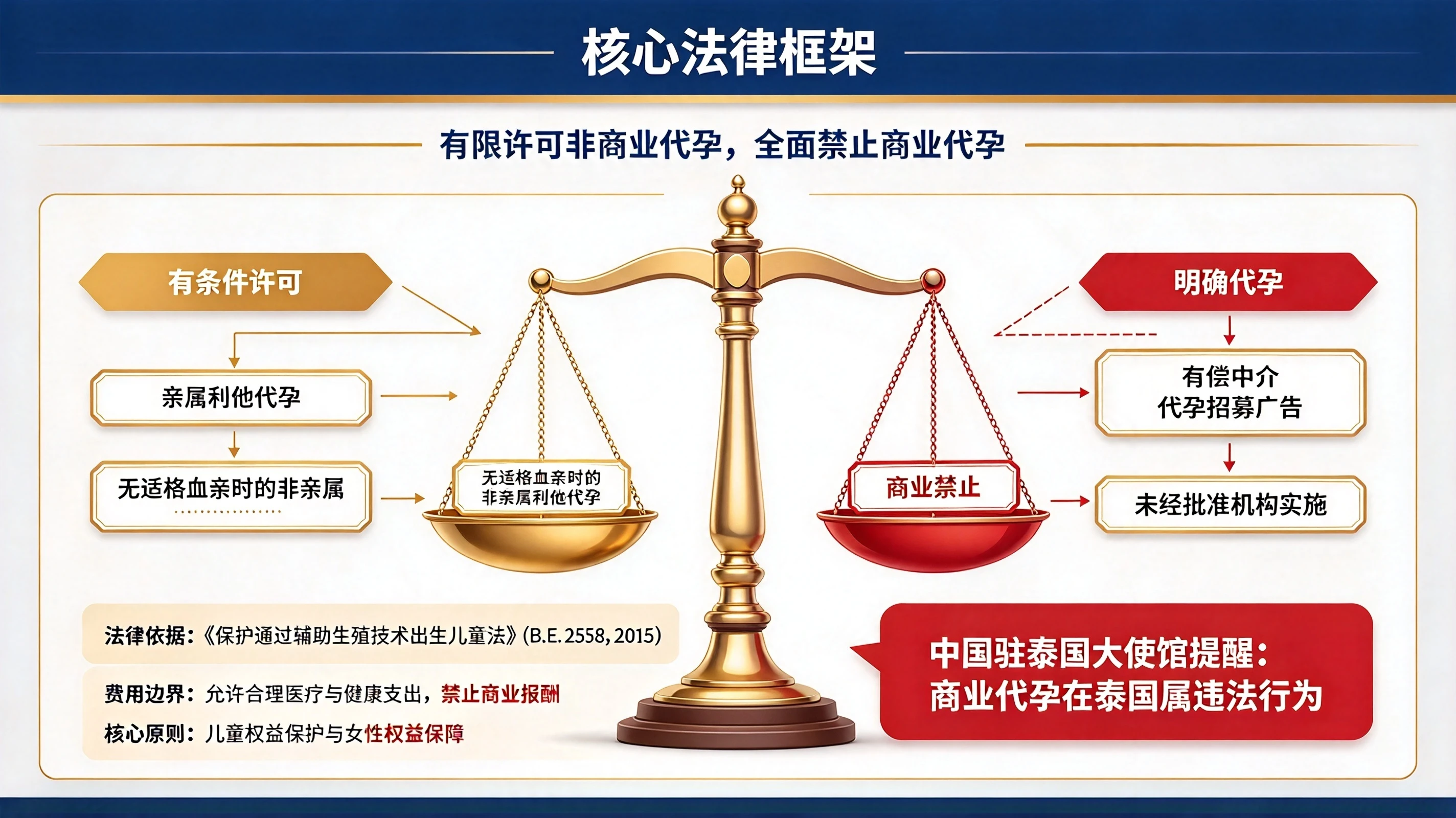
Thailand has not imposed a “one-size-fits-all” ban on surrogacy, but rather adoptsLimited authorization of non-commercial surrogacy, with a complete ban on commercial surrogacy.regulatory model, with the specific boundaries as follows:
Table
Types of Surrogacy | Legal attitude |
|---|---|
Altruistic surrogacy by eligible relatives | Conditional permit, subject to administrative approval |
Non-Relative Altruistic Surrogacy in the Absence of Eligible Blood Relatives | Statutory exceptions requiring specialized approval |
For-profit commercial surrogacy | Explicitly prohibited |
Fee-based intermediary brokering surrogacy matches | Explicitly prohibited |
Surrogacy recruitment advertising | Explicitly prohibited |
Unauthorized institutions conducting surrogacy medical services | Explicitly prohibited |
Evading official approval through private contracts | Does not have the legal effect of surrogacy. |
Common Misconception Corrected: Legal surrogacy in Thailand is not limited to surrogacy by relatives. Under Article 21 of the law, if the intended couple has no eligible biological relative, they may apply, in accordance with the regulations of the Ministry of Public Health, for another eligible woman to carry the pregnancy. However, this provision does not amount to allowing open recruitment for commercial surrogacy; it remains subject to strict approval, and commercial compensation is prohibited.
1.3 Cost Boundaries of Legal Surrogacy
Thai law permits covering reasonable and necessary medical and health-related expenses in surrogacy arrangements, but strictly distinguishes "compliant expenses" from "commercial compensation."✅Legally allowable expenses: Medical costs for prenatal check-ups, delivery, and postpartum recovery for the surrogate; necessary costs for health maintenance and living care during pregnancy; and basic medical care expenses for the newborn.❌Strictly prohibited fees: commercial compensation in consideration of pregnancy, disguised remuneration under such labels as “hardship fee” or “nutrition fee,” and surrogacy matching service fees charged by intermediary agencies.
Any arrangement that disguises commercial compensation as compliant expenditure by reclassifying fees may be deemed commercial surrogacy and subject to legal liability.
II. Eligibility Requirements for Legal Surrogacy in Thailand
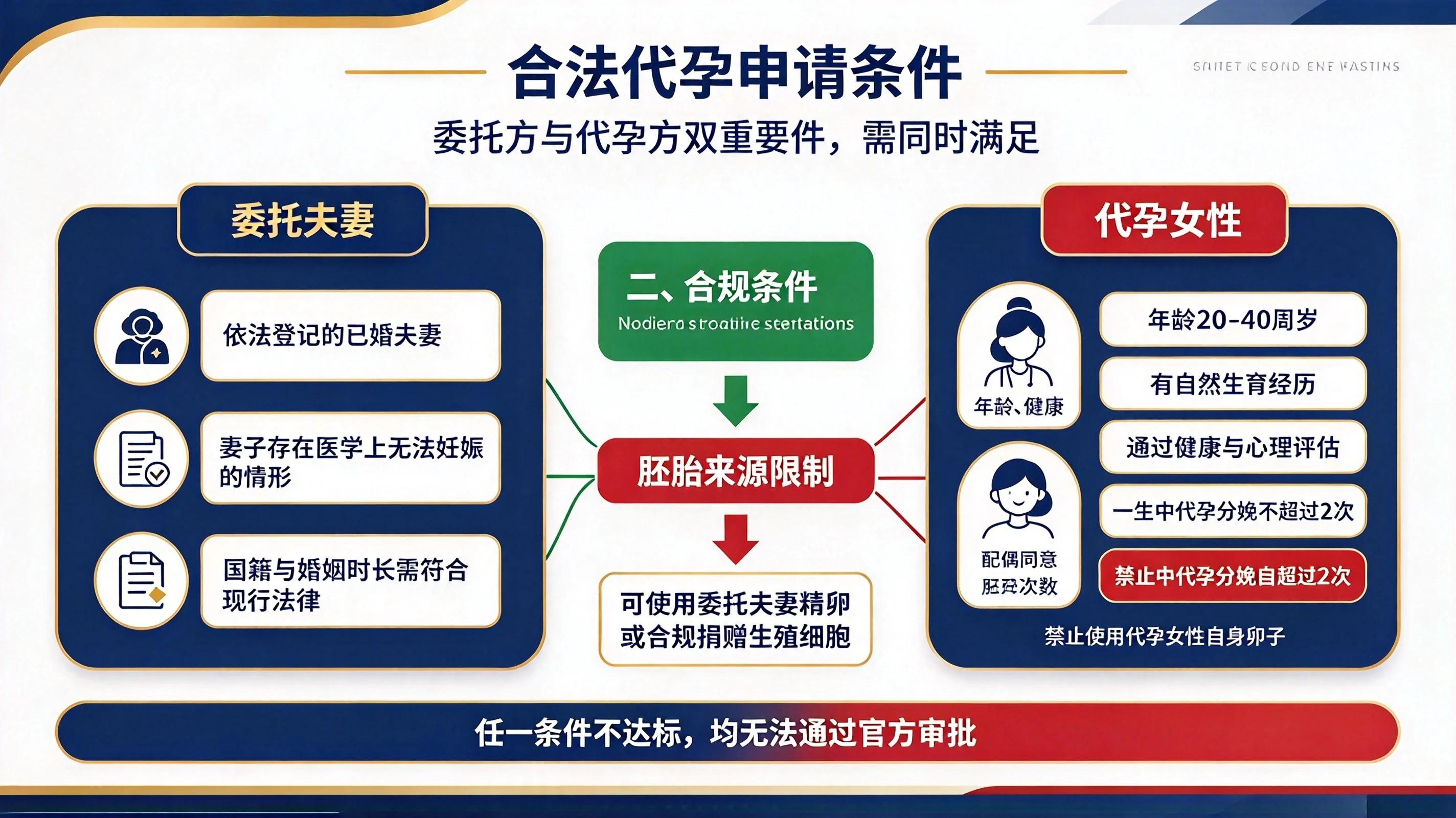
Eligibility to apply for lawful surrogacy is determined jointly by law and supporting administrative regulations. The application must simultaneously meet requirements applicable to both the commissioning party and the surrogate; if any condition is not satisfied, it will not be approved.
2.1 Eligibility Requirements for Intended Parents
Marriage and Nationality Requirements
Under current law, surrogacy applications may be filed only by legally registered married couples where the wife has a medical condition that makes pregnancy impossible; nationality-based access is divided into three categories:
Both parties are Thai citizens: once the other conditions are met, the approval application may be submitted as usual.
If one party is Thai and the other is foreign, the marriage must have been registered for at least 3 years before submission for approval.
Both parties are foreign nationals: ineligible as surrogacy applicants under current law.
Important Notice: Satisfying the nationality and marital eligibility criteria merely constitutes a threshold for application and does not guarantee approval. The final determination will depend on a comprehensive assessment of medical indications, the qualifications of the surrogate mother, and other relevant factors.
Medical indication requirements
Surrogacy applications require clear medical evidence proving that the wife is unable to carry a pregnancy safely. Common eligible situations include:
Congenital absence or severe developmental malformation of the uterus
The uterus has severe organic lesions and cannot sustain a pregnancy.
Pregnancy poses significant risks to the mother's life and health.
Other conditions determined through professional medical evaluation to preclude natural conception
Please note: infertility due to advanced age,Repeated IVF failuresConditions such as diminished ovarian function do not automatically meet the statutory medical indications for surrogacy, and the final determination shall be subject to the evaluation by qualified medical institutions in Thailand and the review by the competent authorities.
2.2 Legal Requirements for Surrogate Mothers
Under Thailand's relevant administrative regulations, a surrogate mother must simultaneously satisfy the following conditions:
Table
Review Dimensions | Specific requirements |
|---|---|
Nationality | Having the same nationality as at least one of the intended parents |
Age | Ages 20–40 |
Childbirth experience | History of natural childbirth, with no more than 3 vaginal deliveries and no more than 1 cesarean section. |
Health status | After a comprehensive physical examination, no contraindications to pregnancy were found. |
Psychological Assessment | Has adequate capacity to give informed consent, as determined by psychological assessment. |
Marital Status | If the applicant has a spouse, written consent from the spouse must be obtained. |
Number of surrogacies | The number of surrogate deliveries in a lifetime shall not exceed two. |
The Distinction Between Kinship and Non-Kinship Surrogacy
Kinship surrogacy (in principle): The surrogate mother is a consanguineous relative of either spouse in the intended-parent couple, and shall not be a lineal ascendant or lineal descendant.
Non-relative surrogacy (exceptional circumstances): Applications for non-relative surrogacy may be made only when the commissioning couple has no qualified biological relatives, subject to strict specialized review, and market-based recruitment is prohibited.
2.3 Legal Restrictions on Embryo Sources
Thai law clearly specifies the source of embryos used in surrogacy:
Embryos can be formed using the sperm and eggs of the intended parents.
Sperm and egg from one intended parent may be used, combined with third-party gametes donated in compliance with regulations.
The use of the surrogate's own oocytes is strictly prohibited; the surrogate shall assume only the gestational function.
III. Approval Procedures and Medical Oversight of Surrogacy in Thailand
Implementation of Legal Surrogacy in ThailandCase-by-case approval system,there is no general qualification; each surrogacy case must obtain official approval separately before it can be performed.
3.1 Entry Requirements for Medical Institutions
Medical institutions providing surrogacy services must simultaneously meet the following requirements:
Possesses a valid medical institution practice license
Official Recognition for Assisted Reproductive Technology Services
Meets the specialized medical service standards for surrogacy
Equipped with a compliant reproductive medicine team and ethics committee
Note: NormalTest tube babyQualifications do not imply surrogacy qualifications, and hospitals that have not obtained a specific surrogacy license may not provide related services.
3.2 Complete Official Approval Process
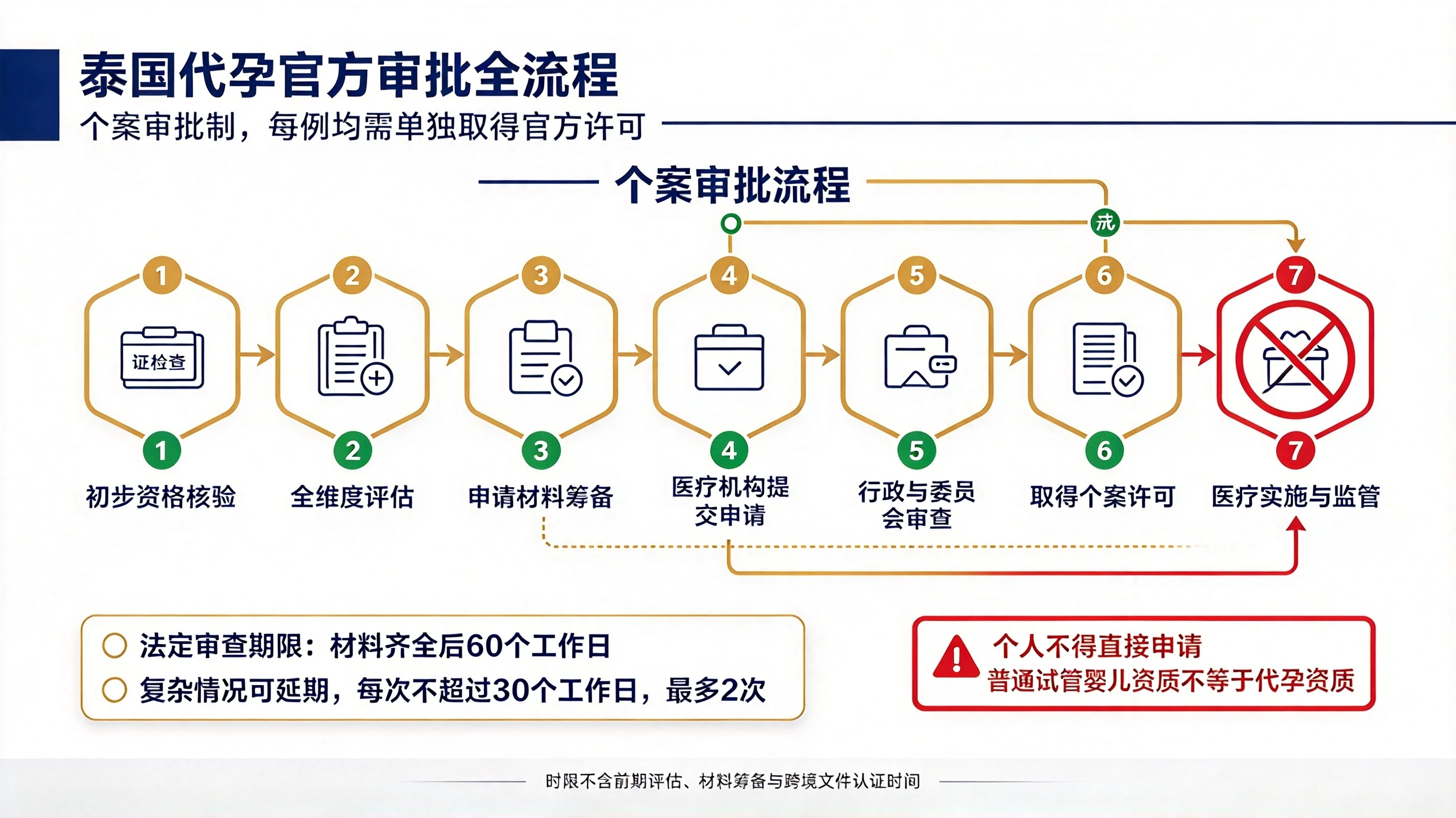
Approval for legal surrogacy must be submitted by a qualified medical institution; individuals cannot apply directly. The complete process is as follows:
Preliminary Eligibility Verification: Healthcare institutions verify basic conditions such as the spouses’ nationality, length of marriage, and medical indications.
Comprehensive assessment: Conduct a holistic physical, psychological, and social-environmental evaluation of intended parents, surrogate mothers, and gamete donors.
Preparation of Application Materials: Compile a complete set of documents, including identification, marriage certificates, medical records, proof of kinship, and informed consent forms from all parties.
Official Application Submission: Medical institutions submit individual case applications to Thailand's Department of Health Service Support and the relevant supervisory committee.
Administrative and Committee Review: The competent authority verifies the materials, and a specialized committee conducts the compliance review.
Obtain case-specific approval: Upon approval, a formal approval document specific to the case shall be issued.
Medical implementation and oversight: Carry out medical procedures in accordance with the approved plan, subject to supervision by competent authorities throughout the entire process, and report progress regularly.
3.3 Notes on Approval Time Limits
The official statutory review period is 60 working days after the required documents are complete. If the case is complex, an extension may be requested, with each extension lasting no more than 30 working days and up to a maximum of two extensions. This timeframe covers only the administrative review cycle and does not include the time required for prior medical assessments, document preparation, cross-border document authentication, or similar preliminary steps; the overall timeline must be planned separately.
IV. Legal Restrictions and Penalties for Violations
4.1 Core Prohibitory Provisions
Prohibition of Commercial Surrogacy: It is illegal for any person to organize or carry out surrogacy for commercial interests.
Prohibition on Paid Intermediary Services: Receiving any form of consideration for surrogacy matching or referral is prohibited.
Surrogacy Advertising Prohibited: Publishing any promotional information relating to surrogacy recruitment or surrogacy demand, in any form, is prohibited, regardless of whether it is for profit.
Prohibition on the Sale and Purchase of Reproductive Cells: The sale and purchase of sperm, eggs, and embryos is prohibited, as is the unauthorized cross-border transportation of reproductive cells.
The Chinese Embassy in Thailand has clearly warned that commercial surrogacy is illegal in Thailand and that Thai law enforcement agencies have been steadily intensifying their crackdowns, and strongly urged against believing promotional claims by intermediaries or traveling to Thailand to participate in related activities.
4.2 Penalty Standards for Violations
Under the relevant provisions of the 2015 law, the maximum penalties for major violations are as follows:
Table
illegal act | Statutory maximum penalty |
|---|---|
Organization and Implementation of Commercial Surrogacy | Up to 10 years in prison and a fine of 200,000 baht |
Paid intermediary services; illegal publication of surrogacy advertisements | Imprisonment for up to 5 years, or a fine of 100,000 baht, or both. |
Unqualified institutions illegally provide medical surrogacy services. | A maximum of 10 years' imprisonment, a fine of 200,000 Thai baht, or both. |
Trafficking in gametes and illegal import/export of embryos | Up to 3 years' imprisonment, a fine of 60,000 baht, or both. |
Medical personnel practicing in violation of regulations | Imprisonment for up to one year, or a fine of 20,000 Thai baht, or both. |
V. Parentage and Legal Status of Children Born via Surrogacy
5.1 Determination of Parentage in Legal Surrogacy
Pursuant to Section 29 of Thai law, in a lawful surrogacy arrangement that has been officially approved by the competent authority, a child born through such surrogacy shall be recognized by law as the legitimate child of the intended spouses and shall enjoy the same legal rights as a child born through natural procreation.
Surrogate mothers do not automatically acquire legal motherhood by virtue of pregnancy.
Gamete donors shall not acquire parent-child rights and obligations solely by virtue of their genetic connection.
The legal effect presupposes official approval of the surrogacy arrangement; unapproved private surrogacy arrangements are not directly covered by this provision.
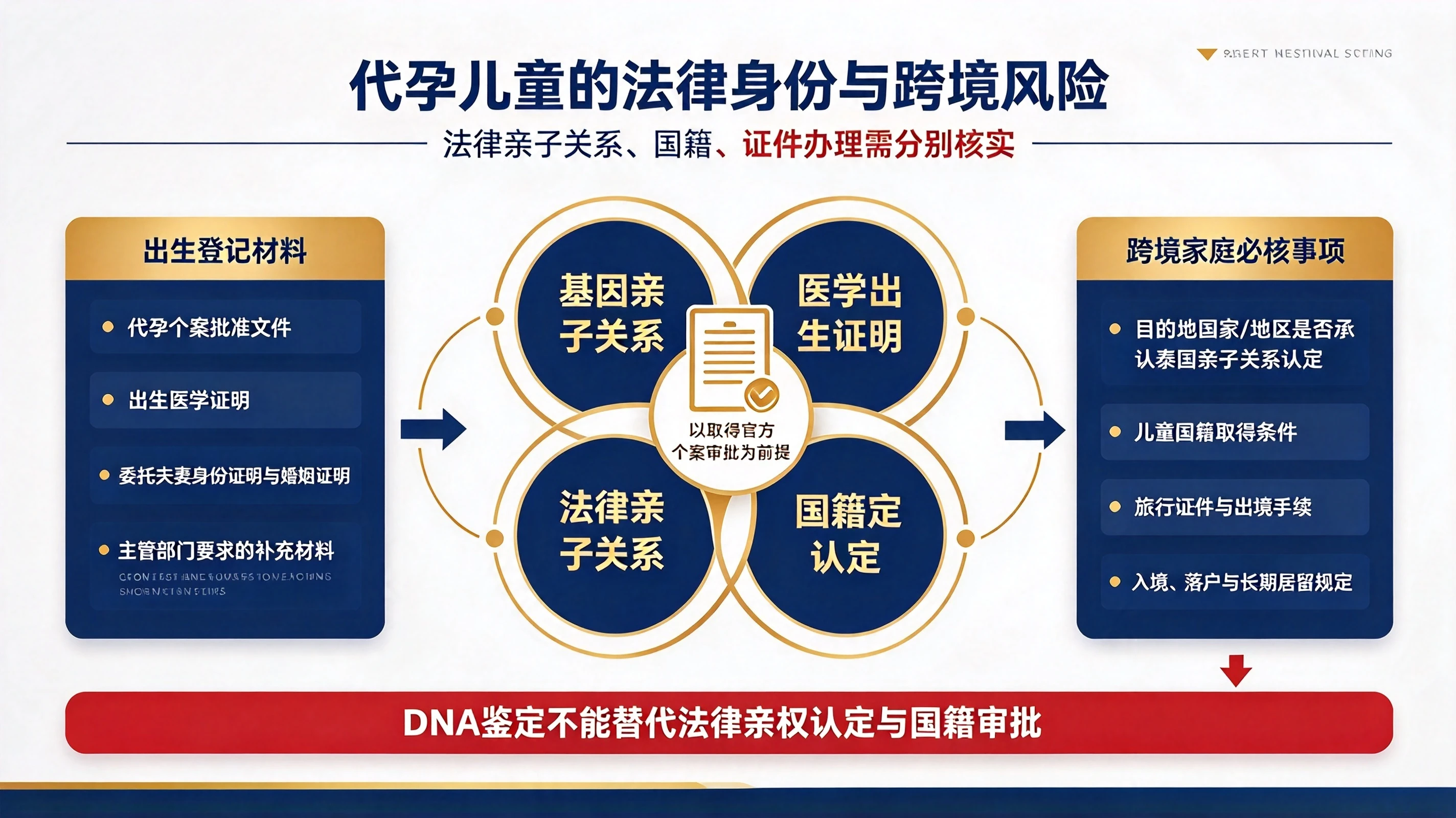
5.2 Requirements for Birth Registration Processing
The following core documents are required for the birth registration of a child born through surrogacy:
Officially issued approval document for individual surrogacy cases
Official medical certificate of birth issued by a medical institution
The entrusting couple's proof of identity and proof of marriage
Other supplementary materials required by the competent authority
A hospital-issued birth certificate alone cannot complete a compliant birth registration; surrogacy approval documents are a mandatory requirement.
5.3 Identity Risks in Transnational Families
For families planning to take their children back to China or any other country, the following matters must be verified separately; do not assume that “a child can be taken away immediately after birth.”
Is the determination of parentage in Thailand recognized by the destination country/region?
Whether the child meets the requirements for acquiring nationality of the destination country.
Travel DocumentRequirements and documents for handling exit formalities
Relevant regulations on entry, household registration, and long-term residence
Key Note: Genetic parentage, medical birth certificates, legal parentage, and nationality are four independent legal concepts; DNA testing cannot substitute for legal determination.Determination of Parental RightsWith nationality approval.
VI. Policy and Legislative Amendment Developments in 2025-2026
6.1 Institutional Coordination Needs Arising from the Marriage Equality Law
Thailand’s Civil and Commercial Code Amendment (No. 24) (the Marriage Equality Act) officially came into effect on January 22, 2025. Same-sex couples may register their marriages under the law and enjoy the same marital rights as opposite-sex spouses. However, the 2015 Assisted Reproduction Act still uses the gendered terms “husband” and “wife,” creating a gap between the statute and the new marriage framework. Legalizing same-sex marriage does not automatically qualify same-sex couples to apply for surrogacy; completion of the relevant supporting legal amendments is still required.
6.2 Main Directions of the 2026 Revised Draft
In July 2026, Thailand's Ministry of Public Health initiated a public consultation on the draft amendment to the assisted reproduction law, with the main directions for revision including:
Replace "husband" and "wife" in laws with the gender-neutral term "spouse" to align with the marriage equality system.
Explore adjustments to the eligibility criteria for surrogacy applications by foreign couples.
Expand the scope of application of assisted reproductive technology for married couples.
Improve cross-border management rules for reproductive cells and embryos
Strengthen law enforcement and regulatory oversight, and raise the penalty standards for certain illegal acts.
6.3 Cultivation Status Prompt
As of October 31, 2026, the draft amendment remains in the legislative advancement stage; public consultation does not mean it has legal effect, and the draft’s content cannot serve as a legal basis for current applications. At this stage, all surrogacy applications must still be governed by the 2015 law currently in force. Particular vigilance is warranted against misleading promotions by commercial entities that use the catchphrases “the policy has been opened” and “the new bill has taken effect” as marketing ploys.
7. Special Considerations for Chinese Families Traveling to Thailand for Surrogacy
7.1 Regulatory Rules within China
China's Administrative Measures on Human Assisted Reproductive Technologies clearly stipulate that medical institutions and medical practitioners within China shall not perform any form of surrogacy technology, and that the buying and selling of gametes, zygotes, and embryos is prohibited; the National Health Commission and 14 other departments have also listed illegal surrogacy and illegal trade in sperm and eggs as key targets for rectification.
It should be clarified that the above regulations in China govern domestic medical services and practitioners, rather than directly imposing criminal liability on all surrogacy activities conducted abroad by Chinese citizens; howeverSurrogacy AbroadThe involved issues of parent-child relationships, nationality determination, and document processing all carry multiple legal risks and require careful assessment.
7.2 Core Risks of Nationality and Identity
The determination of Chinese nationality follows a principle combining jus sanguinis and jus soli. Children born through surrogacy do not automatically acquire or lose Chinese nationality solely by reason of birth outside China, nor can nationality registration be directly completed solely on the basis of a genetic connection.Cross-border surrogacyThe nationality determination, travel document processing, and domestic household registration for children born must comply with the relevant regulations of the competent Chinese authorities. It is recommended to verify with Chinese embassies and consulates abroad and professional foreign-related lawyers before making a decision, so as to avoid obstacles in identity determination.
7.3 Illegal Risks Requiring Heightened Vigilance
False promises made by intermediary institutions under the guise of “special channels” and “guaranteed approval”
Obtaining birth registration and certificates by fabricating identities and forging materials
Non-compliant practices that disguise commercial surrogacy as “altruistic surrogacy” or “kinship surrogacy”
Marketing promotions built around gimmicks such as "guaranteed success" and "guaranteed citizenship"
Misleading advertising claiming that the new 2026 law has opened up surrogacy to foreigners.
The aforementioned practices may not only render the surrogacy arrangement void but also give rise to legal liabilities such as forgery of documents and fraud, seriously affecting the child's legal status.
VIII. Family Decision Support Framework
Families with relevant needs are advised to assess step by step according to the following tiers, avoiding prioritizing price and hospitals at the expense of compliance:
8.1 Five-Dimensional Compliance Assessment Checklist
Table
Evaluation dimensions | Core Judgment Criteria |
|---|---|
Entity Qualification | Whether the spouses' nationalities and length of marriage comply with current legal requirements |
Medical indications | Is there a clear medical basis for surrogacy eligibility? |
Qualifications of the surrogate | Whether the surrogate meets all requirements, including age, health, and nationality |
administrative approval | Whether it is possible to obtain the official formal approval document for the individual case |
Identity implementation | Are there clear and feasible procedures for establishing the parent-child relationship, nationality, and relevant documents after the child is born? |
8.2 Tiered Decision-Making Recommendations
Grade A (may be further evaluated)All basic conditions comply with current legal requirements. We are willing to follow the formal approval process and can engage professional agencies and lawyers to conduct case-by-case assessments.
Grade (On Hold)Some conditions remain questionable (such as insufficient marriage duration, unverified family relationship, and unclear residency status); it is recommended to obtain professional legal advice first and avoid paying large fees upfront.
Grade C (not recommended for advancement)Clearly failing to meet current eligibility requirements (e.g., both parties are foreign nationals), or planning to circumvent approval through non-compliant practices, poses significant legal and immigration-status risks.
8.3 Questions That Must Be Verified Before Consulting in Thailand
It is recommended to request a written response from the medical institution and service provider, and to have it reviewed by an independent attorney:
Complete List of Legal Requirements and Documents for Surrogacy Applications
How to Query the Approval Submission Entity and Official Approval Response
Itemized breakdown and legal basis of all fees
Arrangements for Safeguarding the Rights and Interests of Surrogate Mothers
Complete Official Procedures for Birth Registration and Determination of Parentage
Frequently Asked Questions
The content on this website is general educational material and compiled public information about IVF. It is provided for reference only, does not constitute a basis for diagnosis or medical decision-making, and does not constitute any medical advice or treatment recommendation. For policy and technical requirements, please refer to official publications issued by the relevant authorities and institutions. If you find any content errors, numerical inconsistencies, or outdated information, please contact us so we can verify and update it.