
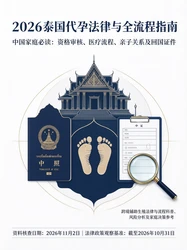
2026 Guide to Thailand's Surrogacy Laws, Policies, and Cross-Border Procedures: This guide analyzes the application requirements for intended (commissioning) couples, surrogate mother eligibility, medical institution accreditation, government approval, birth registration of the baby, parentage establishment, Chinese nationality, and documentation for the child's return to China, helping Chinese families understand Thailand's surrogacy legal regulations and cross-border risks.
Read allKey Verification for Chinese Families: Application Eligibility, Medical Institution Certification, Case-Specific Permits, Birth Registration, and Repatriation Documents
Data verification date: November 2, 2026
Scope of Materials: Based on Thai laws, government service guides, Chinese laws, and publicly available consular services information from Chinese embassies and consulates in Thailand that were accessible as of the date of verification.
Article positioning: Legal and policy education on cross-border assisted reproductive technology, with risk warnings; does not constitute service recommendation or commitment
Important NoticeThis article provides general information on legal policies only and does not constitute legal advice from Thai or Chinese lawyers for specific families. It does not guarantee that any family will obtain surrogacy permits, confirmation of parent-child relationships, nationality determinations, or entry/exit documents.Cross-border surrogacyThis involves children’s rights, medical ethics, criminal risks, and the differing legal systems of Thailand and China. Prior to signing any contract, making payments, or initiating medical procedures, all families should have their arrangements separately verified by a licensed Thai attorney, a Chinese legal professional specializing in cross-border matters, and the relevant Chinese embassy or consulate that will process visa applications. The phrase “as of the verification date” used herein does not imply that subsequent policy changes will not occur; if this document conflicts with official legal texts or the latest regulations issued by competent authorities, the laws, regulations, and official documents in effect at that time shall prevail.
I. Preface: Surrogacy in Thailand requires simultaneously addressing legal, medical, and cross-border identity issues
Surrogacy in Thailand is primarily governed by the Protection of Children Born through Assisted Reproductive Technologies Act B.E. 2558 (hereinafter referred to as the “2015 Assisted Reproduction Act”), along with its supporting announcements and implementing regulations. The current system sets requirements for the eligibility of intended parents, conditions for surrogate mothers, accreditation of medical institutions, case-by-case permits, and commercial activities.
In July 2026, the Thai government launched a public consultation on the draft amendment to the Assisted Reproductive Technology Act of 2015, with the consultation period running from July 2 to July 31, 2026. The proposed amendments mentioned in the government announcement include replacing “husband and wife” with “spouse,” adjusting application requirements involving foreign spouses, and revising rules governing the export of gametes and embryos. **A public consultation or a draft law does not mean that the law has been promulgated and entered into force.** As of November 2, 2026 (the date of this verification), the official sources identified confirm only the existence of the public consultation announcement; no Royal Gazette text sufficient to prove that the draft amendment has been officially promulgated and brought into effect has yet been obtained. Accordingly, this analysis continues to be based on the Assisted Reproductive Technology Act of 2015 and its current implementing regulations. Before proceeding with any formal applications, it is essential to re-verify the latest information through the Royal Gazette and announcements by the competent authorities. [1][2][4]
For Chinese families, at least five questions need to be answered separately:
Do the intended parents meet the eligibility requirements for application under current Thai law?
Are the surrogate mothers, medical institutions, and specific medical protocols compliant with Thai regulations, and has the project obtained formal approval?
After a child is born, can legal parentage and guardianship be established under Thai law?
Does the child have Chinese nationality, and what types of Chinese entry and exit documents can they apply for?
After the child returns to China, how are birth registration, household registration (hukou), and other rights handled?
The fact that Thailand permits certain assisted reproductive arrangements does not mean that China will necessarily recognize parent-child relationships in the same manner; nor does the willingness of Thai medical institutions to accept cases equate to the project having obtained government approval.
II. Current Status of Surrogacy Laws in Thailand in 2026: Which Families Are Eligible to Apply?
1. Basic qualifications under current laws
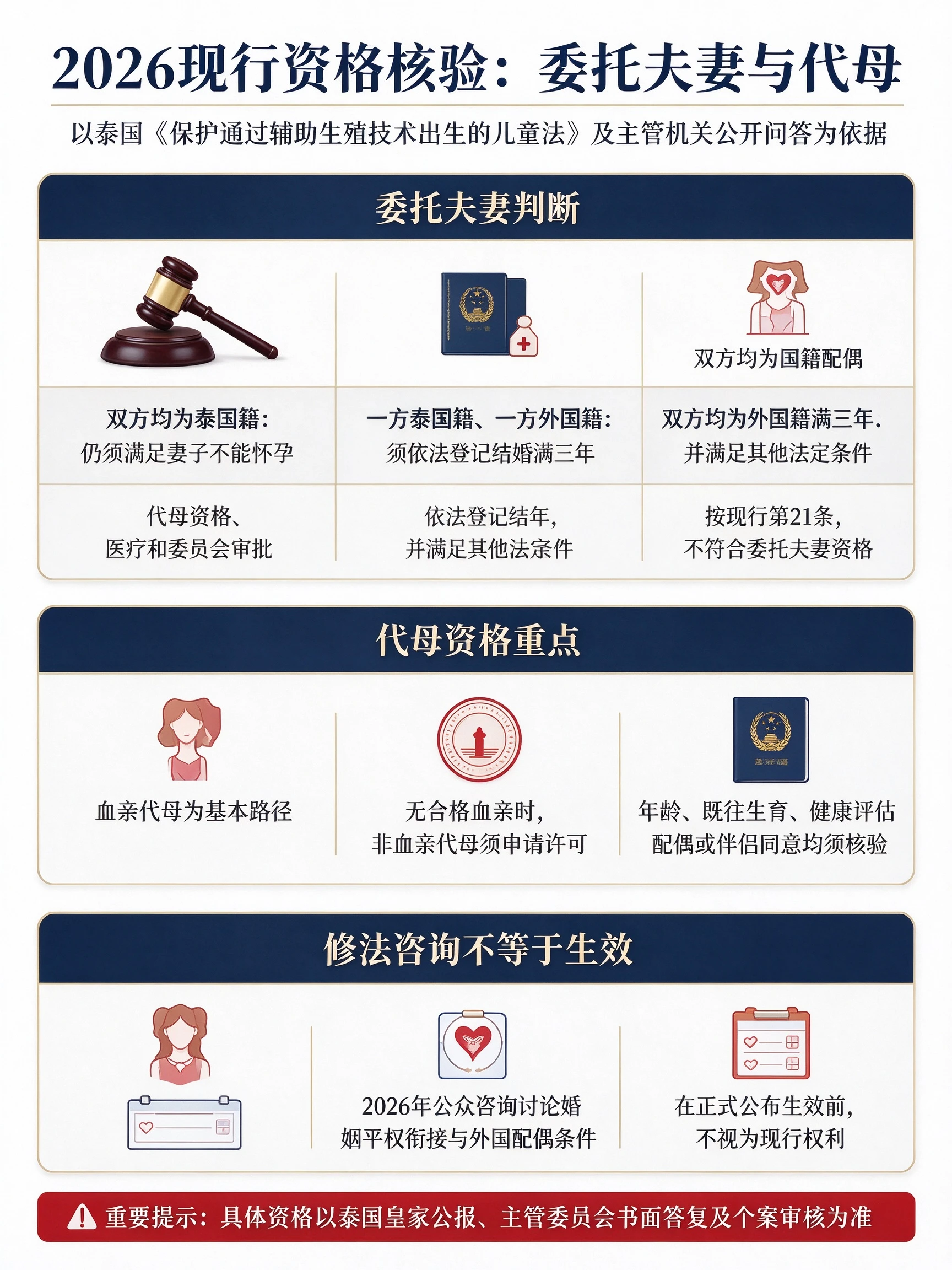
Section 21 of the 2015 Assisted Reproductive Technology Act stipulates the basic eligibility criteria for intended parents and surrogate mothers. According to this section and the public FAQs issued by Thailand’s Department of Health Service Support (HSS), the intended parents must be legally married, and the wife must be medically unable to carry a pregnancy herself. Nationality requirements typically fall into two categories: both spouses are Thai nationals, or one spouse is a Thai national while the other is a foreign national, provided that the couple has been legally married for at least three years. The HSS FAQs explicitly list these two scenarios.[1][2]
Status of the Commissioning Couple | Based on current laws and official Q&A |
|---|---|
Both parties are Thai nationals. | The requirements that the wife must not be able to become pregnant, the surrogate’s eligibility, medical conditions, and committee approval must still be met. |
One party is a Thai national, and the other is a foreign national. | The marriage must have been legally registered for at least three years, and other statutory requirements must be met. |
Both parties are foreign nationals, and neither has a Thai spouse. | Does not fall within the two categories of application scenarios listed in HSS’s public Q&A; eligibility cannot be presumed solely based on being married for three years or residing in Thailand. |
Therefore,For families in which both parties are Chinese nationals and neither has a Thai spouse, the “three years of marriage” requirement should not be interpreted as automatically qualifying them to apply for surrogacy in Thailand.. The paths outlined in HSS’s public Q&A require that at least one spouse be a Thai national; long-term residence, work visas, purchasing assets in Thailand, or assurances from intermediaries cannot substitute for statutory eligibility and government approval. Specific cases should still be verified with the competent authorities by a Thai lawyer, who should obtain written opinions. [1][2]
2. Bridging Marriage Equality and Surrogacy Law
Thailand’s marriage equality law took effect on January 23, 2025; however, relevant provisions such as Section 21 of the Assisted Reproductive Technology Act B.E. 2558 (2015) still retain original terms like “husband” and “wife.” In its 2026 public consultation on legal amendments, the Thai government proposed updating these terms to “spouse” and discussed application requirements involving foreign spouses. This indicates that the enactment of the marriage equality law should not be interpreted as automatically synchronizing eligibility criteria under surrogacy laws. Until the amended laws are officially promulgated and take effect, one cannot presume eligibility for surrogacy applications solely based on marriage registration. [2][4][15]
For applicants who are same-sex spouses or otherwise do not fully meet the traditional definition of a married couple under current provisions, eligibility to apply for surrogacy cannot be presumed solely on the basis of a marriage certificate. Determinations shall be based on officially promulgated and effective amendments to the law, implementing regulations, and written responses from the competent authority.
III. Eligibility of Surrogate Mothers, Source of Gametes, and Embryo Requirements
1. Genetic Surrogates and Non-Genetic Surrogates
Section 21 of the Assisted Reproductive Technology Act (2015) establishes a basic pathway whereby a female blood relative of one party to the intended parents serves as the surrogate, while excluding lineal ascendants and descendants of both intended parents. Only when no eligible blood-related surrogate is available may a non-blood-related woman be engaged for surrogacy pursuant to the implementing regulations, subject to approval by the competent authority. [1][2]
The conditions for non-genetic surrogacy listed in the Thai HSS public Q&A include: [2]
have the same nationality as the corresponding party in the intended parents;
The age must be no less than 20 years old and no more than 40 years old.
With a history of prior childbirth, no more than three natural deliveries and no more than one cesarean section;
Physical, psychological, and living environment assessments passed;
If there is a legal husband or a male cohabiting partner who meets the relevant requirements, their written consent shall be obtained;
Submit a written surrogacy consent form in the prescribed format, stating the relationship with the intended parents.
According to the Thai government’s procedural guide for surrogacy permits, surrogate mothers must not exceed 40 years of age on the date the permit is issued and must comply with the provisions of relevant implementation announcements. The HSS public FAQ also states that a surrogate mother may undergo surrogacy and give birth no more than twice. These requirements regarding age, childbirth history, and number of births should be verified in conjunction with the type of surrogate, current implementation announcements, and review by competent authorities; they should not be assessed solely based on simplified checklists provided by intermediaries.[2][3]
Special distinction is requiredThe detailed criteria, such as an age range of 20 to 40 years and the number of natural deliveries and cesarean sections, are explicitly listed in the HSS Q&A as eligibility requirements for non-kin surrogates. It is inappropriate to mechanically apply every detailed condition specified for non-kin surrogates in the Q&A as identical requirements for kin surrogates without verification. Kin surrogates must still meet the upper age limit, have prior childbearing experience, undergo necessary health assessments, and comply with other applicable implementation regulations, subject to final review by the competent authorities. [1][2][3]
2. Restrictions on Commercial Surrogacy, Intermediaries, and Advertising
Thai law prohibits surrogacy for commercial purposes; it also prohibits acting as an intermediary to arrange or introduce surrogacy in exchange for property or other benefits, and bans the publication of related recruitment or demand advertisements. The advertising prohibition is not contingent on whether there is a profit motive.[1]
Legal Provisions | Main Prohibited Behaviors | Overview of Statutory Penalties |
|---|---|---|
Article 24 and Article 48 | Commercial surrogacy | The maximum penalty is up to 10 years of imprisonment, along with a fine of up to 200,000 Thai Baht. |
Article 27 and Article 49 | Receiving or agreeing to receive money or benefits, and acting as an intermediary in arranging or introducing surrogacy services | The maximum penalty is five years' imprisonment, a fine of up to 100,000 baht, or both. |
Articles 28 and 49 | Publishing or disseminating advertisements seeking surrogate mothers or intended parents; the prohibition of such advertisements as specified in the provisions is not contingent upon whether they are for-profit. | The maximum penalty is five years' imprisonment, a fine of up to 100,000 baht, or both. |
Article 33 and Article 49 | The intended parents or one of them refuse to accept the child born through a surrogacy arrangement | The maximum penalty is five years' imprisonment, a fine of up to 100,000 baht, or both. |
Article 25 authorizes the competent authorities to establish rules governing surrogacy agreements, as well as the costs associated with pregnancy, termination of pregnancy, delivery, postpartum health care for the surrogate mother, and at least 30 days of health care for the child after birth. This does not constitute authorization for arbitrary payment of commercial surrogacy fees, nor does it mean that intermediary commissions can be legalized by reclassifying them as “medical expenses” or “care costs.” Any fee arrangements must specify item-by-item details regarding the recipient, the nature of the charge, the legal or medical basis, supporting documentation, and settlement methods, and must be reviewed by a Thai lawyer. [1]
3. Sources of Sperm, Eggs, and Embryos
The main methods permitted under Section 22 of the Assisted Reproductive Technology Act 2015 include:
Use the sperm from the intended husband and the eggUsing the intended husband's sperm and the intended wife's egg to form an embryo; or
Using the reproductive cells of one spouse from the intended parents, combined with sperm or eggs donated by a third party, to form an embryo.
A surrogate mother shall not simultaneously use her own ova to become the genetic mother in the same program.Complete and traceable medical records shall be maintained for the donation of germ cells, embryo formation, cryopreservation, and usage. [1]
Attention must also be paid to Section 41: The law prohibits the purchase, offer to purchase, sale, importation, or exportation of sperm, eggs, and embryos. Violations of this section may trigger penalties under Section 51, which include imprisonment for up to three years, a fine of up to THB 60,000, or both.[1]
Therefore, if a project involves importing embryos or reproductive cells formed in China or other countries into Thailand, or exporting reproductive materials from within Thailand, legality cannot be determined solely based on hospital consent or intermediary arrangements. Prior to any transportation, payment, or medical procedure, written legal advice from a licensed Thai attorney regarding Section 41 and its related implementing regulations must be obtained, and the lawful pathway must be verified with the competent authorities. Provisions concerning adjustments to rules on the export of reproductive materials discussed in the 2026 legislative amendment consultations shall not serve as a basis for current permits until they are officially promulgated and take effect. [1][4]
4. Embryonic Genetic Testing
The decision to perform preimplantation genetic testing and its scope should be determined by the medical team based on medical indications, applicable regulations, and informed patient consent. Genetic screening cannot guarantee the absolute health of embryos or future children, nor can it replace prenatal examinations during pregnancy. Medical institutions must not advertise screening results as "guaranteed success" or "guaranteed health." Specific procedures should comply withThailand's Assisted Reproductive Technology Lawand relevant medical standards. [1]
IV. Qualifications of Medical Institutions and Doctors: Do Not Only Check Whether the Hospital Offers IVF
The Thai government has established a specific standard certification procedure for assisted reproductive technology service institutions. Medical facilities must obtain certification of standards for assisted reproductive technology services from the competent committee. According to the government’s procedural guidelines, the standard certification certificate is valid for three years, and renewal applications must be submitted within the timeframe specified in the guidelines before the expiration of the original certificate.[5]
Verify each item before signing the contract:
Whether the hospital or clinic holds a valid accreditation for assisted reproductive services;
Certificate number, date of issue, validity period, and scope of certification;
The practice qualifications of the responsible physician and the physician performing the actual operation;
Whether the medical institution meets the conditions for undertaking such surrogacy projects and submitting individual case license applications;
Whether the facility has the capability for oocyte retrieval, embryo culture, cryopreservation, pregnancy management, delivery, and neonatal care;
Whether there are arrangements for premature infants, neonatal intensive care, and medical referrals.
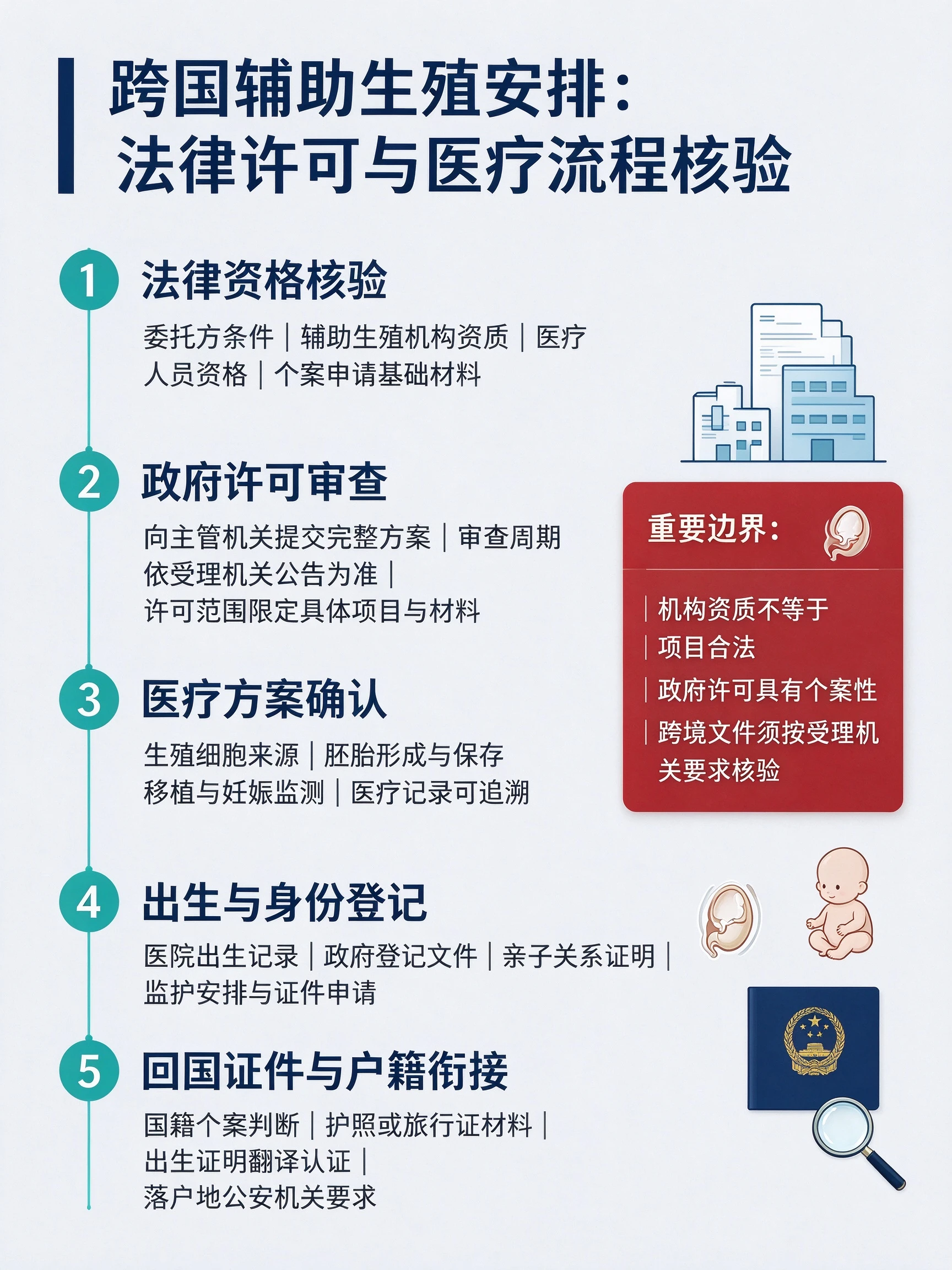
Institutional standard certification and specific surrogacy project licensing are two distinct types of review.Obtaining certification for assisted reproductive services does not imply that a specific family, surrogate mother, or source of sperm and eggs has been granted surrogacy permission, nor does it mean that each arrangement is automatically lawful. [3][5]
V. Government Approval: Permits corresponding to the actual project must be obtained
1. Who applies, and to whom
According to the Thai government’s official procedural guide, surrogacy project permits are submitted by medical institutions providing assisted reproductive services to the competent authority in accordance with established procedures, and are then reviewed by the supervisory committee. The application materials include information on the intended parents, the surrogate mother, the physicians providing the services, the sources of gametes, and related medical documents. [3]
Typically includes:
The medical institution completes the qualification review of the commissioned couple and the surrogate mother;
Organize identity, marriage, nationality, kinship, and medical certificates;
Submit materials such as sperm and egg sources and embryo protocols;
Arrange for the relevant parties or donors to appear in person for verification as required by the competent authority.
Subject to review by the relevant administrative departments and committees;
Implementation shall proceed in accordance with the approved plan only after submitting the required supplementary documents and obtaining formal approval.
2. Approval Time
According to the Thai government’s publicly available service guide, the committee is in principle required to complete its review within 60 working days from the date on which a complete and correct application and supporting documents are accepted. If the review cannot be completed within this timeframe, it may be extended by up to 30 working days per extension, with a maximum of two extensions. Consequently, the total review period specified in the service guide can extend to a maximum of 120 working days. This timeframe does not include the time required for preliminary medical examinations, document preparation, submission of supplementary evidence, applicant cooperation in providing additional information, or internal assessments by medical institutions, nor does it guarantee that the application will be approved. [3]
3. The license is case-specific
Thai government guidelines clearly state that surrogacy permits are issued on a case-by-case basis. If any approved elements change, such as the responsible physician, the intended parents (husband or wife), the surrogate mother, the sperm source, or the egg source, a new application and permit may be required. A permit previously obtained by a hospital for other clients cannot be treated as a general "hospital license" or "program approval" applicable to all clients. [3]
4. Reporting obligations after approval
The Government Service Guidelines also require licensed service providers to report the implementation status of each project in accordance with regulations. The guidelines specify that, within 45 days after a child’s birth, the results of the project implementation, the postpartum health of the surrogate mother, and the health of the child must be reported to the competent committee; if a surrogacy project is terminated, the report must be submitted within 30 days after termination. This reporting obligation rests with the licensed service providers as defined in the guidelines.[3]
VI. Medical Procedures: From Medical Assessment to Pregnancy Management
Only after obtaining the necessary permits may one enter the medical stages allowed for the approved project. These generally may include:
Phase 1: Medical AssessmentConduct assessments of the intended parents and surrogate on reproductive health, infectious diseases, genetic risks, prior pregnancy history, and psychological status; specific examinations shall be arranged by physicians based on medical indications.
Stage 2: Gamete processing and embryo preparation.Ovulation induction, egg retrieval, sperm collection, in vitro fertilization, embryo culture, and necessary cryopreservation shall be performed in accordance with the approved sources and medical protocols. All sourcing and use of reproductive materials must comply with the provisions of the license.
Stage 3: Embryo TransferThe medical team develops the embryo transfer protocol based on the surrogate’s health status, endometrial condition, and applicable regulations. Following the transfer, pregnancy testing, ultrasound examinations, and necessary pregnancy monitoring are conducted. The success rate of a single transfer must not be advertised as a guaranteed outcome.
Phase 4: Pregnancy and Delivery Management.This includes routine prenatal checkups, fetal growth monitoring, screening for pregnancy complications, psychological and physical care for the surrogate mother, delivery planning, and arrangements for emergency referrals.
The contract and medical consent documents should clearly specify: how medical information is shared, who has the authority to make emergency medical decisions, how medical expenses are settled, how miscarriage or premature birth is handled, and the costs and caregiving responsibilities if the newborn requires admission to the Neonatal Intensive Care Unit (NICU). Medical decision-making should be centered on patient informed consent, professional judgment, and the best interests of the child.
7. After the Baby's Birth: Birth Registration and Parental Relationship in Thailand
1. Documents to be kept after birth
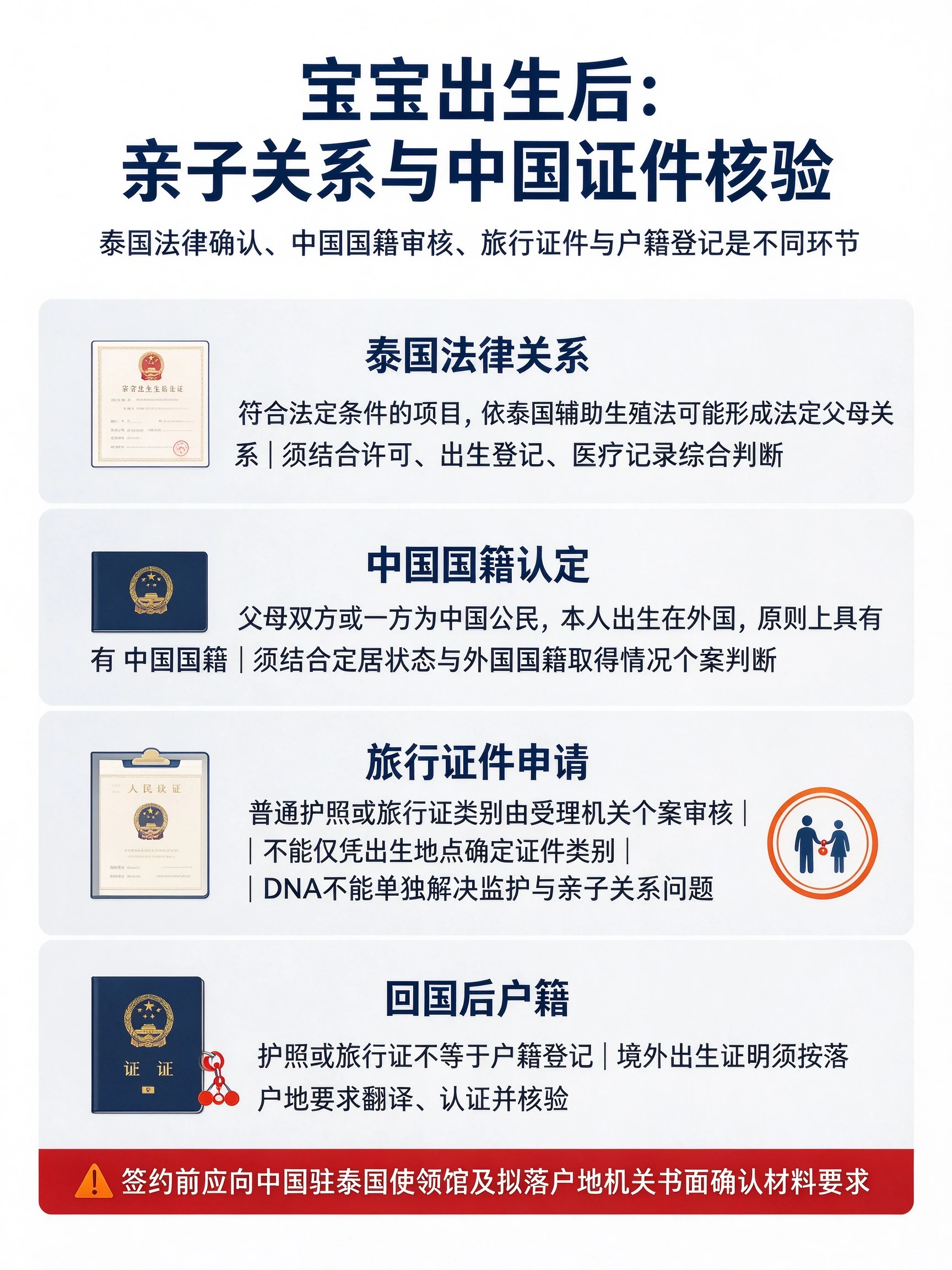
Recommend keeping a complete copy
Hospital Birth Confirmation Documents and Delivery Records;
Official Thai Government Birth Registration Document
Official permits and related approval documents for the surrogacy program;
The surrogacy agreement established pursuant to Article 25, the written consent documents of the intended parents and the surrogate mother, and the relevant donor documents;
Records of the sources of sperm and eggs, as well as embryo formation and transplantation;
Newborn health report and necessary medical records;
Other documents required by the Thai birth registration authority.
The birth confirmation document issued by the hospital is not the same as the official birth registration certificate issued by the registering authority. The Thai government’s procedural guidelines require that, in accordance with regulations, both the surrogacy authorization and the hospital-issued birth confirmation document be submitted together for birth registration, and that a birth certificate be applied for from the competent registering authority. Additionally, pursuant to Section 31, when a surrogate mother visits a medical institution for prenatal care or childbirth, she must present the surrogacy agreement referred to in Section 25 to the relevant physician, serving as one of the bases for issuing the birth confirmation document and making subsequent birth declarations.[1][3]
2. Parentage under Thai law
Article 29 of the Assisted Reproductive Technology Act B.E. 2558 (2015) addresses children born through assisted reproductive technology using donated sperm, eggs, or embryos in accordance with this Act. Under the circumstances prescribed by this article, such a child is deemed the legitimate child of the intending married couple, and no parent-child rights and obligations under Thailand’s Civil and Commercial Code relating to family law and inheritance arise between the donor and the child. It should be noted that the text of this article pertains specifically to the source of gametes; it cannot be broadly generalized to apply to all assisted reproduction or surrogacy arrangements without distinguishing among different scenarios, such as cases where the intended parents use their own gametes, where one spouse uses donated gametes, or where donated embryos are used. Specific cases should be confirmed by licensed Thai lawyers based on the complete statutory provisions, related regulations, and project documentation.[1]
But Article 29 is not aSurrogacy AbroadAutomatic recognition of the arrangement. It should be confirmed that the qualifications of the intended parents, the surrogate mother, the source of the embryos, the medical procedures, government permits, and the actual birth all comply with Thai law, and it should be verified whether Article 29 applies to the source of the gametes and the specific facts in question.Projects that are unauthorized, do not meet eligibility requirements, or involve medical practices inconsistent with their licenses cannot automatically claim the legal effects under Article 29 solely on the basis of birth certificates, private agreements, or DNA reports.[1][3]
3. Birth Registration, Child Reception, and Guardianship Arrangements
Article 32 of Thai law stipulates that birth registration for children born through surrogacy is normally filed by the legally married couple intending to have children via surrogacy; however, if the couple dies before the child’s birth, is absent from Thailand, or fails to appear as required after the birth, the surrogate mother assumes the obligation to register the birth. Article 30 further provides that if both intended parents die before the child’s birth, the surrogate mother serves as the child’s guardian until a different guardian is appointed by the court. The surrogate mother, competent officials under the Child Protection Act, interested parties, or public prosecutors may petition the court for the appointment of an alternative guardian, with the court giving paramount consideration to the child’s welfare and best interests. [1]
Article 33 also provides that the intended parents or either of them shall not refuse to accept the child born through the surrogacy arrangement; a violation of this provision may trigger the penalties under Article 49. Therefore, it cannot be categorically asserted that “the birth registration will invariably be handled by the intended parents themselves after birth” or that “it will invariably be handled by the surrogate,” nor can the responsibilities for post-birth acceptance, guardianship, and care be deferred until disputes arise. Prior to delivery, specific details regarding the applicant for registration, required authorization documents, and procedural pathways should be confirmed with the hospital and the competent birth registration authority. [1]
4. Is a court judgment required?
It cannot be generalized. Whether a court judgment is required should first be determined by distinguishing the source of the reproductive cells and the conditions for applying parentage rules under Thai law. For cases that meet the requirements of Section 29 and have obtained formal authorization, they should be handled in accordance with the applicable legal provisions and administrative registration procedures. If the intended parents use their own sperm and eggs, or if existing documents do not clearly establish the basis for parentage, a licensed Thai attorney should verify the relevant legal grounds and birth registration pathways. It must not be claimed that all families are required to obtain a court judgment first, nor promised that any family can complete all procedures solely based on birth registration documents.
If there are disputes regarding project compliance, parental status, birth registration, or guardianship relationships, or if consular and diplomatic missions and registration authorities require further legal proof, legal opinions, administrative reviews, or judicial proceedings may be necessary. Whether court documents are required should be determined based on the specific dispute and the formal requirements of the receiving authority. [1][3]
VIII. Returning to China with a Chinese Baby: Nationality, Passport, Travel Document, and Household Registration
1. Determination of Chinese Nationality
Article 5 of the Nationality Law of the People's Republic of China stipulates that, in principle, a person born abroad to parents who are both Chinese citizens or one of whom is a Chinese citizen shall have Chinese nationality; however, such a person shall not have Chinese nationality if both parents or one parent are Chinese citizens and settled abroad, and the child acquires foreign nationality at birth.[6]
The determination of nationality for children born via surrogacy cannot rely solely on the place of birth or DNA results. It is particularly important to note that Article 5 of the Nationality Law does not provide specific rules for determining parental status for children born abroad through surrogacy; in practice, a distinction should be made between:
Genetic relationships: Whether DNA proves a genetic link between the child and one party;
Parent-Child Relationships under Thai Law: Whether Thai laws and approval documents confirm the intended parents as the legal parents;
Parental Identity in Chinese Nationality Verification: How the competent Chinese authorities determine the relevant parental status based on Chinese law, foreign legal documents, and all evidence;
Guardianship: whether the person who submits the certificate application and takes the child abroad has legal guardianship or agency qualifications.
Article 5 of the Nationality Law does not itself establish a specific, standalone rule for determining the nationality status of children born through surrogacy abroad. Public responses from the National Immigration Administration regarding the nationality of children born overseas indicate that determinations must be based on factual circumstances, such as whether Chinese citizens are settled abroad and whether the child acquired foreign nationality at birth, with nationality assessments conducted by Chinese embassies and consulates during document processing. A Thai birth certificate, the legal effects under Section 29 of Thai law, genetic relationships, and nationality determinations by Chinese diplomatic missions cannot be automatically equated. Before initiating any project, it is advisable to truthfully disclose the surrogacy arrangement, the origins of the gametes (sperm and egg), and the intended parents’ identities to the Chinese Embassy or Consulate in Thailand, and to inquire about the required documentation. [6][9][10][16]
At the same time, it cannot be presumed that a child automatically acquires Thai nationality solely by virtue of being born in Thailand; whether the child has acquired other nationalities must be verified in accordance with the nationality laws and determinations made by the competent authorities of the respective countries.Nationality Law of ChinaThe condition in Article 5 that one “acquires foreign nationality at birth” shall be determined based on the actual legal facts. [6]
2. Regular Passports and Travel Documents
The Chinese Embassy in Thailand has published a guide for ordinary passport applications, primarily applicable to first-time applicants who are Chinese citizens born in Thailand. The required documents listed in the guide include the child’s photograph, valid passports of both parents, foreign visas or residence permits held by the parents at the time of the child’s birth, birth certificates, or other materials proving parent-child relationships. The guide states that passport production typically takes approximately 10 working days after the applicant visits the embassy in person; however, this is only a general processing timeframe and does not imply that children born via surrogacy necessarily meet the eligibility criteria for an ordinary passport, nor does it constitute a commitment to process special individual cases. [9]
The publicly available information from the Chinese Embassy in ThailandTravel DocumentGuidelines primarily applicable to Chinese-national children born from transnational marriages, listing requirements such as photographs, parents’ passports, foreign visas or residence permits held by the parents at the time of the child’s birth, birth certificates or proof of parent-child relationship, and documentation verifying guardianship. [10]
These two public guidelines are general instructions for applying for ordinary passports and travel documents, rather than special rules or commitments specifically tailored to children born through surrogacy abroad. For children born via surrogacy, it cannot be determined solely based on the fact that they were "born in Thailand" that they must apply for an ordinary passport or a travel document. The specific type of document, nationality determination, proof of parent-child relationship, and applicant eligibility shall be assessed by the relevant embassy or consulate handling the case, based on individual circumstances and submitted documentation. [9][10]
3. Is DNA identification necessary?
At present, DNA testing cannot be established as a uniform mandatory requirement for issuing documentation to all children born via surrogacy abroad. Whether DNA testing is required should be determined based on the case-specific notifications issued by the actual processing authorities. Even if DNA evidence can demonstrate a biological connection between the child and the genetic father or mother, it cannot, on its own, resolve issues regarding legal parentage, custody, or nationality determination for the non-genetic party.
4. Whether a court judgment or guardianship certificate is required
If the existing birth registration, surrogacy permits, parentage records, or guardianship documentation are insufficient to establish the legal relationship between the applicant and the child, the receiving authority may request additional legal documents, relevant medical records, paternity testing results, or court orders. It cannot be presumed that every surrogacy case necessarily requires a court judgment, nor can it be guaranteed that every case is exempt from requiring court documents.
It is recommended that, prior to project initiation, you truthfully disclose the surrogacy arrangement, the sources of sperm and eggs, the approval status in Thailand, and the intended parents for registration to the Chinese embassy or consulate likely to process your application, and inquire about the required documentation. However, embassies and consulates may not provide advance commitments regarding nationality determination or document issuance for unborn children. The Chinese Embassy in Thailand clarified in its 2025 public Q&A that first-time applications for passports or travel certificates for newborns involve nationality determination, and consular officers may require both parents to appear in person for interviews during the review process, depending on the circumstances. Actual processing of individual cases shall be subject to notifications issued by the relevant embassy or consulate. [11]
5. Household Registration After Returning to China
ObtainChinese PassportA passport or travel document does not mean that household registration (hukou) in mainland China has been completed. After returning to China, you must still verify nationality, birth certificates, parent-child relationships, and guardianship documents in accordance with the regulations of the public security authority at the intended place of registration. Requirements for translating, authenticating, and supplementing overseas birth certificates may vary by region. Therefore, it is advisable to confirm these details with the household registration counter of the public security authority at the intended place of registration well in advance, rather than waiting until after the child’s birth to begin this process.
IX. Interfacing between Chinese Law and Thai Law
1. Surrogacy Management in China
Article 3 of the Measures for the Administration of Human Assisted Reproductive Technologies stipulates that human assisted reproductive technologies shall be performed in medical institutions for medical purposes and comply with national policies, ethical principles, and relevant laws and regulations; the sale or purchase of gametes, zygotes, or embryos in any form is prohibited, and medical institutions and medical personnel are prohibited from performing surrogacy techniques in any form. [7]
This regulation explicitly prohibits medical institutions and healthcare professionals within China from performing any form of surrogacy. However, this provision alone does not support the inference that every Chinese citizen’s participation in assisted reproductive arrangements abroad automatically constitutes a criminal offense under Chinese law. Whether other legal liabilities arise, the validity of relevant agreements in China, and how parentage and custody are determined must each be assessed on a case-by-case basis, taking into account the place where the conduct occurred, the specific actions involved, the applicable laws, and the available evidence.
2. Risks Regarding the Validity of Overseas Surrogacy Agreements in China
Article 8 of the Civil Code stipulates that civil subjects shall not violate laws or public order and good morals when engaging in civil activities; Article 153(2) provides that a civil juristic act violating public order and good morals is null and void. [8]
Therefore, whether an overseas commercial surrogacy agreement can obtain judicial protection in China should be determined by considering the terms of the agreement, the manner of its actual performance, the applicable law, and Chinese courts’ review and assessment of rules such as public order and good morals. It cannot be assumed that signing an overseas contract automatically ensures enforceability in China, nor can it be presumed that the parental status stipulated in a Thai agreement will automatically produce identical legal effects in China.
3. Thailand’s recognition of parental status does not automatically result in China recognizing it.
Article 29 of Thai law stipulates the arrangements for parent-child relationships under specific assisted reproductive programs within the Thai legal system, provided that the conditions set forth in its provisions are met. Determination of Chinese nationality, issuance of passports or travel documents, recognition of guardianship, and domestic household registration constitute distinct administrative and legal procedures. Accordingly, one should separately prepare Thai approval and birth certificates, materials related to Chinese nationality and documentation, proof of guardianship, and necessary translated and authenticated documents. [1][6][9][10]
X. Timeline for Cross-Border Document Translation, Certification, and Apostille
1. Processing principles as of November 2, 2026
On June 30, 2026, Thailand deposited its instrument of accession to the Hague Convention Abolishing the Requirement of Legalisation for Foreign Public Documents (the Apostille Convention) with the Hague Conference on Private International Law (HCCH). The HCCH announced that the Convention would enter into force for Thailand on February 28, 2027. Therefore, as of November 2, 2026, the Convention had not yet entered into force for Thailand.[12][13]
Therefore, as of November 2, 2026, the Apostille cannot be regarded as a document certification system that has already taken effect in Thailand. When Thai documents are used in China, they must be processed in accordance with the document certification procedures effective in Thailand at that time, as well as the requirements of the Chinese Embassy in Thailand and domestic receiving authorities.
2. After February 28, 2027
The effective date of Thailand’s accession to the Convention is 28 February 2027. However, pursuant to Article 12 of the Convention, the applicability of the Convention between an acceding State and existing contracting parties depends on whether any other contracting party has raised an objection within the prescribed period. Therefore, for procedures undertaken after 28 February 2027, it remains necessary to consult the latest HCCH status table on contracting states to confirm whether the Convention applies to document exchanges between China and Thailand; one cannot assume that all Thai documents are eligible for direct Apostille issuance solely based on Thailand’s accession date. [12][13][14]
An Apostille applies to public documents within the scope of the Convention. Private surrogacy contracts, general commercial agreements, and all medical records are not automatically considered public documents eligible for an Apostille. The nature of the document, the issuing authority, the format of translation, and the specific requirements of Chinese receiving institutions must still be verified on a case-by-case basis.[14]
XI. Project Timeline and Budget
1. Time Planning
The officially published procedural guidelines clearly specify the timeframe for reviewing surrogacy case permits in Thailand: once an application is complete, accurate, and accepted, the review shall in principle take 60 working days; it may be extended twice at most, with each extension not exceeding 30 working days. This timeframe does not represent the total project cycle, nor does it guarantee that the application will be approved. [3]
Beyond this, individual cases vary in terms of medical examinations, embryo preparation, the success of transplantation, pregnancy progression, delivery, newborn care, birth registration, nationality review, and the processing of Chinese documents. A full-term pregnancy typically lasts approximately nine months, but this does not imply that the entire cross-border program can be completed within a fixed timeframe.
No fixed or guaranteed timelines, such as "completion within 12 months" or "return to home country within 15 months," should be promised externally until formal permission is obtained, the medical plan is finalized, and the preliminary review of nationality and document materials is completed.
2. Budget
This article does not list purported unified quotes for the Thai surrogacy market. Thailand has clear restrictions on commercial surrogacy and related intermediary activities; agency quotes cannot prove that a program is legal, nor can they demonstrate that the associated payment arrangements comply with Thai regulations.
Families should require itemized statements and verify them:
Expense Category | Verify the content |
|---|---|
Medical Assessment | Medical examinations and necessary follow-up checks for the commissioning couple and the surrogate |
IVF Medical | Ovarian stimulation, egg retrieval, sperm processing, fertilization, and embryo culture |
Embryo preservation | Freezing, Shelf Life, and Subsequent Management |
Transplantation and Pregnancy | Transplantation, prenatal check-ups, and necessary treatments |
Childbirth and Newborns | Delivery, postpartum care, newborn examination, and potential NICU costs |
Legal Services | Thai Lawyers, Document Review, Application Assistance, and Dispute Resolution |
Administration and Documentation | Birth Registration, Translation, Authentication, and Document Applications |
Cross-border Living | Accommodation, transportation, airfare, and necessary stay expenses |
Emergency Reserve Fund | Preterm birth, hospitalization, changes in medical care, project termination, and extended stays |
The fee schedule shall distinguish between fixed fees, medical expenses settled based on actual costs, refundable fees, and non-refundable fees. The contract shall also specify fund escrow arrangements, conditions triggering refunds, proof of incurred expenses, and responsibilities for child care and medical services following project termination.
XII. Enforcement Risks and Penalty Provisions: Based on the Original Legal Text
This document lists only the prohibited acts and penalties explicitly stipulated in Thai legal texts. Individual case data, including the number of persons involved, prison sentences, and judgment details that cannot be verified through court judgments or official announcements by competent authorities, are not cited as verified judicial facts.
Under the Assisted Reproduction Act of 2015, program participants should primarily avoid the following behaviors: [1]
Arranging or implementing surrogacy for commercial purposes;
Illegally acting as an intermediary to introduce or arrange surrogacy services in exchange for remuneration or other benefits;
Publishing advertisements for surrogacy recruitment or demand that are prohibited by law;
Using doctors, intended parents, surrogate mothers, or sources of reproductive cells that are inconsistent with the license documentation;
Buying, selling, importing, or exporting sperm, eggs, and embryos without verification;
Circumvent statutory approvals through private agreements, falsified documents, or changing service providers.
Specific liability shall be determined based on the parties' actual conduct, the applicable legal provisions, subjective and objective facts, and the findings of the competent authorities. Criminal judgments against individual medical practitioners or intermediaries in specific cases cannot be directly presumed to impose identical criminal liability on all intended parents.
XIII. The Eight Most Overlooked Risks in Entrusted Households
Risk Category | Typical manifestations | Possible Consequences |
|---|---|---|
Delegation Qualification Risk | Neither party is of Thai nationality, yet they are eligible to apply under the provision that requires three years of marriage. | Unable to meet the eligibility requirements under the current Article 21 |
Surrogacy Eligibility Risks | Non-compliant documentation regarding blood relationships, age, prior childbirth, or spousal consent | Unable to obtain permission or the project is challenged |
Commercial arrangement risks | Surrogacy compensation, agency fees, or advertising activities violate Thai regulations | Administrative or criminal risks and contractual disputes |
Risk of Reproductive Materials | Unclear origin of sperm and egg; cross-border embryo transport without verification | Violation of Thai law or falsification of approval materials |
Medical Quality Risk | Expired institutional certification, mismatched doctor or service items | Medical Safety and Regulatory Risks |
Birth Registration Risks | Discrepancies between birth certificates, permits, and medical records | Delays or obstacles in birth registration |
Parent-Child Relationship and Document Risks | China does not necessarily recognize the intended parents’ status based solely on DNA or birth certificates. | Obstruction of confirmation regarding nationality, travel documents, or guardianship |
Follow-up care risks | Premature birth, NICU admission, project termination, and lack of arrangements when surrogate parents refuse to accept the infant or cannot arrive in a timely manner | Pediatric medical care, stay, supervision, fees, and liability risks under Article 33 |
In particular, it should be clarified before the child’s birth: who will legally care for the newborn, who will make medical decisions, how costs will be covered, and when departure can be legally arranged, in cases where the newborn requires hospitalization, travel documents are temporarily unavailable, or the delegating parents cannot arrive in a timely manner.
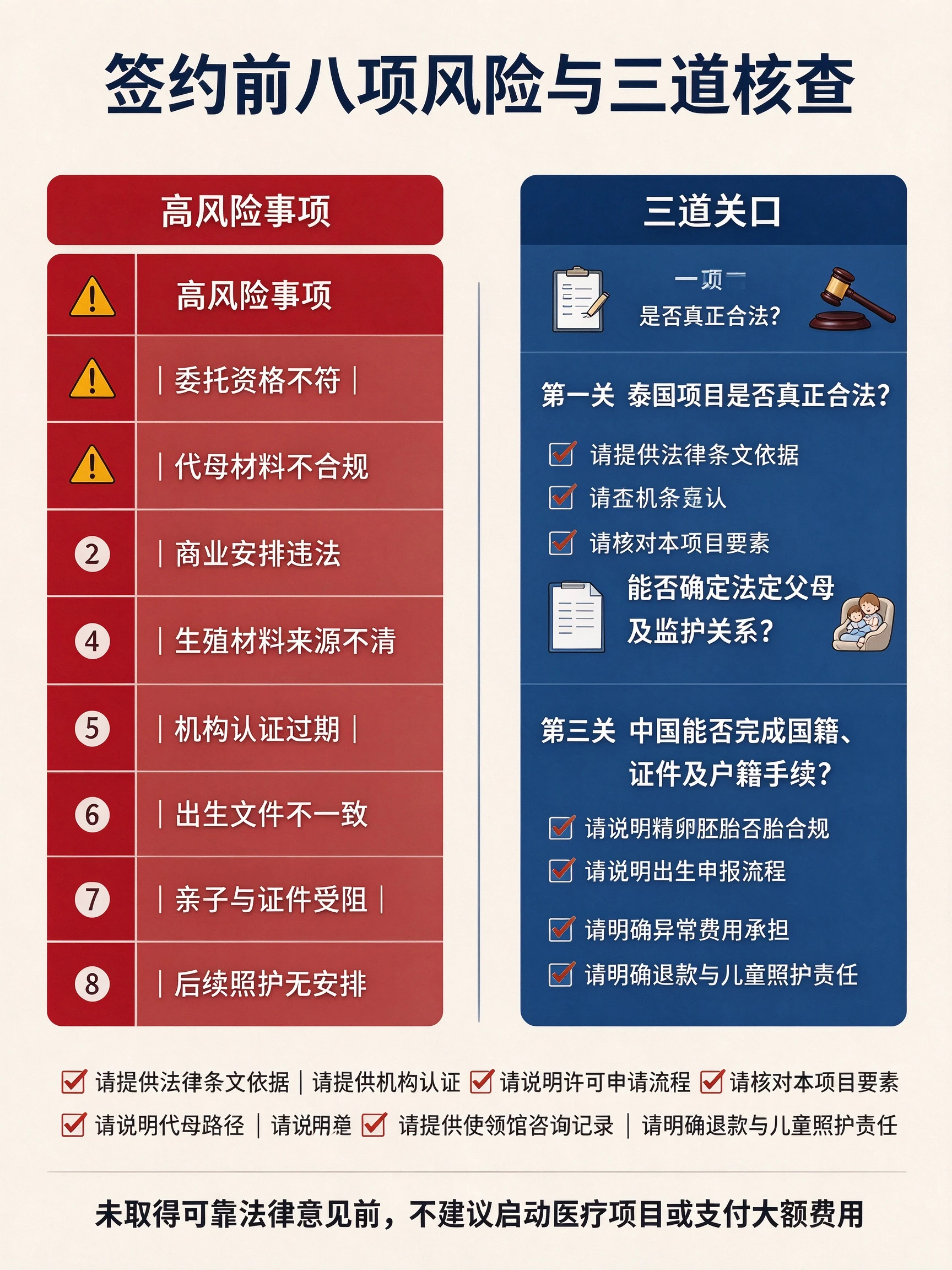
XIV. Pre-Signing Professional Checklist
It is recommended to divide the project review into three gates and maintain written verification records.
Level 1: Is the Thailand project truly legal?
Do the commissioning spouses meet the nationality, marital, and medical requirements under Article 21 of the current law?
If same-sex spouses or international marriages are involved, is there a clear basis in current laws and competent authorities?
Whether the surrogate mother is a qualified blood relative; if not, whether she meets the special conditions and has obtained permission?
Are the surrogate mother's age, prior obstetric history, health assessment, and spousal consent documents compliant?
Is the hospital accreditation still valid, and does the actual attending physician meet the requirements?
Has formal approval been obtained for the specific project regarding this family, this surrogate mother, and the source of the gametes for this instance?
Do commercial payments, intermediary services, and advertising arrangements fall under Articles 24, 27, and 28?
Does it involve the cross-border transfer of sperm, ova, or embryos? If so, has Article 41 been reviewed?
Level 2: Can parentage and guardianship be established under Thai law after the baby is born?
Does the project fully comply with Thailand’s 2015 Act and its implementing regulations?
Does Article 29 apply to this specific project?
Are all the required documents for birth registration, including the permit documents, hospital birth confirmation documents, and other relevant papers, complete?
Article 32: Who is responsible for fulfilling the birth registration obligation, the commissioning couple or the surrogate mother?
If the intended parents pass away or are outside Thailand before the child’s birth, have statutory reporting and child care arrangements been made?
Are there any disputes regarding parentage, registration, or guardianship that require judicial resolution?
Stage 3: Can China complete the procedures for nationality, identification documents, and household registration?
Does the child meet the Chinese nationality requirements under Article 5 of the Nationality Law?
Do Chinese-national parents qualify as "settled abroad" in the legal sense?
Did the child acquire citizenship of another country by law at birth?
Can Thai legal parentage meet the case-by-case review requirements of Chinese embassies and consulates?
Should I apply for a regular passport or a travel document? Are additional documents regarding guardianship or parent-child relationship required?
Whether DNA testing or Thai court documents are required shall be subject to the specific requirements of each individual case as determined by the embassy or consulate.
How to Translate, Authenticate, and Use Thai Birth Certificates, Permit Documents, and Court Documents in China?
What specific documents does the public security authority of the proposed place of household registration require?
Ten Questions to Ask an Agency Before Signing a Contract
Please provide the specific legal provisions and written confirmation from the competent authority demonstrating that this family meets the eligibility requirements for surrogacy applications in Thailand.
Please provide the current valid certification and number for assisted reproductive services standards from the medical institution.
Please specify who submits the case-by-case license application for this project, and provide the official application process.
Please explain how the license documents are verified and how they correspond to this family, the surrogate mother, the physician, and the sources of sperm and eggs.
Please provide the legal basis and supporting documentation for the application for a blood relationship or non-blood relationship exception for the surrogate mother.
Please explain how the sourcing, transportation, storage, and use of sperm, eggs, and embryos comply with Sections 22 and 41 of Thailand's regulations.
Please indicate whether Article 29 applies to this project following the child’s birth. If it does, please provide the specific legal basis; if it does not, please specify the alternative legal grounds for establishing parent-child relationships and outline the detailed procedure for registering the birth pursuant to Article 32.
Please explain how the entrusting family should truthfully disclose to Chinese diplomatic missions and consulates in Thailand the fact of surrogacy, the sources of sperm and eggs, and the identities of the intended parents, and verify the materials that can be submitted; do not use general guidelines for issuing certificates for normally born children to promise that a certificate will definitely be issued for individual surrogacy cases.
In the event of preterm birth, NICU care, project termination, DNA testing, court proceedings, or document extensions, who is responsible for covering medical, living, caregiving, and legal expenses?
How are refunds, childcare, custody, and subsequent liabilities arranged if the project fails to obtain a permit, violates regulations, or cannot be completed in accordance with the law?
If an institution only responds with claims such as “we have successful cases,” “all past clients returned home smoothly,” or “we handle all procedures for you,” but refuses to provide formal qualifications, legal basis, project licensing pathways, and written liability arrangements, you should not readily pay substantial fees.
XV. Conclusion: Confirm Three Things Before Launching the Project
First, verify whether the intended parents meet the current eligibility requirements in Thailand.Under the eligibility pathways specified in Section 21 of the 2015 Assisted Reproductive Technology Act and the HSS public FAQ, intended parents must either both be Thai nationals, or one must be a Thai national and the other a foreign national who have been legally married for at least three years. Families where both spouses are Chinese nationals, with no Thai spouse, cannot qualify solely based on being married for three years. The content of consultations regarding the 2026 amendment cannot replace formally enacted and effective laws. [1][2][4]
Second, it is essential to distinguish whether hospital qualifications, project licenses, and commercial arrangements are lawful.Obtaining certification for assisted reproductive services by a medical institution does not imply that specific surrogacy arrangements have been approved; licenses are granted on a case-by-case basis. Commercial surrogacy, intermediaries profiting from such arrangements, and advertisements recruiting or soliciting surrogates are subject to legal restrictions. There are also clear legal risks associated with the purchase, offer to purchase, sale, import, or export of sperm, eggs, and embryos.[1][3][5]
Third, the legal status and care plan for the child after birth must be finalized in advance.Section 29 of Thailand’s law establishes parent-child relationships for specific assisted reproductive technology procedures only when the conditions set forth in its provisions are met. Chinese nationality review, issuance of passports or travel documents, confirmation of guardianship, and domestic household registration remain separate procedural stages. DNA evidence, birth certificates, and Thai authorization documents cannot individually guarantee the issuance of Chinese identity documents.[1][6][9][10]
It is not advisable to initiate the medical project or make substantial payments until reliable Thai legal advice has been obtained, specific project licensing conditions have been confirmed, and identity and documentation pathways have been verified with Chinese embassies/consulates and relevant authorities in the intended place of residence. The entire arrangement should prioritize legal compliance, medical safety, and the best interests of the child.
Frequently Asked Questions
The content on this website is general educational material and compiled public information about IVF. It is provided for reference only, does not constitute a basis for diagnosis or medical decision-making, and does not constitute any medical advice or treatment recommendation. For policy and technical requirements, please refer to official publications issued by the relevant authorities and institutions. If you find any content errors, numerical inconsistencies, or outdated information, please contact us so we can verify and update it.